
Ayuso's Tank Top and Scripted Speech at Anti-Sánchez Rally
Madrid regional leader Isabel Díaz Ayuso faced criticism for her casual attire and lackluster delivery during a protest against Prime Minister Pedro Sánchez.
English · Original discussion in Spanish · Published
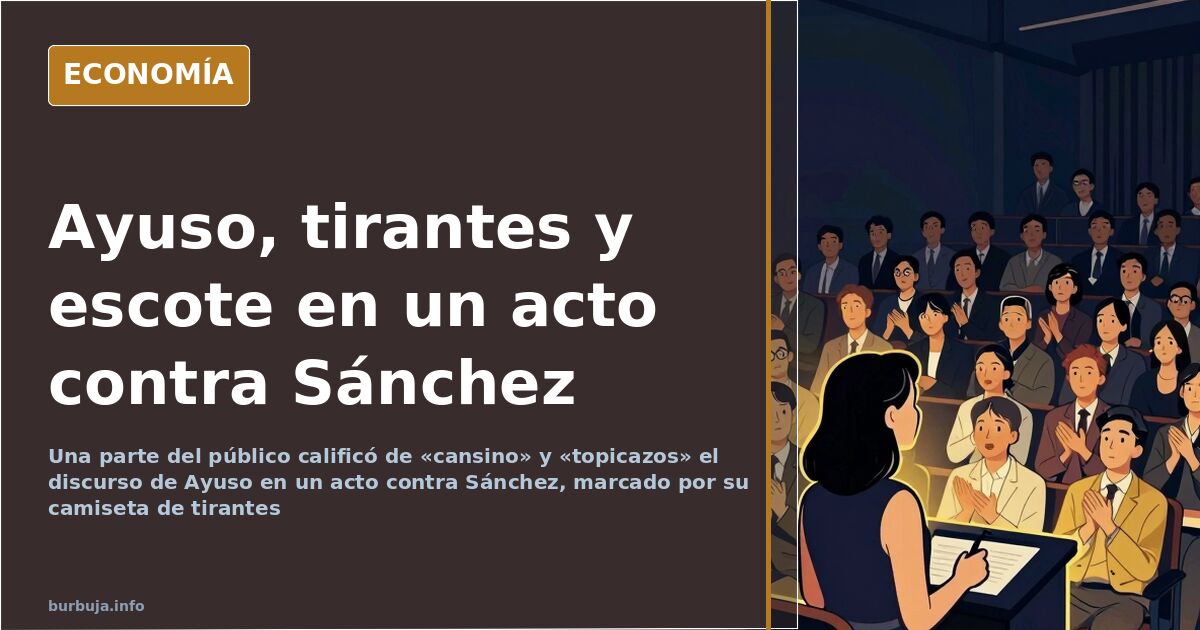
Ayuso’s tank top and scripted speech divide rally audience
What lies behind a regional president taking the stage in a tank top, showing more skin than substance, at a demonstration against the national government? The Community of Madrid’s event against Pedro Sánchez left an image discussed more for the outfit than the content: a leader who, according to some attendees, read from a script filled with clichés. The anecdote—the neckline as headline—hides the core issue: an act against the central executive where the political message was diluted by the speaker’s appearance and online backlash.
The scripted speech and clichés that failed to convince
The rally against Sánchez had a predictable script: criticism of the government, defense of Madrid’s management, and a call to mobilization. That is not what people remember. A portion of the audience described the tone as "tiresome" and the arguments as "clichés," noting that the president read the text instead of improvising. "Not a shred of enthusiasm," summarized one attendee. Apparently, the excitement came from the wardrobe.
The image of the tank top worked like a magnet: some celebrated it as a casual gesture, others interpreted it as a marketing operation. "It’s a masterstroke to sell more beers," one opinion joked, adding that Madrileños have a "down-to-earth" president. Politics as spectacle, with the neckline as the draw and the speech as background noise.
The underlying conflict: Madrid, housing, and who has the right to the city
Underneath the tank top lies a more serious conflict. Some attendees argue that the Community of Madrid has left long-time residents behind: no social housing, no aid, pushed out to Toledo or Ávila due to high rents. The argument persists: the region cares for those arriving with wealth while neglecting those born there without inheritance. This is the tension between Madrid’s cosmopolitan narrative and the reality of those who cannot afford an apartment in their own neighborhood.
The counterpoint comes from those who claim the criticism is mere posturing: Madrid’s administration boasts economic freedom and investment attraction, and supporters view discontent as an excuse to ignore growth data. The problem is that the debate on housing, employment, and aid is framed in terms of identity—who is truly a Madrileño—rather than public policy. There, the discourse gets tangled.
Language as metaphor: What Ayuso said in Chile
The rally against Sánchez wasn’t the only front. A clip from the president’s intervention at the University of Chile circulated widely: she recounted arriving in Ecuador at age 22 and being surprised they spoke the same language, accustomed to switching tongues in London or France. Read as a display of ignorance, the anecdote fueled mockery: "The level of our rulers is terrifying," one reaction summarized. Another called it directly "embarrassing."
This episode measures the wear and tear: every public appearance by the president becomes ammunition for critics, and the anti-Sánchez event was tainted by this sense of fatigue. The internal opposition to the central government faces a narrative problem when its main asset generates more memes than arguments.
Disillusionment among former defenders
There is a fact absent from polls but present in conversations: the shift in mood among a segment of the public that once celebrated every appearance by the president. "Four years ago, whenever Ayuso and Olona spoke, it was like OnlyFans. Now disillusionment has set in," one impression notes. The emerging thesis is uncomfortable for all: politicians shouldn’t be attractive, because if it’s already easy to be scammed when you’re average, with an appealing physique, seduction replaces scrutiny.
The rally against Sánchez, with its tank top and scripted speech, is the photo of this disillusionment. Mobilization against the central government exists, but it arrives with less epicness and more tiredness. And the audience, which years ago would have applauded the gesture, now wonders if the spectacle itself is the problem.
In the end, the demonstration against Sánchez left an involuntary conclusion: in Spanish politics, a tank top generates more conversation than a government program. And that, whether liked or not, is also a data point.
What lies behind a regional president taking the stage in a tank top, showing more skin than substance, at a demonstration against the national government? The Community of Madrid’s event against Pedro Sánchez left an image discussed more for the outfit than the content: a leader who, according to some attendees, read from a script filled with clichés. The anecdote—the neckline as headline—hides the core issue: an act against the central executive where the political message was diluted by the speaker’s appearance and online backlash.
The scripted speech and clichés that failed to convince
The rally against Sánchez had a predictable script: criticism of the government, defense of Madrid’s management, and a call to mobilization. That is not what people remember. A portion of the audience described the tone as "tiresome" and the arguments as "clichés," noting that the president read the text instead of improvising. "Not a shred of enthusiasm," summarized one attendee. Apparently, the excitement came from the wardrobe.
The image of the tank top worked like a magnet: some celebrated it as a casual gesture, others interpreted it as a marketing operation. "It’s a masterstroke to sell more beers," one opinion joked, adding that Madrileños have a "down-to-earth" president. Politics as spectacle, with the neckline as the draw and the speech as background noise.
The underlying conflict: Madrid, housing, and who has the right to the city
Underneath the tank top lies a more serious conflict. Some attendees argue that the Community of Madrid has left long-time residents behind: no social housing, no aid, pushed out to Toledo or Ávila due to high rents. The argument persists: the region cares for those arriving with wealth while neglecting those born there without inheritance. This is the tension between Madrid’s cosmopolitan narrative and the reality of those who cannot afford an apartment in their own neighborhood.
The counterpoint comes from those who claim the criticism is mere posturing: Madrid’s administration boasts economic freedom and investment attraction, and supporters view discontent as an excuse to ignore growth data. The problem is that the debate on housing, employment, and aid is framed in terms of identity—who is truly a Madrileño—rather than public policy. There, the discourse gets tangled.
Language as metaphor: What Ayuso said in Chile
The rally against Sánchez wasn’t the only front. A clip from the president’s intervention at the University of Chile circulated widely: she recounted arriving in Ecuador at age 22 and being surprised they spoke the same language, accustomed to switching tongues in London or France. Read as a display of ignorance, the anecdote fueled mockery: "The level of our rulers is terrifying," one reaction summarized. Another called it directly "embarrassing."
This episode measures the wear and tear: every public appearance by the president becomes ammunition for critics, and the anti-Sánchez event was tainted by this sense of fatigue. The internal opposition to the central government faces a narrative problem when its main asset generates more memes than arguments.
Disillusionment among former defenders
There is a fact absent from polls but present in conversations: the shift in mood among a segment of the public that once celebrated every appearance by the president. "Four years ago, whenever Ayuso and Olona spoke, it was like OnlyFans. Now disillusionment has set in," one impression notes. The emerging thesis is uncomfortable for all: politicians shouldn’t be attractive, because if it’s already easy to be scammed when you’re average, with an appealing physique, seduction replaces scrutiny.
The rally against Sánchez, with its tank top and scripted speech, is the photo of this disillusionment. Mobilization against the central government exists, but it arrives with less epicness and more tiredness. And the audience, which years ago would have applauded the gesture, now wonders if the spectacle itself is the problem.
In the end, the demonstration against Sánchez left an involuntary conclusion: in Spanish politics, a tank top generates more conversation than a government program. And that, whether liked or not, is also a data point.
Summary of a discussion on Burbuja.info - Foro de economía, actualidad y política., translated from Spanish and reviewed before publication. Read the full discussion (188 replies).
More summaries
-
Alba Flores links Ceuta to neo-Nazi squads despite lack of evidence
Alba Flores compares Ceuta to a horror film and mentions neo-Nazi squads. Public records and figures do not support that narrative.
-
Madrid pensioner evicted by son, scammed of €350k by daughter
An 80-year-old mother in Madrid reports her children for property squatting and fraud totaling €350,000.
-
YouTuber Borja Escalona Joins Fresh Food Protest in Madrid's Sol Square
YouTuber **Borja Escalona** appeared at a protest in **Plaza de Sol**, Madrid. We analyze the economic context of such events.
-
Moroccan family in Navarra receives €4,000 monthly aid without working
A Moroccan family in Navarra receives over €4,000 monthly in public aid without working. Discover the details and benefits.
-
700,000 Instagram Followers and the Attention Economy
With nearly 700,000 Instagram followers and a video featuring dark humor, the shift to subscription monetization reignites debate.
-
Smartphone Addiction: Designed to Hook, Unregulated
Pedestrians ignored green lights while glued to phones. Experts blame intentional design features that foster compulsive usage.