
Ayuso scores lowest in laSexta poll for pandemic management, 4.26
The laSexta barometer gives Madrid's president Isabel Díaz Ayuso a 4.26 for her pandemic handling, while Cantabria's Miguel Ángel Revilla tops the ranking with 6.36 ahead of May 4 regional elections.
English · Original discussion in Spanish · Published
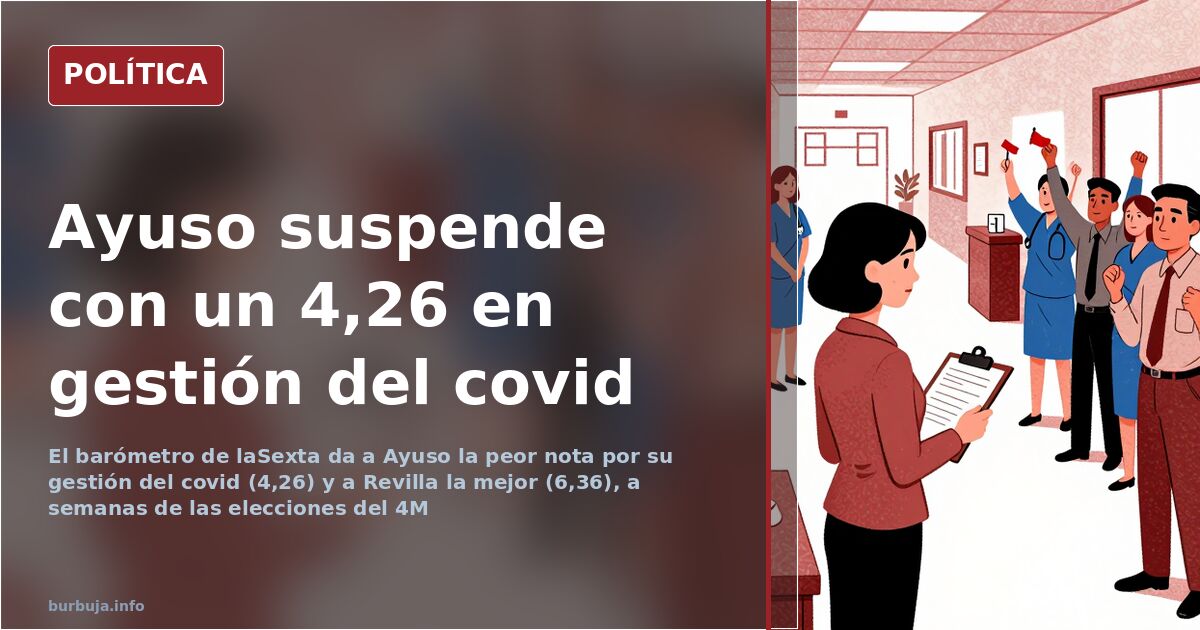
Ayuso fails with a 4.26, while Revilla leads with a 6.36
The lasensla barometer published on Wednesday, February 24, 2021, ranks Isabel Díaz Ayuso as the poorest regional manager of the pandemic, with a 4.26 out of 10. Her Health Councilor, Enrique Ruiz Escudero, scores a 4.29, and Madrid Mayor José Luis Martínez Almeida a 4.53. None pass. At the other end, Miguel Ángel Revilla (Cantabria) achieves the highest score of 6.36, trinc by Guillermo Fernández Vara (Extremadura) with 6.00.
The poll arrives during the pre-campaign for the May 4 Madrid regional elections, a date already circulating in the thread. This is where the noise begins: such a data point serves more as a campaign weapon than a management diagnosis. Measuring infections is one thing; measuring perceptions is another.
What the lasensla barometer actually measures
The list of failures is extensive. Juanma Moreno, Emiliano García-Page, Ximo Puig, and Francina Armengol fail to pass regarding their handling of the health crisis. The poll’s conclusion is uncomfortable for half of Spain’s autonomous communities: those responsible for closures, schedules, and capacity limits consistently score below 5.
It is important to note a detail hinted at by the publication itself: it is an assessment, not an audit. It asks about citizens’ impressions of others’ management. In a country where most people have never visited the region they judge, these impressions are shaped by the media. The result says less about hospitals than about television.
Why Madrid fares worse than other communities?
The debate centers on Madrid’s decision not to close the hospitality sector and maintain economic activity while other regions imposed perimeter closures. This decision, criticized by some, is defended by others who argue it received international press support: a forum user shared a German text noting that infections were falling in Madrid despite relaxed restrictions. This gave rise to the label “Madrid miracle” attributed to her.
Some argue the Madrid president found a reasonable balance between infections and the economy, while other regions closed everything yet failed to reduce incidence. Against this is the argument that comparing figures between regions with different densities, age pyramids, and healthcare pressures is a tricky exercise. Both arguments are defensible, yet rarely held simultaneously by the same person.
The death toll figures used by each side
Here, the debate turns harsh. Critics cite more than 22,500 deaths under Madrid’s responsibility, a figure other versions raise to nearly 23,000. The central accusation concerns the management of nursing homes. Conversely, other forum users note that elderly people died in Madrid, Castilla-La Mancha, Castilla y León, Aragón, Extremadura, Catalonia, Valencia, and Asturias, all sharing the same central health framework.
Another recurring figure is 7,291 elderly deaths in nursing homes, attributed to Madrid’s management by its adversaries. The cross-referencing of numbers is so opaque that each side uses whichever suits them. Without official breakdowns by residence, date, and cause, the discussion remains in the realm of faith.
May 4: From poll to electoral campaign
The early calling of elections in Madrid transformed any poll into pre-campaign material. Among hoteliers and supporters, the president became a banner. The press covered Ayuso’s reception in Barcelona, in the heart of the independentist neighborhood, with hoteliers demanding her presence.
The calculation circulating among her supporters is simple: if attacked from all media fronts, the electorate’s reaction will be the opposite. It is the old thesis of the bounce-back vote. If confirmed, the poll would have acted as the best free advertisement of her career. If not, the 4.26 will remain as the first warning of real wear.
Corruption: the unrequested counterpoint
Amidst the exchange of health-related reproaches, someone brought up the corruption record. The most cited reference is the judgment in the ERE case, involving 679 million euros in damages, the largest corruption case in recent history according to those citing it. On the other side, they respond with the 3.5 billion euros of the Andalusian case and an uncomfortable question: why is one side’s corruption documented while the other’s is cited from memory?
No one has won this tug-of-war. And it is not a minor detail, because the discussion on pandemic management ended up becoming a ledger settlement offering little insight into ICU beds.
The barometer will continue to be cited for months, almost always by those who saw it first on a website rather than in the report. Whether the lowest-rated official wins or loses on May 4 will be decided by the ballots, not an average score. However, given how the poll has been handled in each trench, one can bet the result will be read as confirmation of whatever was said beforehand.
The lasensla barometer published on Wednesday, February 24, 2021, ranks Isabel Díaz Ayuso as the poorest regional manager of the pandemic, with a 4.26 out of 10. Her Health Councilor, Enrique Ruiz Escudero, scores a 4.29, and Madrid Mayor José Luis Martínez Almeida a 4.53. None pass. At the other end, Miguel Ángel Revilla (Cantabria) achieves the highest score of 6.36, trinc by Guillermo Fernández Vara (Extremadura) with 6.00.
The poll arrives during the pre-campaign for the May 4 Madrid regional elections, a date already circulating in the thread. This is where the noise begins: such a data point serves more as a campaign weapon than a management diagnosis. Measuring infections is one thing; measuring perceptions is another.
What the lasensla barometer actually measures
The list of failures is extensive. Juanma Moreno, Emiliano García-Page, Ximo Puig, and Francina Armengol fail to pass regarding their handling of the health crisis. The poll’s conclusion is uncomfortable for half of Spain’s autonomous communities: those responsible for closures, schedules, and capacity limits consistently score below 5.
It is important to note a detail hinted at by the publication itself: it is an assessment, not an audit. It asks about citizens’ impressions of others’ management. In a country where most people have never visited the region they judge, these impressions are shaped by the media. The result says less about hospitals than about television.
Why Madrid fares worse than other communities?
The debate centers on Madrid’s decision not to close the hospitality sector and maintain economic activity while other regions imposed perimeter closures. This decision, criticized by some, is defended by others who argue it received international press support: a forum user shared a German text noting that infections were falling in Madrid despite relaxed restrictions. This gave rise to the label “Madrid miracle” attributed to her.
Some argue the Madrid president found a reasonable balance between infections and the economy, while other regions closed everything yet failed to reduce incidence. Against this is the argument that comparing figures between regions with different densities, age pyramids, and healthcare pressures is a tricky exercise. Both arguments are defensible, yet rarely held simultaneously by the same person.
The death toll figures used by each side
Here, the debate turns harsh. Critics cite more than 22,500 deaths under Madrid’s responsibility, a figure other versions raise to nearly 23,000. The central accusation concerns the management of nursing homes. Conversely, other forum users note that elderly people died in Madrid, Castilla-La Mancha, Castilla y León, Aragón, Extremadura, Catalonia, Valencia, and Asturias, all sharing the same central health framework.
Another recurring figure is 7,291 elderly deaths in nursing homes, attributed to Madrid’s management by its adversaries. The cross-referencing of numbers is so opaque that each side uses whichever suits them. Without official breakdowns by residence, date, and cause, the discussion remains in the realm of faith.
May 4: From poll to electoral campaign
The early calling of elections in Madrid transformed any poll into pre-campaign material. Among hoteliers and supporters, the president became a banner. The press covered Ayuso’s reception in Barcelona, in the heart of the independentist neighborhood, with hoteliers demanding her presence.
The calculation circulating among her supporters is simple: if attacked from all media fronts, the electorate’s reaction will be the opposite. It is the old thesis of the bounce-back vote. If confirmed, the poll would have acted as the best free advertisement of her career. If not, the 4.26 will remain as the first warning of real wear.
Corruption: the unrequested counterpoint
Amidst the exchange of health-related reproaches, someone brought up the corruption record. The most cited reference is the judgment in the ERE case, involving 679 million euros in damages, the largest corruption case in recent history according to those citing it. On the other side, they respond with the 3.5 billion euros of the Andalusian case and an uncomfortable question: why is one side’s corruption documented while the other’s is cited from memory?
No one has won this tug-of-war. And it is not a minor detail, because the discussion on pandemic management ended up becoming a ledger settlement offering little insight into ICU beds.
The barometer will continue to be cited for months, almost always by those who saw it first on a website rather than in the report. Whether the lowest-rated official wins or loses on May 4 will be decided by the ballots, not an average score. However, given how the poll has been handled in each trench, one can bet the result will be read as confirmation of whatever was said beforehand.
Summary of a discussion on Burbuja.info - Foro de economía, actualidad y política., translated from Spanish and reviewed before publication. Read the full discussion (213 replies).
More summaries
-
Madrid PP gives 48 hours to clear Sol camp
Madrid's PP gives 48 hours to clear the Sol encampment, citing cobblestones, stoves and knives; banners against Ayuso appear.
-
Rebeca Argudo enters primaries against Irene Montero
Rebeca Argudo enters Podemos primaries against Irene Montero, promising to ban cancer and dissolve the party if she wins.
-
21 Years Since 9/11: Spain’s Unresolved Terror Narrative
Two decades after the Madrid bombings, no single account satisfies the public. A review of the 72 hours to the vote, authorship, and technical evidence.
-
Sánchez Faces Lawsuit Over DANA: Legal Hurdles Ahead
A lawsuit against Spanish PM Pedro Sánchez regarding the DANA floods clashes with force majeure defenses and lack of criminal liability.
-
Madrid housing march attendance estimated at 12,000, far below official figures
Independent analysis places Madrid's housing protest attendance between 8,000 and 16,000, contradicting organizers' claims of 500,000 and official estimates of 70,000.
-
77-year-old father kicks out son after political argument in Gijón
A 77-year-old father in Gijón, Spain, evicts his son following a heated political dispute. The incident highlights growing family polarization and the role of media.