
Average salary no longer covers living near work
A two-bedroom apartment costs at least €1,300 and electric cars are €30,000. The average salary doesn't stretch far enough.
English · Original discussion in Spanish · Published
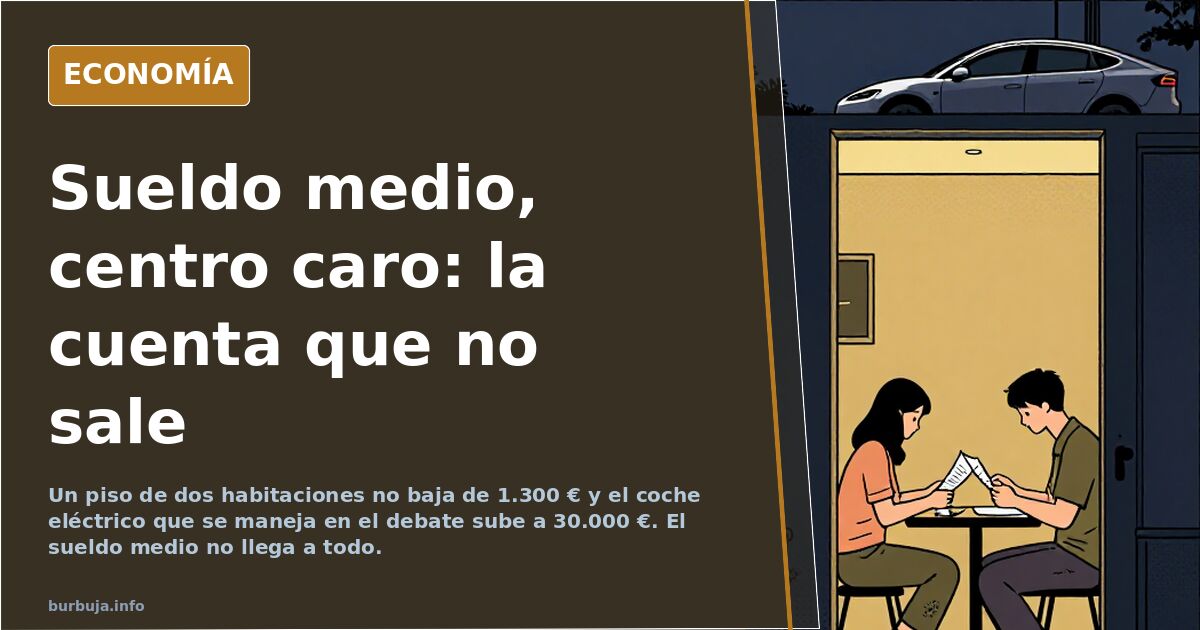
The average salary no longer covers living near work
How are people supposed to get to work when housing prices have pushed them 30 to 45 minutes away from their jobs? This question opens the discussion and has no cheap answer. An average salary, the one many still label as middle class, has to cover three bills at once: housing, car, and time. The first consumes a large part of the budget as soon as you step into a capital city. The second depends on the engine. And the third isn't paid with money, it's paid with life.
Can an average salary pay for a car for low-emission zones?
One participant argues that a new car with an environmental sticker starts below 15,000 euros, but another disputes this, stating that the Eco label requires a hybrid and there are no hybrids at that price. Going below that forces you into the used car market, where a working car costs around 3,000 euros, although it doesn't always have the sticker that allows entry into city centers. And an electric car, according to the figures discussed, costs around 30,000 euros. The gap between these three options explains why some drivers cannot enter their own city.
Insurance and maintenance are left outside this. A car is a money pit, but without it, some journeys simply don't exist.
Are there buses at five in the morning?
It depends on the route. In Madrid, buses leave from the terminals at 5:30 AM or earlier, and the metro runs until 1:30 AM. The problem isn't the first service, it's the frequency: every 15 to 20 minutes on good routes and from 35 minutes on weekdays, depending on the line. With that, a 50-minute bus journey, packed in, is normal. For those living in a town without a direct line to the industrial estate, the commute skyrockets: two hours each way, every day.
How much does it really cost to live downtown?
A two-bedroom apartment in a normal, unpretentious neighborhood costs at least 1,300 or 1,400 euros a month in a city like Valencia, according to one participant. There's no reward for moving to the outskirts: towns in the metropolitan area, they add, are in the same price range. Those who buy, if they can, accept mortgages that consume up to 60% of their salary. With the minimum wage at 1,381 euros per month, the line between earning the minimum wage and being middle class has become an optical illusion.
The car hour calculation
According to a calculation circulating in the discussion, moving an hour away from the capital reduces rent by about 200 euros per month. Gasoline takes the largest chunk: about 30 euros remain. If the commute can be done by public transport, the monthly pass leaves a saving of about 160 euros, but at the cost of about three hours a day round alucinación. Between two and a half hours on a bus or on the sofa, the arithmetic is simple. The decision, however, is not.
The industrial estate that buses don't cover
Industrial estates are usually on the outskirts, five kilometers or less from the urban center, as discussed. Buses do reach them, but rarely with the frequency and hours required for a split shift. There was a time when transport was paid for by the company: SEAT used to pick up its workers at the Plaza de España metro exit and offered them meals at subsidized prices. Other companies built housing for their employees, with swimming pools and company stores. That model was dismantled, and the cost of commuting ended up on the payslip.
Cheap housing that solves nothing
There is housing for less than 100,000 euros, as mentioned in the discussion. It's in municipalities where the square meter price doesn't rise because nobody wants to live there: no school nearby, no services, and no job within walking distance. Meanwhile, downtown land is reserved for tourism and investment. Buying cheap and living far away is a solution on paper and a problem on the ground.
The trap of the rising minimum wage
When the minimum wage rises, those who were previously earning the average salary look in the mirror: according to one participant, 1,800 euros a month no longer means middle class, it means being a step above the average earner. A decade without Netflix or an iPhone, saving about 1,400 euros from their salary, is what, according to their own account, was needed for a mortgage down payment. That's the real benchmark, and it explains why the middle-class label sits so poorly with those who receive it.
The drift nobody signs up for
Part of the exchange devolves into hostile generalizations about immigration and reproaches to landlords who leave apartments empty. This analysis does not endorse either of these points, but the anger stems from a measurable reality: the gap between the cost of living where the job is and what that job pays. The discussion heats up because the numbers don't add up. Everything else is noise.
With these figures, a mass migration to areas with affordable housing would be logical. It's not happening. Those who move 45 minutes away still clock in on time, every morning, at the same place. They call it quality of life.
How are people supposed to get to work when housing prices have pushed them 30 to 45 minutes away from their jobs? This question opens the discussion and has no cheap answer. An average salary, the one many still label as middle class, has to cover three bills at once: housing, car, and time. The first consumes a large part of the budget as soon as you step into a capital city. The second depends on the engine. And the third isn't paid with money, it's paid with life.
Can an average salary pay for a car for low-emission zones?
One participant argues that a new car with an environmental sticker starts below 15,000 euros, but another disputes this, stating that the Eco label requires a hybrid and there are no hybrids at that price. Going below that forces you into the used car market, where a working car costs around 3,000 euros, although it doesn't always have the sticker that allows entry into city centers. And an electric car, according to the figures discussed, costs around 30,000 euros. The gap between these three options explains why some drivers cannot enter their own city.
- Used car: around 3,000 euros
- New car with sticker: below 15,000 euros, according to one participant
- Electric: 30,000 euros, according to figures from the discussion
Insurance and maintenance are left outside this. A car is a money pit, but without it, some journeys simply don't exist.
Are there buses at five in the morning?
It depends on the route. In Madrid, buses leave from the terminals at 5:30 AM or earlier, and the metro runs until 1:30 AM. The problem isn't the first service, it's the frequency: every 15 to 20 minutes on good routes and from 35 minutes on weekdays, depending on the line. With that, a 50-minute bus journey, packed in, is normal. For those living in a town without a direct line to the industrial estate, the commute skyrockets: two hours each way, every day.
How much does it really cost to live downtown?
A two-bedroom apartment in a normal, unpretentious neighborhood costs at least 1,300 or 1,400 euros a month in a city like Valencia, according to one participant. There's no reward for moving to the outskirts: towns in the metropolitan area, they add, are in the same price range. Those who buy, if they can, accept mortgages that consume up to 60% of their salary. With the minimum wage at 1,381 euros per month, the line between earning the minimum wage and being middle class has become an optical illusion.
The car hour calculation
According to a calculation circulating in the discussion, moving an hour away from the capital reduces rent by about 200 euros per month. Gasoline takes the largest chunk: about 30 euros remain. If the commute can be done by public transport, the monthly pass leaves a saving of about 160 euros, but at the cost of about three hours a day round alucinación. Between two and a half hours on a bus or on the sofa, the arithmetic is simple. The decision, however, is not.
The industrial estate that buses don't cover
Industrial estates are usually on the outskirts, five kilometers or less from the urban center, as discussed. Buses do reach them, but rarely with the frequency and hours required for a split shift. There was a time when transport was paid for by the company: SEAT used to pick up its workers at the Plaza de España metro exit and offered them meals at subsidized prices. Other companies built housing for their employees, with swimming pools and company stores. That model was dismantled, and the cost of commuting ended up on the payslip.
Cheap housing that solves nothing
There is housing for less than 100,000 euros, as mentioned in the discussion. It's in municipalities where the square meter price doesn't rise because nobody wants to live there: no school nearby, no services, and no job within walking distance. Meanwhile, downtown land is reserved for tourism and investment. Buying cheap and living far away is a solution on paper and a problem on the ground.
The trap of the rising minimum wage
When the minimum wage rises, those who were previously earning the average salary look in the mirror: according to one participant, 1,800 euros a month no longer means middle class, it means being a step above the average earner. A decade without Netflix or an iPhone, saving about 1,400 euros from their salary, is what, according to their own account, was needed for a mortgage down payment. That's the real benchmark, and it explains why the middle-class label sits so poorly with those who receive it.
The drift nobody signs up for
Part of the exchange devolves into hostile generalizations about immigration and reproaches to landlords who leave apartments empty. This analysis does not endorse either of these points, but the anger stems from a measurable reality: the gap between the cost of living where the job is and what that job pays. The discussion heats up because the numbers don't add up. Everything else is noise.
With these figures, a mass migration to areas with affordable housing would be logical. It's not happening. Those who move 45 minutes away still clock in on time, every morning, at the same place. They call it quality of life.
Summary of a discussion on Burbuja.info - Foro de economía, actualidad y política., translated from Spanish and reviewed before publication. Read the full discussion (299 replies).
More summaries
-
Euthanasia in Old Age: Autonomy vs. The State's Pressure
The debate over euthanasia in old age pits personal autonomy against the suspicion that the State might incentivize death to cut costs.
-
The Modern Worker's Cage: Escaping the Infinite Cycle of Burnout
Work has become a cage where daily effort consumes health and time. Discover why we push ourselves so hard and how to break the cycle.
-
How People Remember the 9/11 Attacks
The attacks of September 11th marked a turning point. Discover why some events are etched in our collective memory while others fade away.
-
Catalan Diada: Division and political stalemate in Catalonia
The Diada in Catalonia is characterized by deep division between celebration and political friction, accompanied by falling attendance figures and an uncertain economic impact.
-
Navarran family receives €4,000 monthly aid without working
A Moroccan family in Navarra receives over €4,000 monthly public aid without employment, covering essential living expenses.
-
Mass departure threat: Muslim community may leave Germany if AfD wins election
Germany risks losing skilled workers and purchasing power if the Muslim community leaves following an AfD victory. We analyze the economic implications.