
Autonomous delivery robot tested in Barcelona: 5-hour range, unmonitored
An autonomous delivery robot is being tested in Barcelona with a 5-hour range and no supervision. Skeptics doubt the project's viability.
English · Original discussion in Spanish · Published
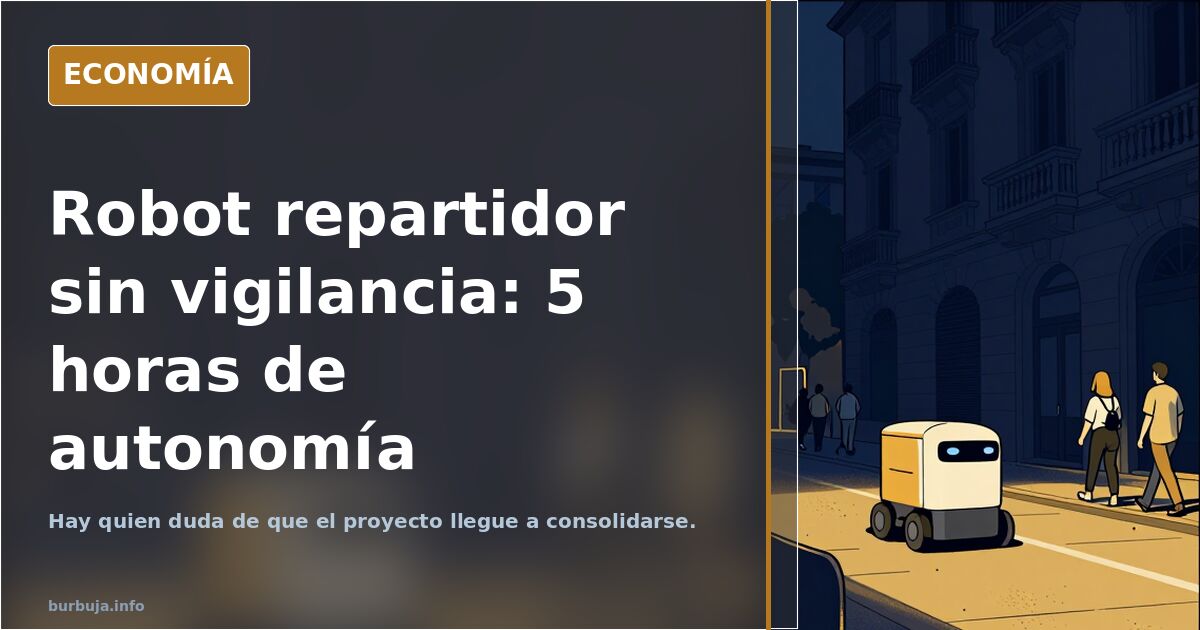
Unmonitored delivery robot tested in Barcelona with 5-hour range
An autonomous delivery vehicle travels along Barcelona sidewalks carrying packages. It has no acompañante or companion and, according to available data, lasts five hours on battery. Some participants question not whether the technology works, but how long it takes for someone to steal the entire robot or open it like a can. Presented as a pilot test, the initiative faces skepticism due to the history of similar projects—delivery drones, Amazon’s autonomous vehicles—that failed to scale.
What exactly is being tested
This involves an autonomous delivery robot currently being trialed in Barcelona. Available information suggests it is a small ground vehicle designed to transport packages via sidewalks and pedestrian areas. Its purported capabilities include predicting and avoiding collisions, which, taken literally, implies other delivery robots spend their time ramming pedestrians for sport.
The test is part of a broader automated delivery initiative, a sector that has been announcing a revolution for years without fully delivering one. Critics note that similar projects have been launched in various countries and cities, most remaining in the demonstration phase. The pattern repeats: heavy press releases, little real-world implementation.
Five hours of range and zero security: the perfect cocktail
The most cited figure is the five-hour range. Specifics on power consumption or recharge times are missing, raising doubts about whether five hours suffice for a full route in a dense city. However, range is not the primary issue.
The main problem is that the robot operates alone. Without supervision, companionship, or physical barriers preventing theft or tampering, it is vulnerable. In an urban environment with narrow sidewalks, construction, and heavy traffic, an autonomous delivery vehicle is essentially a cart full of packages with wheels and no owner. Comparing it to an honeypot—a decoy—is apt: some analyses suggest the robot is more useful as bait to identify vandals than as a viable delivery system.
History: Drones, autonomous vehicles, and broken promises
This is not the first such announcement. Delivery drones were touted years ago as the immediate future but never reached sidewalks. Amazon’s autonomous vehicles were tested in several countries and remained anecdotes. Some point out that the first test of this type of delivery robot dates back to 2016 in New Zealand, indicating how long we have been hearing the same story.
The reasonable question is what makes this test different. So far, the answer is unknown. No pilot results have been published, nor details on the number of robots operating, packages delivered, or incidents of vandalism. The lack of data is itself telling.
Impact on employment: Couriers, freelancers, and announced replacement
Beyond the technological anecdote, the underlying debate is economic. If the robot works, it replaces couriers. If it fails, it remains a pilot and replaces no one. In both cases, delivery workers remain vulnerable: either replaced, or used as cover while companies test if they can do without them.
Some argue couriers will have to resort to crime to survive if autonomous delivery becomes established. Others see the robot merely as leverage against labor conditions, regardless of its functionality. The discussion on whether the robot pays taxes as a freelancer—a recurring irony—highlights the absurdity: debating machine taxation before knowing if the machine is even viable.
Security: Vandalism, theft, and sidewalk jungle
There is broad consensus that the robot won’t last. Predictions range from losing its wheels within two hours to being completely dismantled. Scenarios include theft of goods, tipping over, or use as a training target. Spanish sidewalks, with their density, noise, and unique character, are not controlled testing circuits.
Some propose extreme solutions: facial recognition systems allowing approach only by legitimate recipients, alarms, or defensive mechanisms. All clash with reality: a delivery robot is valuable, visible, and fragile, making it a target. The only effective defense would be constant supervision, negating the economic advantage of autonomous delivery.
Context: Barcelona, Madrid, and the narrative of insecurity
The test takes place in Barcelona, sparking debates on urban insecurity beyond the robot itself. Crime statistics between cities are compared, discussions arise over which data is publicized, and perceptions of safety often diverge from official figures. Choosing Barcelona is not neutral; it is a dense city with vibrant street life and intense public debate on coexistence and security.
In this context, the robot is more of an excuse than a protagonist. The deeper discussion is whether Spanish cities are ready for technologies assuming a controlled environment, when the real environment is anything but.
Is it worth testing a delivery robot in a city where any object left on the sidewalk has a lifespan of minutes? For now, the robot itself holds the answer: if it survives the test, that will be the news. If not, it will be just another anecdote in the long list of tech promises crashing into reality.
Also available in: Deutsch
Summary of a discussion on Burbuja.info - Foro de economía, actualidad y política., translated from Spanish and reviewed before publication. Read the full discussion (104 replies).
More summaries
-
Fake sign targeting Pedro Sánchez appears at Madrid F1 Grand Prix
A fan flipped a double-sided sign at the Madrid Formula 1 Grand Prix and the cameras captured an insulting message aimed at Spain's prime minister Pedro Sánchez.
-
Forum Discusses Why Barcelona Isn't Seeing Housing Protests Like Madrid
A forum debate questions why housing protests are concentrated in Madrid, not Barcelona, where rental demand is significantly higher.
-
Spain's migrant child allocation favors Madrid over Catalonia
Madrid receives 806 spots for unaccompanied minors while Catalonia gets only 27, sparking debate over population-based distribution criteria.
-
Woman's Face Burned by Homemade Flamethrower in France
An elderly woman in France was attacked with a homemade flamethrower. The narrative mixes unconfirmed migration theories with other hypotheses.
-
Who's ready to board Spain's high-speed train again?
Two serious accidents with casualties in nine months on Spain's high-speed rail network have reignited fears about train travel. Here's what lies behind the unease.
-
No Roma, Black, Maghrebi or Latino donors seen in emergency blood donations, why?
A viral tweet uses a mass blood donation to suggest that certain groups don't give blood. The reality: health requirements explain who can donate.