
Autism and Evolution: Genius, Disorder, and an Unsubstantiated Hypothesis
Exploring the evolutionary hypothesis of autism, contrasting everyday challenges with historical figures, and debunking myths about vaccines and neurodiversity.
English · Original discussion in Spanish · Published
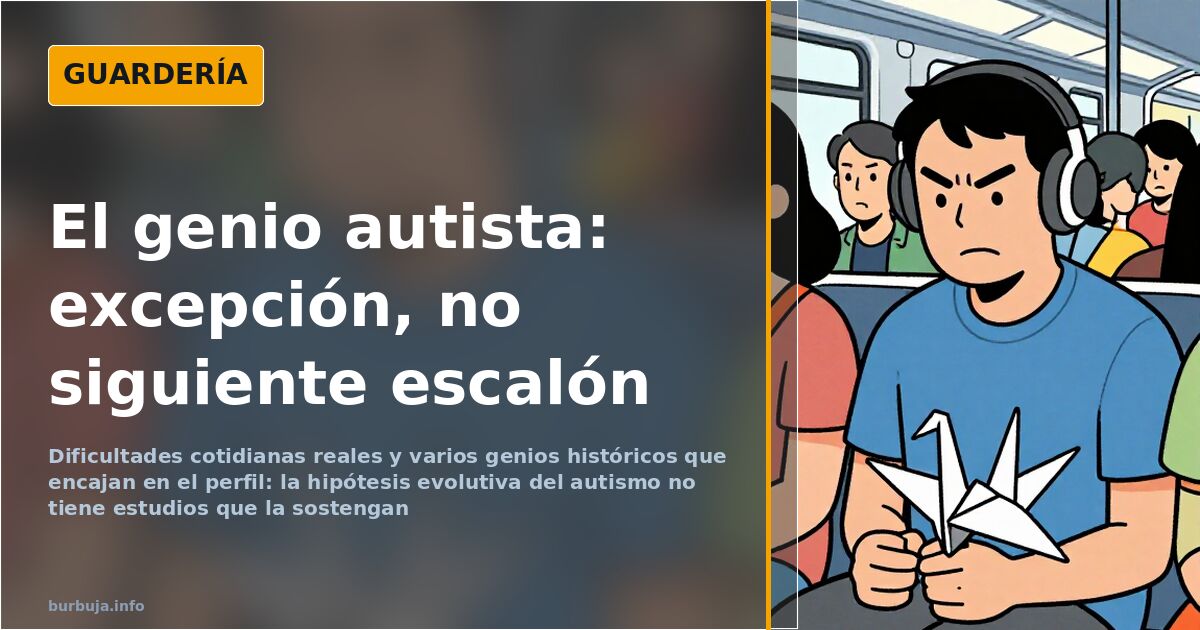
Autism and Evolution: The Hypothesis Lacking Data Support
The idea that autism represents humanity's next evolutionary step sounds intriguing but lacks a single supporting study. Two uncomfortable truths remain: individuals on the spectrum face significant daily challenges in socialization, sensory tolerance, and general life management—hence its clinical classification as a disorder—and numerous historical figures celebrated for their genius fit this profile. The rest is interpretation.
Everyday Challenges Faced by Autistic Individuals
The list of obstacles is not a cliché: understanding social cues, tolerating noise, and experiencing exhaustion in situations that are routine for others. Those who live it describe it with a nuance that dispels stereotypes: the same person who misses a joke might detect micro-expressions invisible to others. Being 'the odd one out' comes at a cost, but also with extraordinary attention to detail.
From Michelangelo to Elon Musk: Why the Autistic Genius is the Exception
The hypothesis is consistently accompanied by the same list: Michelangelo, Mozart, Newton, Elon Musk. Any diagnosis applied to them is retroactive and speculative, and in no case does an exception become a trend. The counterargument is stark: brilliant cases are few, while the rest of the spectrum faces an adult life far more challenging than the narrative of the misunderstood genius suggests. Daryl Hannah's case is cited as both proof and anecdote, depending on the perspective.
Vaccines and Autism: The Unproven Claim
The old myth that childhood vaccines leave an autistic trace is resurfacing. There is no evidence to support it. The claim relies on personal recollections and 'scars' on the arm, not on epidemiology.
Neanderthals, Propaganda, and the Golden Path of Dune
The most literary aspect of the subject: speculation suggests Neanderthals might have had more autistic traits than early sapiens, and plays with the idea of natural immunity to sentimental manipulation and effective propaganda. It's a powerful analogy, and to date, unprovable.
The hypothesis will continue to circulate: it's convenient, explains the present with a promise for the future, and requires no proof. If a measurable adaptive advantage ever emerges, the narrative will change. For now, discussing autism as the next evolutionary step is literature, not biology.
The idea that autism represents humanity's next evolutionary step sounds intriguing but lacks a single supporting study. Two uncomfortable truths remain: individuals on the spectrum face significant daily challenges in socialization, sensory tolerance, and general life management—hence its clinical classification as a disorder—and numerous historical figures celebrated for their genius fit this profile. The rest is interpretation.
Everyday Challenges Faced by Autistic Individuals
The list of obstacles is not a cliché: understanding social cues, tolerating noise, and experiencing exhaustion in situations that are routine for others. Those who live it describe it with a nuance that dispels stereotypes: the same person who misses a joke might detect micro-expressions invisible to others. Being 'the odd one out' comes at a cost, but also with extraordinary attention to detail.
From Michelangelo to Elon Musk: Why the Autistic Genius is the Exception
The hypothesis is consistently accompanied by the same list: Michelangelo, Mozart, Newton, Elon Musk. Any diagnosis applied to them is retroactive and speculative, and in no case does an exception become a trend. The counterargument is stark: brilliant cases are few, while the rest of the spectrum faces an adult life far more challenging than the narrative of the misunderstood genius suggests. Daryl Hannah's case is cited as both proof and anecdote, depending on the perspective.
Vaccines and Autism: The Unproven Claim
The old myth that childhood vaccines leave an autistic trace is resurfacing. There is no evidence to support it. The claim relies on personal recollections and 'scars' on the arm, not on epidemiology.
Neanderthals, Propaganda, and the Golden Path of Dune
The most literary aspect of the subject: speculation suggests Neanderthals might have had more autistic traits than early sapiens, and plays with the idea of natural immunity to sentimental manipulation and effective propaganda. It's a powerful analogy, and to date, unprovable.
The hypothesis will continue to circulate: it's convenient, explains the present with a promise for the future, and requires no proof. If a measurable adaptive advantage ever emerges, the narrative will change. For now, discussing autism as the next evolutionary step is literature, not biology.
Summary of a discussion on Burbuja.info - Foro de economía, actualidad y política., translated from Spanish and reviewed before publication. Read the full discussion (15 replies).
More summaries
-
Fed Up with the Struggles of Asperger's Syndrome.
The frustration of social interaction with autistic individuals. Understand the difficulties and how to approach them.
-
What DUNE's Adaptation Missed
Villeneuve's DUNE adaptation excels visually and politically but falters in key casting and chemistry. Discover why.
-
Real Madrid's Dominance: European Glory vs. Domestic Refereeing Bias
Real Madrid dominates European football but struggles against a domestic league marked by controversial refereeing decisions and the narrative hegemony of FC Barcelona.
-
Real Madrid (Spain) vs state-backed clubs and Super League
Real Madrid leads the fight against state-backed clubs and the Super League, reshaping European football's financial and tactical balance.
-
Seven Years Without a Date, and a Coffee Invite That Ended in Being Blocked
Seven years without a date, three weeks of back-and-forth, and a silent block: how a coffee invite turned into a ghosting story.
-
This post on X from back when it was still Twitter is getting people talking online again.
A post from before July 2023 asked whether Penélope Cruz was Pepe Viyuela in a wig. The joke is doing the rounds again.