
Astral travel: the technique requiring waking up after 3.5 to 6 hours
Conscious out-of-body experiences require waking up after 3.5 to 6 hours of sleep. Critics point to Hemisync audio costs of around 500 euros.
English · Original discussion in Spanish · Published
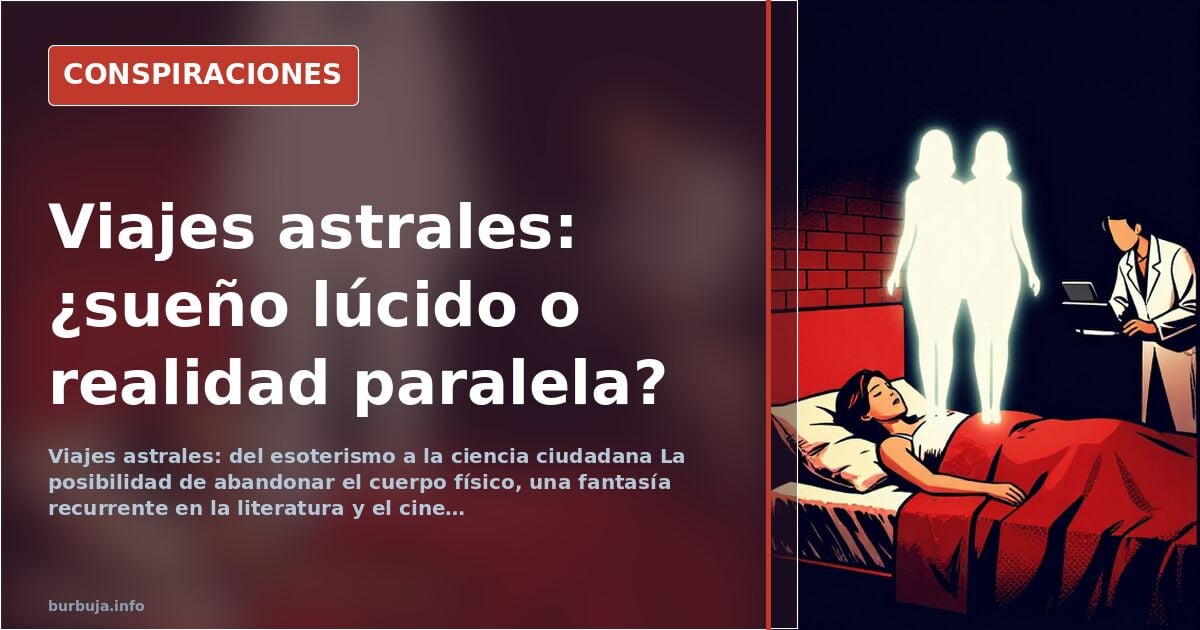
Conscious out-of-body travel: guide, risks, and 500-euro audio tools
Claiming to have left one’s own body invites easy mockery, yet the phenomenon has protocols, institutions, and a community practicing it for decades. An author preparing a book on his own experiences has publicly answered questions from interested parties, resulting in a detailed map of a practice blending technique, psychology, and, according to his account, something harder to classify.
The first distinction he establishes is the most important: it is not a dream. “When you dream, you are not conscious of the beginning; you are directly in the middle of a dream, but with out-of-body experience, you are conscious as you are about to leave”, he summarizes. In a dream, one appears in the scene without having decided anything; in an out-of-body experience, one feels in bed, becomes aware, and executes the action.
What is the difference between the direct and indirect methods?
The indirect method is always recommended initially. It involves sleeping for a few hours, waking up, walking around the house for a few minutes, and returning to bed. The range managed is between 3.5 and 6 hours of prior sleep, and each person must find their own point. Upon returning to bed, sleep is lighter, and micro-awakenings occur where the body remains asleep but the mind is alert. Techniques are applied there.
The direct method involves lying down and leaving without having slept beforehand, and it is the hardest. “The direct method is where you lie down directly, apply techniques, and leave the body. It is the most difficult”, admits the author, who acknowledges having tried it without success. The key to why the indirect method wins, according to his explanation, is that the state of a sleeping body is reached sooner.
Hemisync audio tools and Robert Monroe’s legacy
The most cited tool is hemisync, a sound system created by Robert Monroe, an American sound engineer who began experimenting with out-of-body experiences and eventually founded the Monroe Institute. The proposal is to synchronize brain hemispheres to facilitate altered states of consciousness. There are Spanish-language audio tracks ordered from least to most difficult, and a specific exercise for initial blocks, the energy conversion box.
The price is the weak point. In the thread, critics point out that Hemisync CDs cost around 500 euros each and that seminars are expensive, fueling skepticism. The defense of the method is more modest: according to the author, the audio tools do not guarantee anything on their own but teach technique and relax enough to make the out-of-body experience possible.
Michael Raduga: leaving in a morning, with fright included
One of the most repeated recommendations points to the Michael Raduga method, presented in the thread as the fastest and most direct path, without meditations or detours. The testimony of someone who tried it is eloquent: he managed to leave his body in a single morning and was so impressed that, for now, he has not tried it again. The author himself agrees that it almost always happens spontaneously during the night, upon returning from the bathroom, and that it is only controlled with practice.
Entities, parasites, and Monroe’s “loosh”
Here, the account becomes dark. A ecosystem is described, populated by human-shaped beings, others luminous or large and blue, and others openly non-human: cadaveric figures, creatures with many eyes, or bird-headed beings. The mix of reality and fantasy is, according to the author, inevitable: outside the body, one can create an entire environment with thought, practically instantaneously.
Parasitic entities also appear, which, according to his account, feed on emotional imbalances: addictions, uncontrolled anger, compulsive sens. The more chaos, the better for them. The concept of loosh, taken from Monroe, also hovers: the universe and humanity would exist to produce a certain type of energy. Three successive crops are discussed, from bacteria and plants to dinosaurs, with struggle and death as the engine of performance. The scope of the matter is such that the author himself notes he does not know if there are seven planes or twelve.
Antiestéticar, anxiety, and why some give up
Not everything is enthusiasm. One participant recounts how, after achieving good concentration and chained lucid dreams, he began experiencing anxiety attacks, deep sadness, and suicidal thoughts. Today, he carries, according to his testimony, zero concentration and antiestéticar of retrying. The author’s response points to unresolved blocks, not the practice itself, and refers to the energy box exercise. Another quit due to insomnia: binaural sound made him nervous, and for now, he does not plan to repeat it. The recommendation for calm is not a cliché: with antiestéticar, the experience lasts seconds and disorients.
With these rules, the practice should be in every self-help manual. It is not. Between the technique, the business of audio tools, and the personal diary material the author says he is pouring into his book, no one fully explains why something so documented remains terrain for suspicion.
Claiming to have left one’s own body invites easy mockery, yet the phenomenon has protocols, institutions, and a community practicing it for decades. An author preparing a book on his own experiences has publicly answered questions from interested parties, resulting in a detailed map of a practice blending technique, psychology, and, according to his account, something harder to classify.
The first distinction he establishes is the most important: it is not a dream. “When you dream, you are not conscious of the beginning; you are directly in the middle of a dream, but with out-of-body experience, you are conscious as you are about to leave”, he summarizes. In a dream, one appears in the scene without having decided anything; in an out-of-body experience, one feels in bed, becomes aware, and executes the action.
What is the difference between the direct and indirect methods?
The indirect method is always recommended initially. It involves sleeping for a few hours, waking up, walking around the house for a few minutes, and returning to bed. The range managed is between 3.5 and 6 hours of prior sleep, and each person must find their own point. Upon returning to bed, sleep is lighter, and micro-awakenings occur where the body remains asleep but the mind is alert. Techniques are applied there.
The direct method involves lying down and leaving without having slept beforehand, and it is the hardest. “The direct method is where you lie down directly, apply techniques, and leave the body. It is the most difficult”, admits the author, who acknowledges having tried it without success. The key to why the indirect method wins, according to his explanation, is that the state of a sleeping body is reached sooner.
Hemisync audio tools and Robert Monroe’s legacy
The most cited tool is hemisync, a sound system created by Robert Monroe, an American sound engineer who began experimenting with out-of-body experiences and eventually founded the Monroe Institute. The proposal is to synchronize brain hemispheres to facilitate altered states of consciousness. There are Spanish-language audio tracks ordered from least to most difficult, and a specific exercise for initial blocks, the energy conversion box.
The price is the weak point. In the thread, critics point out that Hemisync CDs cost around 500 euros each and that seminars are expensive, fueling skepticism. The defense of the method is more modest: according to the author, the audio tools do not guarantee anything on their own but teach technique and relax enough to make the out-of-body experience possible.
Michael Raduga: leaving in a morning, with fright included
One of the most repeated recommendations points to the Michael Raduga method, presented in the thread as the fastest and most direct path, without meditations or detours. The testimony of someone who tried it is eloquent: he managed to leave his body in a single morning and was so impressed that, for now, he has not tried it again. The author himself agrees that it almost always happens spontaneously during the night, upon returning from the bathroom, and that it is only controlled with practice.
Entities, parasites, and Monroe’s “loosh”
Here, the account becomes dark. A ecosystem is described, populated by human-shaped beings, others luminous or large and blue, and others openly non-human: cadaveric figures, creatures with many eyes, or bird-headed beings. The mix of reality and fantasy is, according to the author, inevitable: outside the body, one can create an entire environment with thought, practically instantaneously.
Parasitic entities also appear, which, according to his account, feed on emotional imbalances: addictions, uncontrolled anger, compulsive sens. The more chaos, the better for them. The concept of loosh, taken from Monroe, also hovers: the universe and humanity would exist to produce a certain type of energy. Three successive crops are discussed, from bacteria and plants to dinosaurs, with struggle and death as the engine of performance. The scope of the matter is such that the author himself notes he does not know if there are seven planes or twelve.
Antiestéticar, anxiety, and why some give up
Not everything is enthusiasm. One participant recounts how, after achieving good concentration and chained lucid dreams, he began experiencing anxiety attacks, deep sadness, and suicidal thoughts. Today, he carries, according to his testimony, zero concentration and antiestéticar of retrying. The author’s response points to unresolved blocks, not the practice itself, and refers to the energy box exercise. Another quit due to insomnia: binaural sound made him nervous, and for now, he does not plan to repeat it. The recommendation for calm is not a cliché: with antiestéticar, the experience lasts seconds and disorients.
With these rules, the practice should be in every self-help manual. It is not. Between the technique, the business of audio tools, and the personal diary material the author says he is pouring into his book, no one fully explains why something so documented remains terrain for suspicion.
Summary of a discussion on Burbuja.info - Foro de economía, actualidad y política., translated from Spanish and reviewed before publication. Read the full discussion (216 replies).
More summaries
-
Fomenko's New Chronology: the historical fraud that refuses to die
A Russian mathematician claims ancient history was invented in the Middle Ages. A 16-year forum debate with over 3,200 replies. We examine the evidence and the consequences.
-
Losing Control After Surrendering to Jesus: Trial or Temptation?
A crisis of losing control after entrusting oneself to Jesus: mystical trial, demonic assault, or psychological process?
-
Sigils: From Medieval Grimoires to Modern Corporate Logos
A sigil is a drawing to program the subconscious and change reality. This practice has moved from medieval grimoires to corporate logos.
-
Critiquing Mainstream Economics and Financial Models
A critical analysis of mainstream economics examines financial bubbles, the definition of value, and debt.
-
CERN and Demons: Ross Coulhart's Theory Linking Physics and the Occult
Ross Coulhart links the CERN to dimensional portals and demonic entities, exploring connections with Swiss OTO, H.R. Giger, and black metal.
-
Esoteric Electromagnetism: Ohm’s Law as Spiritual Mandate
Esoteric Electromagnetism interprets resistance, ether, and superconductivity as spiritual keys, transforming Ohm’s Law from physics to moral command.