
Asteroid 1999 AN10 to Pass at Moon Distance in 2027
Asteroid 1999 AN10 will pass Earth on August 7, 2027, at a safe distance of 390,000 km. Apophis will be visible to the naked eye in 2029 without impact risk.
English · Original discussion in Spanish · Published
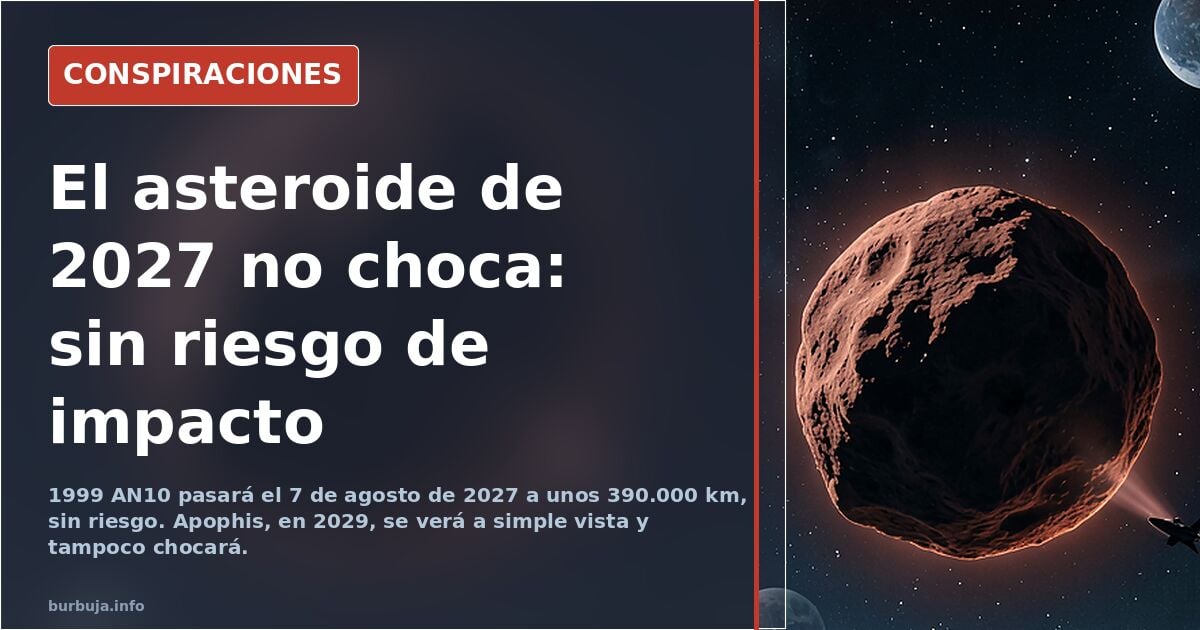
2027 Asteroid to Pass at Lunar Distance Without Impact
August 2027. An object approximately one kilometer in diameter will cross the sky at a distance similar to that of the Moon, around 390,000 kilometers. This is asteroid 1999 AN10, and its orbit is well-measured enough to rule out an impact. NASA does not consider it a threat. The label "GOG" is not astronomy: it is a designation appearing in the work of J. J. Benítez, who allegedly placed the supposed cataclysm in the Caribbean and, as recalled, kept a bottle of champagne ready in case he was wrong.
Rumors about hidden celestial bodies resurface periodically. The difference this time is that public data allows for concrete figures to be put on the table.
What is Asteroid 1999 AN10 and Why It Is Not a Threat
1999 AN10 is a considerable-sized object — nearly one kilometer — that will pass on **August 7, 2027**, at a distance comparable to lunar orbit. Sufficient to observe with a telescope, insufficient to alter tides or cause any appreciable gravitational effect. The key lies in the orbit: the more precise the calculation becomes, the narrower the margin of error, and that margin no longer includes Earth.
Some argue that millions spent on planetary defense hide classified information. The less conspiratorial interpretation is the opposite: precisely because there is no absolute certainty regarding all near-Earth objects, investment is made to learn more. The **DART** mission, which in 2022 crashed a spacecraft into a small asteroid to deflect its trajectory, was a technical trial, not an emergency operation.
Apophis 2029: The One Visible to the Naked Eye
The astronomical spectacle of the decade is not the 2027 event. It is **Apophis**, which on **April 13, 2029**, will pass at about 32,000 kilometers, closer than some geostationary satellites. It will be visible to the naked eye from Europe during dark nights. In 2021, NASA ruled out impact risk for at least the next hundred years, and several missions will take advantage of the flyby to study it closely.
Confusion between "passing close" and "colliding" drives almost all scares. An object can cross Earth's orbit without touching it; the Moon's distance, in astronomical terms, is a whisper, but in terms of risk, it is an abyss.
Origin of the 2027 Date and the Caribbean Prophecy
The specific date of **August 29, 2027**, does not come from any orbital calculation. It is attributed to the work of J. J. Benítez, who presented it as received information, consistent with his other books. There is no observation or ephemeris behind it. Hence the champagne detail: a personal bet, not a scientific forecast.
In the realm of prophecies, the harvest is broad. Nostradamus and alleged seers speaking of a celestial body visible in full daylight are cited. None of these sources provide orbital parameters, which is the only thing allowing for trajectory calculations.
What Will Really Happen in 2029 and 2030
Beyond Apophis, the schedule of approaches continues. The astronomical community maintains catalogs of near-Earth objects and updates probabilities as new observations arrive. Most initial scares dissolve with data. It is the usual pattern: first the headline, then the calculation.
The lingering question is not whether something will fall in 2027. It is how much attention noise deserves compared to data. With the orbit of 1999 AN10 measured and Apophis ruled out for a century, the sky of this decade is reasonably calm. The ground is another matter.
Also available in: Deutsch
Summary of a discussion on Burbuja.info - Foro de economía, actualidad y política., translated from Spanish and reviewed before publication. Read the full discussion (15 replies).
More summaries
-
Apophis 2029 and Garabandal: countdown to the Warning
Apophis will pass 32,000 km from Earth on April 13, 2029. Garabandal prophecies place the Warning there. Coincidence or script?
-
NASA's lunar dust problem reignites Apollo authenticity debate
NASA seeks student help to tackle lunar dust for Artemis, reviving doubts about whether the Apollo missions were real.
-
Neville Goddard vs planetary magic: success or cosmic debt?
A practitioner wins a car using Neville's law; others warn of the price: accidents, sacrifices and cosmic debt. Miracle or trap?
-
Alcàsser Case: AI Bias Test with Three Models
A nine-day experiment queries ChatGPT-4o mini on the Alcàsser case: identical prompts yield three distinct AI responses, revealing significant bias.
-
Grant Morrison links Paul Delvaux to Hannah Montana
Grant Morrison sits at the center of a map connecting Paul Delvaux, Neal Cassady and Hannah Montana. The discussion highlights these links without fully proving them.
-
The Donnie Darko Jesuit Detail That Doesn't Exist
The IHS monogram appears on the school facade in Donnie Darko, but the scene with black clouds after the time travel talk is missing.