
Artisan cheese maker closes after 8 inspections in two years
An artisan cheese maker goes from 160 goats to 16 and closes after 8 inspections in two years, according to a widely shared case. The debate reopens whether regulations suffocate small producers.
English · Original discussion in Spanish · Published
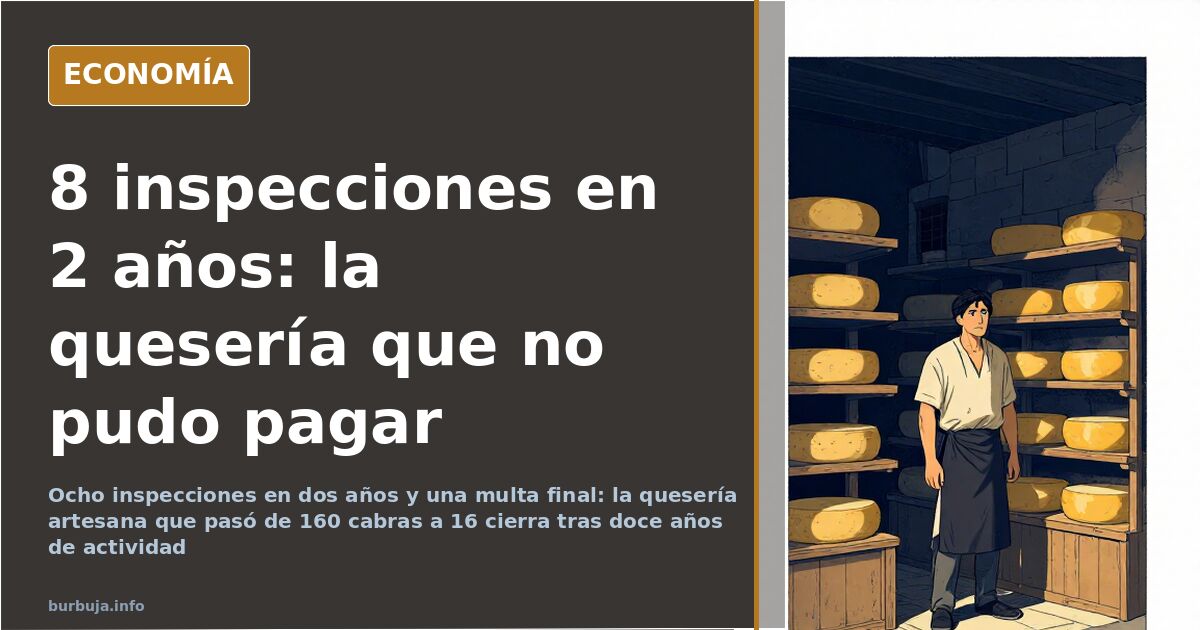
Eight inspections in two years shut down an artisan cheese maker
Twelve years selling cheese from its own goats. A thriving, multi-award-winning business that was going from strength to strength. And in just two years, eight consecutive health inspections, demands the owner calls absurd, and a final hefty fine that forced him to close. The cheese maker, based in Catalonia according to the information spread, has gone from 160 goats to 16. The owner himself sums it up: "They want a cheese maker to be an operating theatre."
The story, reported by the newspaper Segre, has sparked a debate that goes far beyond cheese. Because what is being discussed is not whether it is advisable to monitor the safety of a food product, but to what extent the tangle of regulations and bureaucracy are acting as a filter that expels small producers and leaves the field free for the big ones.
From 160 goats to 16: the suffocation of small producers
The case has an impressive numerical pogre. Twelve years of solvent activity. Eight inspections in 2025 and 2026. A sanction after refusing to let inspectors in on the last visit. And a herd that has plummeted from 160 goats to 16 due to the impossibility of facing taxes and regulations associated with livestock farming. The closure is not a business decision: it is the result of an administrative sequence.
The most repeated response in economic analysis is that the cost of compliance does not scale equally for everyone. An artisan cheese maker bears the same documentary, traceability and environmental control requirements as an industrial plant, but without economies of scale to spread them. Some argue that regulations are designed with the big player in mind and applied to the small one, and that this mismatch is, in fact, the real industrial policy.
Why are small businesses inspected more than large ones?
The question runs through the entire conversation and has an uncomfortable answer: because the small one pays. A direct testimony illustrates this. A manager at an IBEX construction company recounts that inspectors visited them month after month, and when he asked why they didn't go to small companies, where health and safety rules are less complied with, the answer was that large companies can be fined because they pay, while small ones disappear and create another company.
That perverse incentive—fining where there are attachable assets—would explain the asymmetry. The same pattern is described in other sectors: a pizzeria with rented premises in a good area of Málaga received almost weekly surprise inspections, to the point that on inspection day they couldn't cook, while a street vendor set up almost at its door operated without the health authority bothering him. It ended up closing. The street vendor is still there.
Cheese as a pretext: regulation, competition and Agenda 2030
Part of the analysis argues that the stated objective—food safety—does not explain the result. It is argued that blue cheese or roquefort owe their character precisely to bacteria and fungi, and that except in cases of listeria, salmonella or E. coli, the demand for hospital-grade asepsis has no technical basis. At the same time, the paradox is pointed out that a cheese with hydrogenated vegetable fat from mass production passes all controls without problem.
The most repeated thesis is that of regulatory capture: large companies benefit from suffocating regulation because it makes it more expensive for competitors to enter. Hilaire Belloc and his The Servile State (1912) are cited as a precedent for the diagnosis, and it is linked to Agenda 2030 as an alleged continuity of the process. It should be noted that this connection is a political interpretation, not a documented fact.
Bureaucracy measured in pages: 960,000 a year
The debate provides a figure that helps dimension the problem. During the economic crisis, official gazettes published an average of 960,000 pages a year: about 203,000 from the State and another 757,000 from regional governments. The former Attorney General criticised the abuse of decree-laws and the "unbearable inflation of state and regional laws", which can cause legal uncertainty and poor compliance.
There lies the crux. It is not only how many regulations there are, but how many administrative layers issue them and how much real capacity a self-employed person has to comply with them all. The result, according to several testimonies, is an underground economy that grows out of necessity: those who cannot afford compliance leave the system.
The exit that is becoming normalised: working off the books
The most uncomfortable conclusion of the debate is that the small business owner's response is not protest, but informality. Several messages confirm it bluntly: "I've been running my business off the books for five years," says one. "Close the door and work off the books, it seems stupid but that's how it is, they're only going to screw those who are legal," adds another.
It is the logical consequence of a system where compliance is more expensive than the expected sanction. And it explains why the number of self-employed does not fall as much as might be expected while the number of fully legal businesses does. The cheese maker that closes is not an exception: it is the visible part of a phenomenon better measured in business closures than in headlines.
With these ingredients, the question is not whether inspections were needed. It is how many inspections, with what criteria and at whose expense. The debate remains exactly there: whether the State is protecting the consumer or protecting the competitor who was already winning.
Twelve years selling cheese from its own goats. A thriving, multi-award-winning business that was going from strength to strength. And in just two years, eight consecutive health inspections, demands the owner calls absurd, and a final hefty fine that forced him to close. The cheese maker, based in Catalonia according to the information spread, has gone from 160 goats to 16. The owner himself sums it up: "They want a cheese maker to be an operating theatre."
The story, reported by the newspaper Segre, has sparked a debate that goes far beyond cheese. Because what is being discussed is not whether it is advisable to monitor the safety of a food product, but to what extent the tangle of regulations and bureaucracy are acting as a filter that expels small producers and leaves the field free for the big ones.
From 160 goats to 16: the suffocation of small producers
The case has an impressive numerical pogre. Twelve years of solvent activity. Eight inspections in 2025 and 2026. A sanction after refusing to let inspectors in on the last visit. And a herd that has plummeted from 160 goats to 16 due to the impossibility of facing taxes and regulations associated with livestock farming. The closure is not a business decision: it is the result of an administrative sequence.
The most repeated response in economic analysis is that the cost of compliance does not scale equally for everyone. An artisan cheese maker bears the same documentary, traceability and environmental control requirements as an industrial plant, but without economies of scale to spread them. Some argue that regulations are designed with the big player in mind and applied to the small one, and that this mismatch is, in fact, the real industrial policy.
Why are small businesses inspected more than large ones?
The question runs through the entire conversation and has an uncomfortable answer: because the small one pays. A direct testimony illustrates this. A manager at an IBEX construction company recounts that inspectors visited them month after month, and when he asked why they didn't go to small companies, where health and safety rules are less complied with, the answer was that large companies can be fined because they pay, while small ones disappear and create another company.
That perverse incentive—fining where there are attachable assets—would explain the asymmetry. The same pattern is described in other sectors: a pizzeria with rented premises in a good area of Málaga received almost weekly surprise inspections, to the point that on inspection day they couldn't cook, while a street vendor set up almost at its door operated without the health authority bothering him. It ended up closing. The street vendor is still there.
Cheese as a pretext: regulation, competition and Agenda 2030
Part of the analysis argues that the stated objective—food safety—does not explain the result. It is argued that blue cheese or roquefort owe their character precisely to bacteria and fungi, and that except in cases of listeria, salmonella or E. coli, the demand for hospital-grade asepsis has no technical basis. At the same time, the paradox is pointed out that a cheese with hydrogenated vegetable fat from mass production passes all controls without problem.
The most repeated thesis is that of regulatory capture: large companies benefit from suffocating regulation because it makes it more expensive for competitors to enter. Hilaire Belloc and his The Servile State (1912) are cited as a precedent for the diagnosis, and it is linked to Agenda 2030 as an alleged continuity of the process. It should be noted that this connection is a political interpretation, not a documented fact.
Bureaucracy measured in pages: 960,000 a year
The debate provides a figure that helps dimension the problem. During the economic crisis, official gazettes published an average of 960,000 pages a year: about 203,000 from the State and another 757,000 from regional governments. The former Attorney General criticised the abuse of decree-laws and the "unbearable inflation of state and regional laws", which can cause legal uncertainty and poor compliance.
There lies the crux. It is not only how many regulations there are, but how many administrative layers issue them and how much real capacity a self-employed person has to comply with them all. The result, according to several testimonies, is an underground economy that grows out of necessity: those who cannot afford compliance leave the system.
The exit that is becoming normalised: working off the books
The most uncomfortable conclusion of the debate is that the small business owner's response is not protest, but informality. Several messages confirm it bluntly: "I've been running my business off the books for five years," says one. "Close the door and work off the books, it seems stupid but that's how it is, they're only going to screw those who are legal," adds another.
It is the logical consequence of a system where compliance is more expensive than the expected sanction. And it explains why the number of self-employed does not fall as much as might be expected while the number of fully legal businesses does. The cheese maker that closes is not an exception: it is the visible part of a phenomenon better measured in business closures than in headlines.
With these ingredients, the question is not whether inspections were needed. It is how many inspections, with what criteria and at whose expense. The debate remains exactly there: whether the State is protecting the consumer or protecting the competitor who was already winning.
Summary of a discussion on Burbuja.info - Foro de economía, actualidad y política., translated from Spanish and reviewed before publication. Read the full discussion (120 replies).
More summaries
-
Lola Gallardo, OnlyFans, and the Business of Women's Football
The debate around Lola Gallardo and OnlyFans hides an economic question: who pays for women's football and who has the right to monetize the image of...
-
Madrid Building Collapse: Negligence or Structural Failure?
A seven-story building collapse in Madrid leaves four missing. Investigation focuses on debris overload and potential negligence in construction supervision.
-
Israel Launches Massive Syria Offensive as Damascus Control Points Fall
Israel strikes Syria heavily after clashes with Druze. Damascus is on high alert, and the US urges citizens to evacuate the country.
-
Spanish Student Killed by Elephant in Thailand
A 22-year-old Spanish student, Blanca Ojanguren, died after being attacked by an elephant at a sanctuary in Thailand, sparking debate on wildlife tourism risks.
-
Dover: From 800,000 to 5,000 Copies With Final Album
Dover sold 800,000 copies with Devil Came to Me but only 5,000 with their last album. The African shift led to the band's dissolution.
-
Tinder date accused of two rapes in Spain faces 27 years in prison
A woman accuses her Tinder date of two rapes in Zaragoza, Spain. The accused faces 27 years in prison, sparking intense debate over consent and credibility.