
Armed Nationalist Groups Spark Debate in France
Nationalist groups patrol French streets with bats, reigniting the debate over self-defense versus vigilantism and accusations of fascism.
English · Original discussion in Spanish · Published
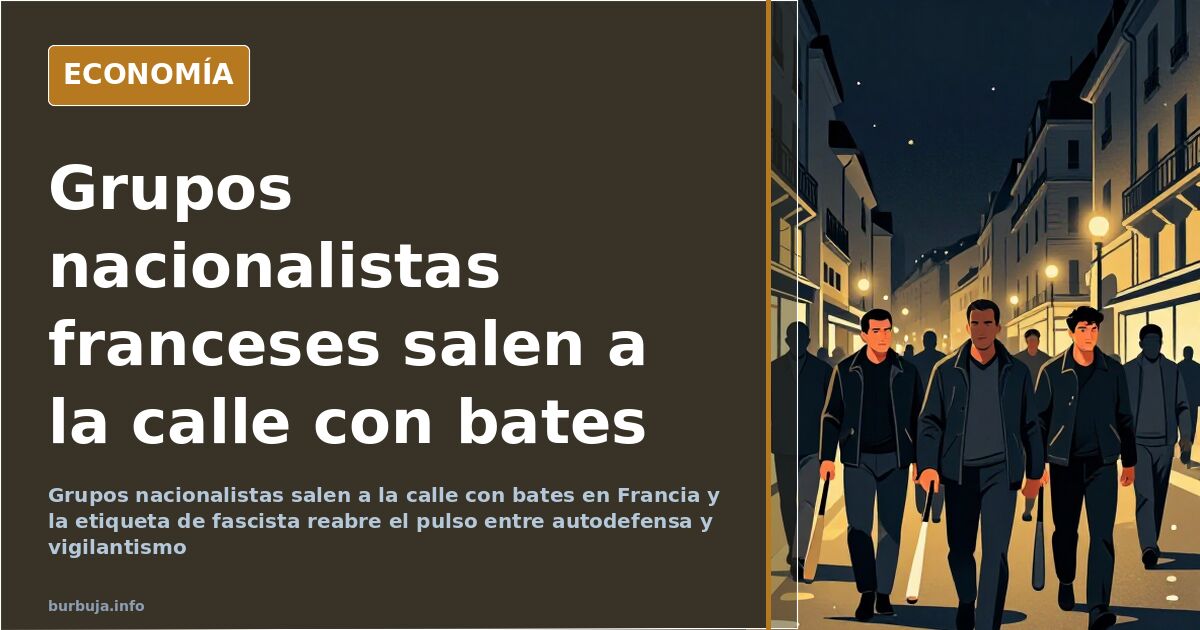
Self-Defense Groups in France and the Fascist Label
Two narratives, one scene, and two irreconcilable adjectives. Amidst urban riots that rocked France, groups identifying as nationalists took to the streets armed with baseball bats to confront rioters, according to messages spread on social media. The texts accompanying the images left no doubt about the controversy: for some, they were neighbors defending their neighborhoods against unchecked violence; others criticize labeling these same neighbors as fascists. The discussion revolves less around facts and more around terminology.
What Peine in France?
The accounts that sparked the issue describe French nationalist groups taking to the streets to confront those responsible for the riots and protect their neighborhoods. One message places them opposite far-left groups; another claims they beat rioters with bats. None provide a tally: no injuries, arrests, or damages accounted for. What they do depict are neighbors who decided not to wait for the police.
Self-Defense or Fascism?
The first axis of the clash is purely terminological, and it is not minor. The same image—a street at night, a group of men, and a blunt object in hand—admits two readings that share neither subject nor motive. Those wielding the bat out of antiestéticar, say some, are exercising a fundamental right; those wielding it for ideology, respond others, are engaging in paramilitary-style patrols.
There is a recurring irony in the material: calling someone fascist has ceased to function as an insult and has almost become a compliment. The joke has substance. When the term is applied equally to a neighbor and a political party, the label loses its edge and stops describing anything.
The Double Standard Denounced by Part of the Analysis
One school of thought argues that the measuring stick is asymmetric. The same gesture changes name depending on who performs it: if a neighbor goes out to defend their business, they are labeled a fascist; if the riot is led by another, social explanations and poverty excuses are sought. This is not a new complaint, but the French episode has put it back on the table with special crudeness.
Does the State Protect or Must We Protect Ourselves?
The other vein of the debate concerns the role of the State. If the police do not arrive and the State fails, the conclusion drawn by some is that everyone must protect themselves. Some formulate this as a matter of coherence: delegating one's own defense to a third party amounts to renouncing the only freedom truly exercised, the one one can guarantee with their own hands.
Against this, another part of the thread reminds us that a government must always exist and that its absence would expose the country to invasion by its neighbors. The discussion, at its core, is the old question of who has the final word when security fails.
The Cultural Framework Hovering Over the Debate
Underneath the episode lies a broader discussion on coexistence. Some messages frame it as a clash of cultural models that, they argue, do not fit together, and attack the word multiculturalism considering it a wrapper for forced coexistence. It is a thesis launched without a single data point to support it, based on perception rather than statistics.
Another reading, which the material itself attributes to opponents of the former view, attributes the violence of the riots to specific social grievances and lack of prospects, not to cultural identity. Two ways of looking at the same sustancia ilegal that share neither diagnosis nor remedy.
The Roman Analogy of Hannibal and Fabius Maximus
Among the highlighted messages slips a historical digression that shows how far the focus has drifted. It recalls that Hannibal, after defeating Roman legions at Trebia, Trasimeno, and Cannae, found resistance in the Senate that did not involve pitched battles. Rome chose to buy time, avoid frontal clashes, and wear down the invader while unable to defeat him in open field.
The insinuated parallel is evident: some believe that confronting street violence head-on is a tactical error and that it is smarter to endure.
In the end, the French scene leaves a question that no side fully answers. When the State does not arrive, who should arrive first? The answer each person gives decides, almost without margin, what word they use to describe a bat in a hand.
Also available in: Deutsch
Summary of a discussion on Burbuja.info - Foro de economía, actualidad y política., translated from Spanish and reviewed before publication. Read the full discussion (111 replies).
More summaries
-
Riots in France and Europe: Economic Chaos on the Periphery
Analysis of the riots in France: €60 billion in peripheries and persistent social tension
-
France Riots Fuel Spanish Migration and Election Debate
Analysis compares US-Spain election costs and migration theories to explain why Spain avoids France's unrest.
-
France: 700 arrested as educator struggles to comprehend
France faces its fifth night of riots with over 700 arrests, 45 police injured, and a visibly distressed social worker questioning the unrest.
-
Ignacio Lázaro: 'Maricarmen paid €154 rent while we paid €750'
Ignacio Lázaro, grandson of the original owner, reveals the other side of the Maricarmen case: 'We subsidized her for years and now, with our taxes.'
-
Gabriel Zucman's 2% wealth tax plan: will Spain's middle class foot the bill?
We analyse Gabriel Zucman's 2% levy on the ultra-rich: tax justice or a real risk to the savings of Spain's middle class?
-
.
The story of a father who left 90% of his fortune to his youngest son, based on character rather than tradition. Did he get it right?