
Argentina: Poverty Rises to 32.3% in First Half
Argentina's INDEC reports poverty at 32.3% and extreme poverty at 7.5%, with two million more poor in six months as country risk climbs to 610.
English · Original discussion in Spanish · Published
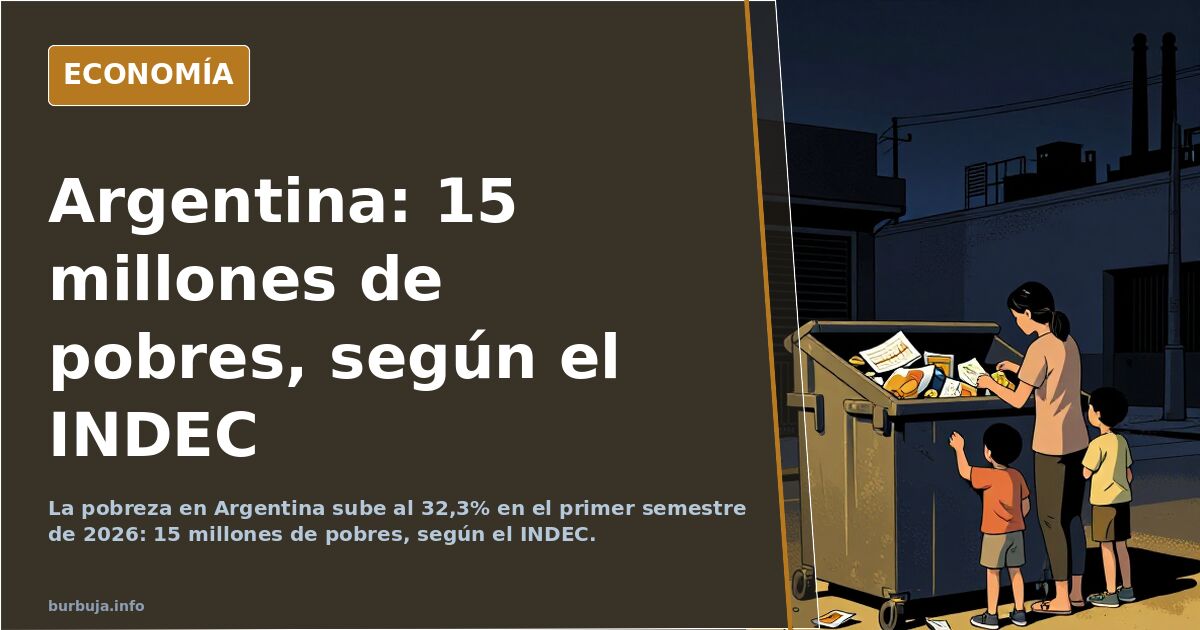
Argentina Returns to 32.3% Poverty: Two Million More in Six Months
Two million Argentinians crossed the poverty line in just six months. INDEC released data this Thursday showing that 32.3% of the population lived below the threshold in the first half of 2026, with extreme poverty at 7.5%. This amounts to fifteen million people. The figure represents a 4.1 percentage point increase compared to the second half of 2025, occurring as Argentina's country risk climbed from 570 to 610 in a single day.
The report maps the situation below the headline: 9.7 million poor are concentrated in the major urban centers surveyed. One participant noted that even three IMF loans have failed to contain the financial deterioration, and that labor income is bearing the brunt of the adjustment. The chainsaw was for the working class's income, summarized another participant. These are opinions, not data from the report.
What the INDEC Report Says, Figure by Figure
The official statistical agency quantified a deterioration measured in months, not years. With 32.3% poverty, two million people swelled a total of 15 million. The 4.1 percentage point rise from the previous semester makes this setback the politically uncomfortable data of the week.
Risk Premium: 610 Points in Argentina and 47 in Spain
The most volatile indicator in recent hours is the country risk. It went from 570 to 610 in a single day, according to circulating figures, although the accumulated correction from highs of 1300 remains notable. With the Spanish differential at 47 points, the gap between the two economies is an entire order of magnitude.
The comparison with Spain has become central to the debate. Some recall that the Spanish premium reached 638 points, while others counter that the starting data was much lower; the disagreement over which government inherited what is not resolved by headlines. What is verifiable is that Spanish poverty affects 12.6 million people, 25.7% of the population, according to a report by EAPN Spain.
Why is Poverty Measurement Being Discussed?
Because the method matters as much as the outcome. One participant questions that the index weighs variables such as owning a computer, a tonalidad TV, a car, or affording vacations and leisure, arguing that this excludes those who forgo a computer because their mobile phone suffices or who don't want a car because they don't need one. The criticism is that it measures material deprivation in a world where the consumption basket has changed.
Added to this is a more uncomfortable suspicion: that statistics are manipulated and no macroeconomic data is accepted without contrasting opposing sources. This is a participant's assertion, not supported by the material. Citizens compare, infer, and decide whom to believe.
One participant recalled that in 2010, alternative estimates of urban poverty in Argentina ranged between CEDLAS's 32.8% and the UCA Social Debt Observatory's 28.2%. Today's official figure of 32.3% is almost identical to what was calculated then. More than fifteen years, several currencies, and two economic models later, the starting point remains unchanged.
Two million Argentinians crossed the poverty line in just six months. INDEC released data this Thursday showing that 32.3% of the population lived below the threshold in the first half of 2026, with extreme poverty at 7.5%. This amounts to fifteen million people. The figure represents a 4.1 percentage point increase compared to the second half of 2025, occurring as Argentina's country risk climbed from 570 to 610 in a single day.
The report maps the situation below the headline: 9.7 million poor are concentrated in the major urban centers surveyed. One participant noted that even three IMF loans have failed to contain the financial deterioration, and that labor income is bearing the brunt of the adjustment. The chainsaw was for the working class's income, summarized another participant. These are opinions, not data from the report.
What the INDEC Report Says, Figure by Figure
The official statistical agency quantified a deterioration measured in months, not years. With 32.3% poverty, two million people swelled a total of 15 million. The 4.1 percentage point rise from the previous semester makes this setback the politically uncomfortable data of the week.
Risk Premium: 610 Points in Argentina and 47 in Spain
The most volatile indicator in recent hours is the country risk. It went from 570 to 610 in a single day, according to circulating figures, although the accumulated correction from highs of 1300 remains notable. With the Spanish differential at 47 points, the gap between the two economies is an entire order of magnitude.
The comparison with Spain has become central to the debate. Some recall that the Spanish premium reached 638 points, while others counter that the starting data was much lower; the disagreement over which government inherited what is not resolved by headlines. What is verifiable is that Spanish poverty affects 12.6 million people, 25.7% of the population, according to a report by EAPN Spain.
Why is Poverty Measurement Being Discussed?
Because the method matters as much as the outcome. One participant questions that the index weighs variables such as owning a computer, a tonalidad TV, a car, or affording vacations and leisure, arguing that this excludes those who forgo a computer because their mobile phone suffices or who don't want a car because they don't need one. The criticism is that it measures material deprivation in a world where the consumption basket has changed.
Added to this is a more uncomfortable suspicion: that statistics are manipulated and no macroeconomic data is accepted without contrasting opposing sources. This is a participant's assertion, not supported by the material. Citizens compare, infer, and decide whom to believe.
One participant recalled that in 2010, alternative estimates of urban poverty in Argentina ranged between CEDLAS's 32.8% and the UCA Social Debt Observatory's 28.2%. Today's official figure of 32.3% is almost identical to what was calculated then. More than fifteen years, several currencies, and two economic models later, the starting point remains unchanged.
Summary of a discussion on Burbuja.info - Foro de economía, actualidad y política., translated from Spanish and reviewed before publication. Read the full discussion (76 replies).
More summaries
-
Public Efficiency: Poverty Hits New Lows in Milei's Argentina
Poverty in Argentina reached historic lows in Q3 2025, dropping 27.3 points since Javier Milei took office. Discover the key factors.
-
Euthanasia in Old Age: Autonomy vs. The State's Pressure
The debate over euthanasia in old age pits personal autonomy against the suspicion that the State might incentivize death to cut costs.
-
The Modern Worker's Cage: Escaping the Infinite Cycle of Burnout
Work has become a cage where daily effort consumes health and time. Discover why we push ourselves so hard and how to break the cycle.
-
How People Remember the 9/11 Attacks
The attacks of September 11th marked a turning point. Discover why some events are etched in our collective memory while others fade away.
-
Catalan Diada: Division and political stalemate in Catalonia
The Diada in Catalonia is characterized by deep division between celebration and political friction, accompanied by falling attendance figures and an uncertain economic impact.
-
Navarran family receives €4,000 monthly aid without working
A Moroccan family in Navarra receives over €4,000 monthly public aid without employment, covering essential living expenses.