
Apple's €3,800 foldable iPhone sells out its preorders and sparks a spending debate
Apple has sold out preorders for the iPhone Duo, priced from €2,300 to €3,800, with deliveries pushed to January. The sellout reopens the debate over status, debt and consumption.
English · Original discussion in Spanish · Published
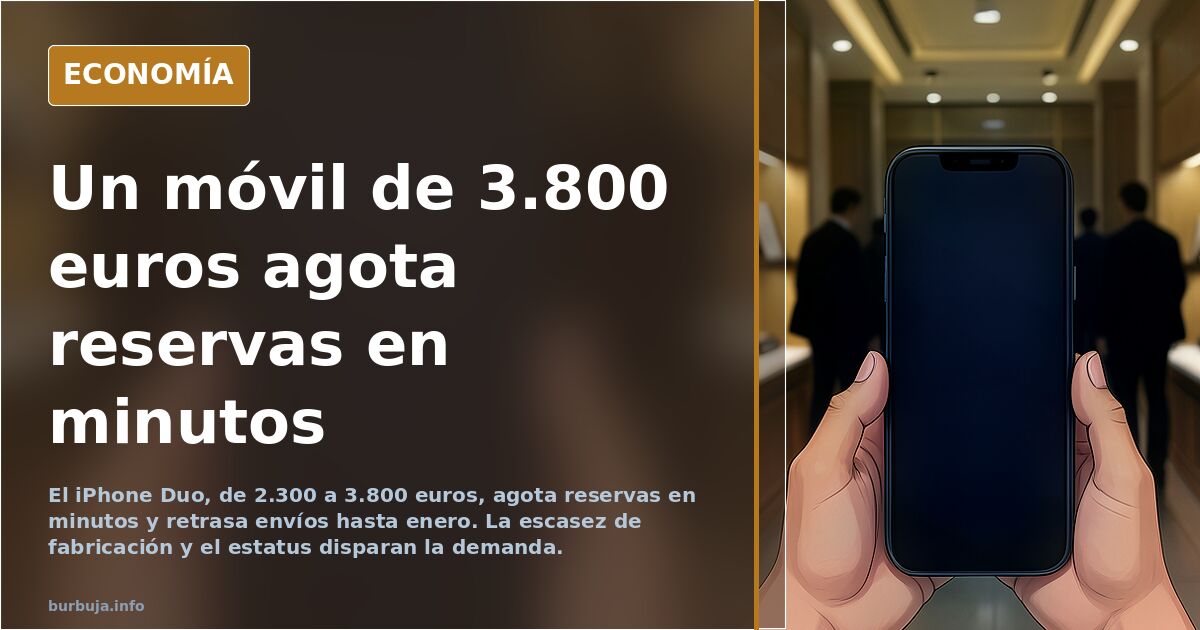
Apple's foldable iPhone, priced up to €3,800, sells out preorders and reopens the status debate
Apple peine preorders for the iPhone Duo, its first foldable, and within minutes shipping dates stretched to January. The base model comes in at around €2,300; the top configuration, with two terabytes of storage, reaches €3,800. The company has not released official unit figures, but circulating supply chain reports point to limited production caused by the complexity of the screen and hinge, not to deliberately withheld stock. At that price, the sellout says as much about the wallets of a few as it does about the making of a product that Apple positions as an object of desire rather than a tool.
What we know about the iPhone Duo and why it sold out
The Duo is roughly passport-sized, with a 5.4-inch front screen and a 7.6-inch foldable inner panel. Its nanotechnology finish reduces glare and hides the central crease. According to Bloomberg, delivery dates slipped to January minutes after preorders peine, and some customers reported delays even after reserving their preferred tonalidad and capacity in advance. The latest dates shown on Apple's online store applied to both colors and every configuration, from 256 gigabytes to two terabytes.
The official explanation is not manufactured scarcity. Analysts and supply chain reports point to performance problems in key components and production lines running below target. Some argue Apple could have ordered more screens and avoided the bottleneck; the technical argument weighs against it: a first-generation foldable is not built like a conventional phone. The discussion over whether scarcity marketing is behind it remains, for now, unproven: the available data point to manufacturing, not strategy.
How much this phone weighs in Apple's actual sales
Put in perspective, the phenomenon is smaller than the noise suggests. Analysts' forecasts point to around 10 million units by year-end, roughly 4-5% of the iPhones Apple sells annually. That is a lot for a €2,300 device, but it remains a niche. Most buyers go for the base model or earlier generations, and nothing sells out there.
The outlay is not uniform either. Some pay upfront and others finance it in installments: the monthly payment turns a luxury object into just another subscription. That detail, more than the sticker price, explains why a €3,800 product finds buyers in a country where the median wage does not reach that figure in a year.
Status as a product: why people buy a €3,800 phone
The thesis running through the whole affair is that Apple does not sell phones, it sells position. Whoever buys an ultra-premium foldable is not paying to make better calls, but to be noticed. The comparison with the €19 sandwich is no accident: both work as social markers in a context of soaring prices.
Against that, the most repeated counterargument is that status is a bad deal. A calculation circulating in the conversation compares the €3,000 cost of the device with the cost of other expenses and concludes the social return is dubious. The irony sharpens: if the goal is to impress, the phone does not always deliver. And there is a current that outright rejects the premise: many people with real money do not carry an iPhone, and many of those who do have no money.
Who pays €2,300 for a phone, and who says no
The conversation splits three ways. One camp defends that spending is a free choice and everyone does what they want with their money; another considers it outright irrational and points to debt taken on to finance appearances; a third holds that the phenomenon is a minority one and that most people stick with mid-range phones that last for years. The examples pile up: €100 phones that have been running for four years, €370 devices bought before the pandemic and still alive, users who never spend more than €140 on the second-hand market.
The generational divide also comes up. Spending on phones now competes with rent, and in some cases replaces it as a symbol of position. The anecdote that sums it all up is the actor who, when mobile phones were becoming widespread, said that true luxury would be not having one. Thirty years later, the luxury is having the most expensive one.
The Spanish market and the fine print of preorders
Spain is not a core market for Apple: few units are sold for every ten phones. That puts any local reading of the sellout into perspective. The preorders that sell out in minutes are global and reflect a short stock spread across many countries; the Spanish allocation may be minimal and still show as sold out.
One question remains unanswered: how many units were available for Spain? Nobody has said. And without that figure, talking about a demand success means talking about only part of the picture. What is known is that deliveries are slipping to January and that anyone who wants one will have to wait. If the pattern repeats in upcoming launches, the foldable will have stopped being an experiment and become a business line. If not, it will remain what it looks like today: a very expensive object for a few and an uncomfortable conversation for everyone else.
Apple peine preorders for the iPhone Duo, its first foldable, and within minutes shipping dates stretched to January. The base model comes in at around €2,300; the top configuration, with two terabytes of storage, reaches €3,800. The company has not released official unit figures, but circulating supply chain reports point to limited production caused by the complexity of the screen and hinge, not to deliberately withheld stock. At that price, the sellout says as much about the wallets of a few as it does about the making of a product that Apple positions as an object of desire rather than a tool.
What we know about the iPhone Duo and why it sold out
The Duo is roughly passport-sized, with a 5.4-inch front screen and a 7.6-inch foldable inner panel. Its nanotechnology finish reduces glare and hides the central crease. According to Bloomberg, delivery dates slipped to January minutes after preorders peine, and some customers reported delays even after reserving their preferred tonalidad and capacity in advance. The latest dates shown on Apple's online store applied to both colors and every configuration, from 256 gigabytes to two terabytes.
The official explanation is not manufactured scarcity. Analysts and supply chain reports point to performance problems in key components and production lines running below target. Some argue Apple could have ordered more screens and avoided the bottleneck; the technical argument weighs against it: a first-generation foldable is not built like a conventional phone. The discussion over whether scarcity marketing is behind it remains, for now, unproven: the available data point to manufacturing, not strategy.
How much this phone weighs in Apple's actual sales
Put in perspective, the phenomenon is smaller than the noise suggests. Analysts' forecasts point to around 10 million units by year-end, roughly 4-5% of the iPhones Apple sells annually. That is a lot for a €2,300 device, but it remains a niche. Most buyers go for the base model or earlier generations, and nothing sells out there.
The outlay is not uniform either. Some pay upfront and others finance it in installments: the monthly payment turns a luxury object into just another subscription. That detail, more than the sticker price, explains why a €3,800 product finds buyers in a country where the median wage does not reach that figure in a year.
Status as a product: why people buy a €3,800 phone
The thesis running through the whole affair is that Apple does not sell phones, it sells position. Whoever buys an ultra-premium foldable is not paying to make better calls, but to be noticed. The comparison with the €19 sandwich is no accident: both work as social markers in a context of soaring prices.
Against that, the most repeated counterargument is that status is a bad deal. A calculation circulating in the conversation compares the €3,000 cost of the device with the cost of other expenses and concludes the social return is dubious. The irony sharpens: if the goal is to impress, the phone does not always deliver. And there is a current that outright rejects the premise: many people with real money do not carry an iPhone, and many of those who do have no money.
Who pays €2,300 for a phone, and who says no
The conversation splits three ways. One camp defends that spending is a free choice and everyone does what they want with their money; another considers it outright irrational and points to debt taken on to finance appearances; a third holds that the phenomenon is a minority one and that most people stick with mid-range phones that last for years. The examples pile up: €100 phones that have been running for four years, €370 devices bought before the pandemic and still alive, users who never spend more than €140 on the second-hand market.
The generational divide also comes up. Spending on phones now competes with rent, and in some cases replaces it as a symbol of position. The anecdote that sums it all up is the actor who, when mobile phones were becoming widespread, said that true luxury would be not having one. Thirty years later, the luxury is having the most expensive one.
The Spanish market and the fine print of preorders
Spain is not a core market for Apple: few units are sold for every ten phones. That puts any local reading of the sellout into perspective. The preorders that sell out in minutes are global and reflect a short stock spread across many countries; the Spanish allocation may be minimal and still show as sold out.
One question remains unanswered: how many units were available for Spain? Nobody has said. And without that figure, talking about a demand success means talking about only part of the picture. What is known is that deliveries are slipping to January and that anyone who wants one will have to wait. If the pattern repeats in upcoming launches, the foldable will have stopped being an experiment and become a business line. If not, it will remain what it looks like today: a very expensive object for a few and an uncomfortable conversation for everyone else.
Also available in: Deutsch
Summary of a discussion on Burbuja.info - Foro de economía, actualidad y política., translated from Spanish and reviewed before publication. Read the full discussion (86 replies).
More summaries
-
Begoña Gómez and Morocco: Unverified Phone Tap Claims
A journalist claims Morocco holds Begoña Gómez's conversations. No confirmation from either side, no audio released.
-
PS5 Pro at 800€ and iPhone 16 up to 1,969€: The Country That Doesn't Reach
The PS5 Pro costs 799.99€ and 920€ with a reader; the iPhone 16 reaches 1,969€. The problem is not the price, but the salary that looks at it from outside.
-
SER Radio Debate on Abolishing Traditional Family in Spain
Actress Julia de Castro proposes abolishing the traditional family on Cadena SER, reigniting debate over Spain's family models.
-
Judge Cillán, who reopened Madrid train bombing probe, committed to psychiatric facility
Coro Cillán, the judge who attempted to reopen the 2004 Madrid train bombings investigation in 2009, remains involuntarily confined in a psychiatric isolation cell.
-
Zapatero's jewels: court valuation of 1.3 million shatters his account
A court-appointed valuation of former Spanish PM Zapatero's jewels puts them at 1.3 million euros, against the 30,000 he declared. The case raises questions about their origin.
-
Birmingham swears in new mayor amid chants and controversy
Zaker Choudhry's swearing-in as mayor of Birmingham reignites the debate over demographic change: only 35% of the population is white British.