
Anti-woke swing is elite narrative, not real change
Media promote an anti-woke shift, but skeptics argue it lacks legal reversals and remains a narrative strategy rather than substantive policy change.
English · Original discussion in Spanish · Published
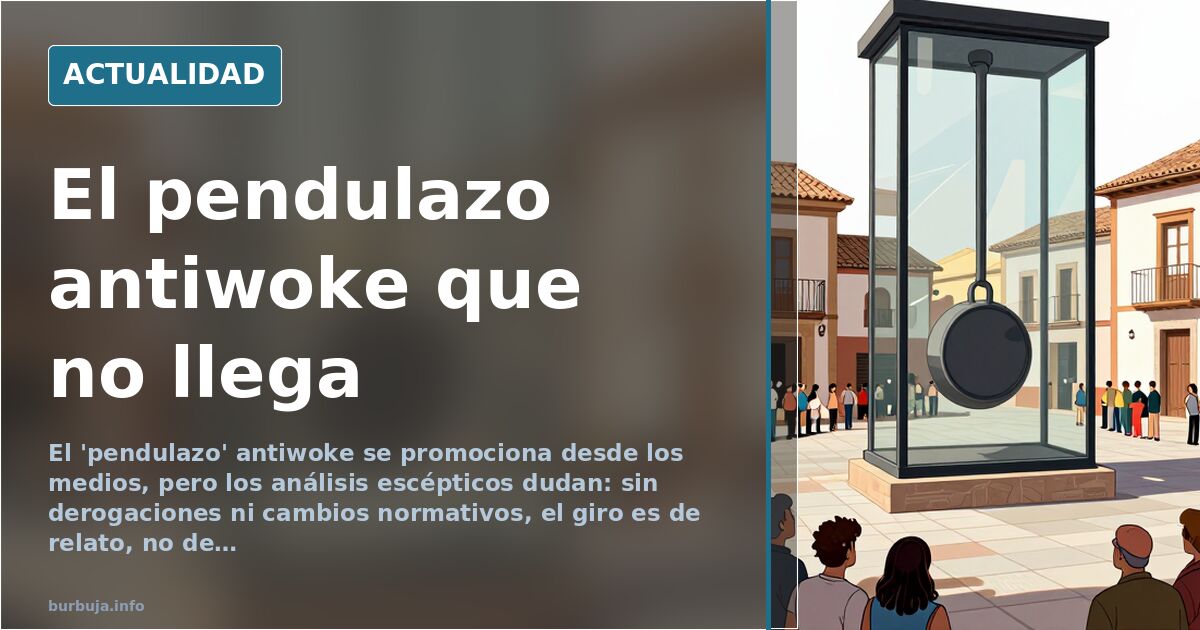
The 'anti-proge swing': A narrative shift, not a regime change
The elite now promotes the end of the proge era. This is not a right-wing victory: it is a board move. The most skeptical analysis suggests that those who championed the pogre framework for years dismantle it when convenient, aiming not to return to the nation-state but to deepen technocratic globalism where corporations and unelected bodies continue to erode parliamentary power. The question is not if the pendulum swings, but how far and in which direction.
Why are media outlets discussing the end of proge now?
The starting point is an uncomfortable observation: for years, whoever held the US presidency was treated by much of the mainstream press with mockery and disdain. Now, the same outlets openly discuss the end of the proge era and promote the shift. According to the dominant reading, this change in tone is not explained by an electoral upset or ideological defeat, but because the agenda favors a hard-handed world.
Some argue the true displacement is not toward the right but toward authoritarianism, and that the cultural wrapper—nationalism, testosterone, identity—is merely packaging for a phase requiring more disciplined societies. The most repeated thesis: balance is not sought; the opposite pendulum swing is desired so everything remains equally unbalanced. The oppressed become oppressors and vice versa; what matters is maintaining the vibration of confrontation.
The pendulum that barely moves: from -5 to -1
The most repeated argument against euphoria is quantitative. If the framework has moved from -5 to -1, it has not crossed to the opposite side: it has corrected an excess without reversing the trend. For a real swing to occur, some analyses claim specific norms would need to be repealed, legal discriminations reversed, and installed common sense changed. To date, the count of such reversals is zero.
Criticism points to a psychological effect: believing one has won leads to deactivation. If conservative voters believe the culture war is won, they do not lift a finger. This is precisely the risk of the swing narrative: it functions as anesthesia. The culture of the "gotcha" moment and triumphant headlines—"so-and-so destroyed," "pogre have lost"—feeds a sense of victory without translating into verifiable regulatory changes.
Culture war as geopolitical cover
Another line of analysis argues that the culture war is a distraction while real conflicts are prepared. While part of the electorate celebrates saying "Merry Christmas" instead of "Happy Holidays," other actors—state and non-state—advance in disputes over territory, resources, and influence without firing a shot. In this reading, the culture war is demoralizing propaganda: it entertains the population while the real board moves elsewhere.
There is also a more uncomfortable hypothesis: that hard conflict is approaching, and for that, a nationalist, testosterone-driven, and identity-focused society is useful. No one will die in the middle of nowhere for LGBTQ+ rights or multiculturalism, but they might for the fatherland. It is argued that within five years, a supposedly feminized society must transform into 300 Spartans. The logistical problem is evident: reversing decades of cultural change in five years is not a decree, it is a fantasy.
The Spanish case: a hurricane arriving as a breeze
In Spain, the skeptical consensus is even more absolute. The lobbies sustaining the pogre framework—climate activists, legislated feminism, immigration policies, inclusive language—are rooted and watered by the political and business class. There is no organized cultural opposition capable of disputing their ground. Add to this a segment of the population in functional illiteracy and a majority that shifts when things shift but clings to the brush, and the result is that the anti-proge hurricane passes through Spain like a breeze.
The most repeated forecast: there will be no swing in Spain at least until 2030. Institutional inertia, control of the narrative, and the absence of an articulated cultural alternative weigh more than any executive order signed across the Atlantic. Decrees are signed in Washington; the norms affecting ordinary citizens are drafted in Madrid.
Authority fallacy mortally wounded
A detected collateral effect: the prestige of "experts" speaking on anything outside their field has deteriorated. Previously, commentators or artists opined on social issues with authority; now that resource sounds stale. The authority fallacy that shielded scientists and creators on social topics is gravely wounded. It is perhaps the only real and measurable change in the entire phenomenon.
The unanswered question remains: if the shift is aesthetic and those in power haven't changed, what is gained by celebrating a victory that doesn't translate into norms? The answer, for now, is that time is gained. And in politics, time is the most valuable resource.
The elite now promotes the end of the proge era. This is not a right-wing victory: it is a board move. The most skeptical analysis suggests that those who championed the pogre framework for years dismantle it when convenient, aiming not to return to the nation-state but to deepen technocratic globalism where corporations and unelected bodies continue to erode parliamentary power. The question is not if the pendulum swings, but how far and in which direction.
Why are media outlets discussing the end of proge now?
The starting point is an uncomfortable observation: for years, whoever held the US presidency was treated by much of the mainstream press with mockery and disdain. Now, the same outlets openly discuss the end of the proge era and promote the shift. According to the dominant reading, this change in tone is not explained by an electoral upset or ideological defeat, but because the agenda favors a hard-handed world.
Some argue the true displacement is not toward the right but toward authoritarianism, and that the cultural wrapper—nationalism, testosterone, identity—is merely packaging for a phase requiring more disciplined societies. The most repeated thesis: balance is not sought; the opposite pendulum swing is desired so everything remains equally unbalanced. The oppressed become oppressors and vice versa; what matters is maintaining the vibration of confrontation.
The pendulum that barely moves: from -5 to -1
The most repeated argument against euphoria is quantitative. If the framework has moved from -5 to -1, it has not crossed to the opposite side: it has corrected an excess without reversing the trend. For a real swing to occur, some analyses claim specific norms would need to be repealed, legal discriminations reversed, and installed common sense changed. To date, the count of such reversals is zero.
Criticism points to a psychological effect: believing one has won leads to deactivation. If conservative voters believe the culture war is won, they do not lift a finger. This is precisely the risk of the swing narrative: it functions as anesthesia. The culture of the "gotcha" moment and triumphant headlines—"so-and-so destroyed," "pogre have lost"—feeds a sense of victory without translating into verifiable regulatory changes.
Culture war as geopolitical cover
Another line of analysis argues that the culture war is a distraction while real conflicts are prepared. While part of the electorate celebrates saying "Merry Christmas" instead of "Happy Holidays," other actors—state and non-state—advance in disputes over territory, resources, and influence without firing a shot. In this reading, the culture war is demoralizing propaganda: it entertains the population while the real board moves elsewhere.
There is also a more uncomfortable hypothesis: that hard conflict is approaching, and for that, a nationalist, testosterone-driven, and identity-focused society is useful. No one will die in the middle of nowhere for LGBTQ+ rights or multiculturalism, but they might for the fatherland. It is argued that within five years, a supposedly feminized society must transform into 300 Spartans. The logistical problem is evident: reversing decades of cultural change in five years is not a decree, it is a fantasy.
The Spanish case: a hurricane arriving as a breeze
In Spain, the skeptical consensus is even more absolute. The lobbies sustaining the pogre framework—climate activists, legislated feminism, immigration policies, inclusive language—are rooted and watered by the political and business class. There is no organized cultural opposition capable of disputing their ground. Add to this a segment of the population in functional illiteracy and a majority that shifts when things shift but clings to the brush, and the result is that the anti-proge hurricane passes through Spain like a breeze.
The most repeated forecast: there will be no swing in Spain at least until 2030. Institutional inertia, control of the narrative, and the absence of an articulated cultural alternative weigh more than any executive order signed across the Atlantic. Decrees are signed in Washington; the norms affecting ordinary citizens are drafted in Madrid.
Authority fallacy mortally wounded
A detected collateral effect: the prestige of "experts" speaking on anything outside their field has deteriorated. Previously, commentators or artists opined on social issues with authority; now that resource sounds stale. The authority fallacy that shielded scientists and creators on social topics is gravely wounded. It is perhaps the only real and measurable change in the entire phenomenon.
The unanswered question remains: if the shift is aesthetic and those in power haven't changed, what is gained by celebrating a victory that doesn't translate into norms? The answer, for now, is that time is gained. And in politics, time is the most valuable resource.
Summary of a discussion on Burbuja.info - Foro de economía, actualidad y política., translated from Spanish and reviewed before publication. Read the full discussion (189 replies).
More summaries
-
Spain's 'La bola negra' sparks culture war with €4.7M opening
'La bola negra' grosses €4.7 million in its first weekend and divides Spain between critical praise and accusations of propaganda and historical sectarianism.
-
Spain's Summer Cultural War: Provocation vs. Freedom
Spain's summer streets spark debate over women's fashion, highlighting tensions between tradition, personal freedom, and public display.
-
Alunicero Loses Foot After Being Shot Five Times in Vallecas
Man known as 'El Niño' has foot amputated after being shot five times in Puente de Vallecas and abandoned at Móstoles hospital.
-
Viral Video of Spanish Party Podemos Candidate Sparks Debate
A viral video featuring a woman at a Podemos event sparks online debate over authenticity, with users comparing her to fictional characters amid no official confirmation.
-
Spain ranks tenth globally in IQ, but online test data is skewed
Spain appears tenth worldwide in an online IQ test, though the site admits participants do not represent the general population.
-
Right-wing workers: Why the left no longer understands class voting
Why a growing part of the working class votes right or far-right: Gramsci's shift, tax anger, and 1975 unemployment data.