
Analysis: Trump’s Iran remarks hint at nuclear option
An analysis suggests Trump’s Iran comments imply nuclear use after conventional strikes failed. Congress debates War Powers Act.
English · Original discussion in Spanish · Published
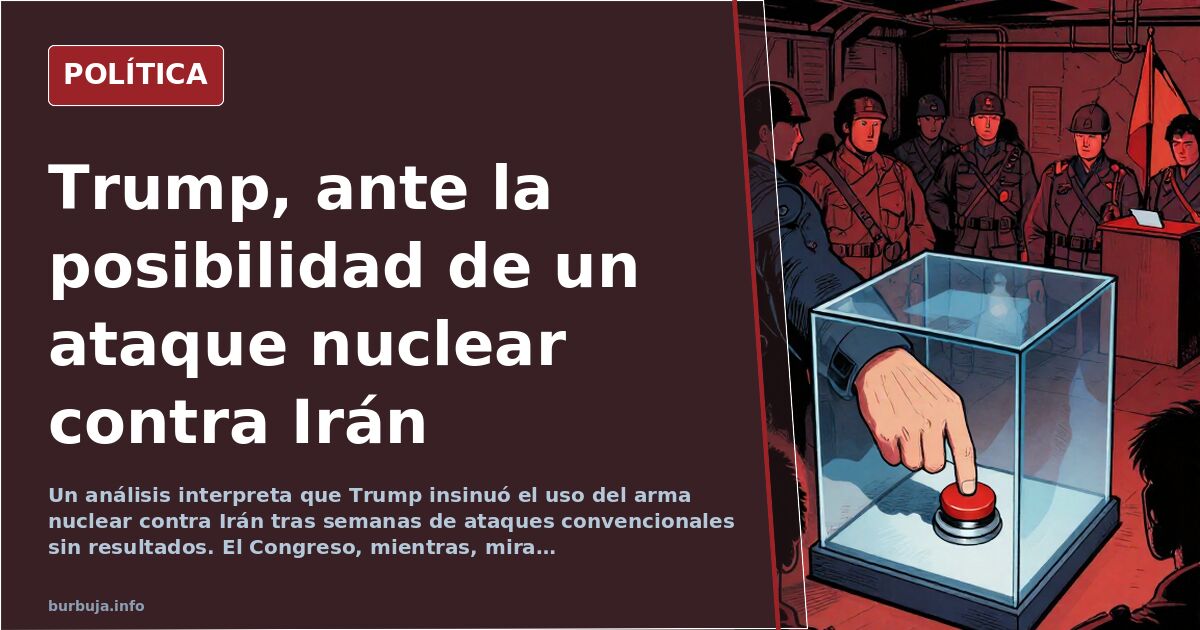
Analysis: Trump’s Iran remarks hint at nuclear option
Donald Trump has triggered alarms with statements on Iran that sound like an existential threat. The analysis suggests the US president spoke of a "civilization dying tonight," language interpreted as non-conventional. If Tomahawk missiles and bunker-busters failed, what remains?
The debate extends beyond rhetoric. The US has struck Iranian infrastructure for weeks without destroying key targets or forcing surrender. Some argue only nuclear weapons could cause such devastation quickly. The War Powers Act, requiring congressional approval, appears ignored.
What Trump said and why it’s seen as a nuclear threat
The core issue is a phrase Trump used during the Iran escalation. The dominant reading is not campaign rhetoric but a warning of extreme consequences, pointing directly to the nuclear arsenal.
The logic is simple: if conventional means are insufficient, the only tool for that result is the bomb. There is no other. In diplomatic language, this is vertical escalation.
Why conventional attacks failed
The US has attacked Iran for weeks using Tomahawk missiles and bunker-busters, the heaviest conventional arsenal. The result: no key infrastructure destroyed, no regime forced to bend.
This relative failure fuels suspicion. If the non-conventional arsenal isn’t enough, what remains? The blunt answer is nuclear. It’s an unpleasant conclusion, but it trinc from the facts.
Congress and the War Powers Act: control that fails
Institutional criticism accuses Congress of failing its constitutional role, allowing the president to act without war authorization. The War Powers Act, designed to prevent unilateral adventures, is cited as ignored in practice.
The result is one man can escalate conflict freely. This concentration of decision-making without effective checks turns aggressive rhetoric into real risk.
Iran responds: retaliation against US infrastructure
Iran has warned it will attack US infrastructure if attacked. The conflict could spread beyond the region. No diplomatic advances are in sight. The US demands surrender; Iran rejects this outright.
This dead-end standoff breeds escalation. With no diplomatic channel and maximalist positions, any spark could ignite the powder keg.
What happens if nuclear weapons are used
The scenario has global consequences. Such an attack would isolate the US, trigger major war, and cause worldwide economic fallout in energy and food. Even allies might sever ties.
A more uncomfortable scenario: military refusal to execute nuclear orders. This would open a constitutional crisis and severe internal instability. The analyst urges political pressure before it’s too late. The moment is critical and dangerous.
The analysis stops here: at the point where the only visible solution is political pressure, with no signs it will happen.
Donald Trump has triggered alarms with statements on Iran that sound like an existential threat. The analysis suggests the US president spoke of a "civilization dying tonight," language interpreted as non-conventional. If Tomahawk missiles and bunker-busters failed, what remains?
The debate extends beyond rhetoric. The US has struck Iranian infrastructure for weeks without destroying key targets or forcing surrender. Some argue only nuclear weapons could cause such devastation quickly. The War Powers Act, requiring congressional approval, appears ignored.
What Trump said and why it’s seen as a nuclear threat
The core issue is a phrase Trump used during the Iran escalation. The dominant reading is not campaign rhetoric but a warning of extreme consequences, pointing directly to the nuclear arsenal.
The logic is simple: if conventional means are insufficient, the only tool for that result is the bomb. There is no other. In diplomatic language, this is vertical escalation.
Why conventional attacks failed
The US has attacked Iran for weeks using Tomahawk missiles and bunker-busters, the heaviest conventional arsenal. The result: no key infrastructure destroyed, no regime forced to bend.
This relative failure fuels suspicion. If the non-conventional arsenal isn’t enough, what remains? The blunt answer is nuclear. It’s an unpleasant conclusion, but it trinc from the facts.
Congress and the War Powers Act: control that fails
Institutional criticism accuses Congress of failing its constitutional role, allowing the president to act without war authorization. The War Powers Act, designed to prevent unilateral adventures, is cited as ignored in practice.
The result is one man can escalate conflict freely. This concentration of decision-making without effective checks turns aggressive rhetoric into real risk.
Iran responds: retaliation against US infrastructure
Iran has warned it will attack US infrastructure if attacked. The conflict could spread beyond the region. No diplomatic advances are in sight. The US demands surrender; Iran rejects this outright.
This dead-end standoff breeds escalation. With no diplomatic channel and maximalist positions, any spark could ignite the powder keg.
What happens if nuclear weapons are used
The scenario has global consequences. Such an attack would isolate the US, trigger major war, and cause worldwide economic fallout in energy and food. Even allies might sever ties.
A more uncomfortable scenario: military refusal to execute nuclear orders. This would open a constitutional crisis and severe internal instability. The analyst urges political pressure before it’s too late. The moment is critical and dangerous.
The analysis stops here: at the point where the only visible solution is political pressure, with no signs it will happen.
Summary of a discussion on Burbuja.info - Foro de economía, actualidad y política., translated from Spanish and reviewed before publication. Read the full discussion (196 replies).
More summaries
-
Trump vs Harris: A Close Race in the 2024 US Election
Analysis of the Trump vs Harris contest in the US: election trends, vote count data, and voter polarization.
-
Spain should become the 51st US state, some argue
The idea of Spain becoming the 51st US state arises from perceived political and economic instability, seeking external protection against internal divisions.
-
Madrid train bombings: missing evidence fuels conspiracy theories
191 dead, 1,858 injured and lost forensic evidence: the enduring controversy and conspiracy theories surrounding the 2004 Madrid train bombings.
-
Morocco Forms Committee to Annex Ceuta and Melilla
Reports indicate Morocco established a committee to claim sovereignty over Spanish enclaves, prompting military reinforcements amid migration tensions.
-
Spain's Election Integrity Under Scrutiny
Castilla y León's expat voter roll exceeds five provinces, fueling distrust ahead of the Nov 29 general elections.
-
PSOE Wins with Voters Aged 65-74, Vox Leads Among Under-34s in Spain
In Spain, PSOE would secure 220 seats if only voters aged 65-74 participated, while Vox would win among those under 34.