
Amenábar's Cervantes Film Sparks Historical Controversy in Spain
Amenábar's new film depicts a homoerotic relationship between Cervantes and an Algerian sultan, igniting debates on historical accuracy, public subsidies, and box office success.
English · Original discussion in Spanish · Published
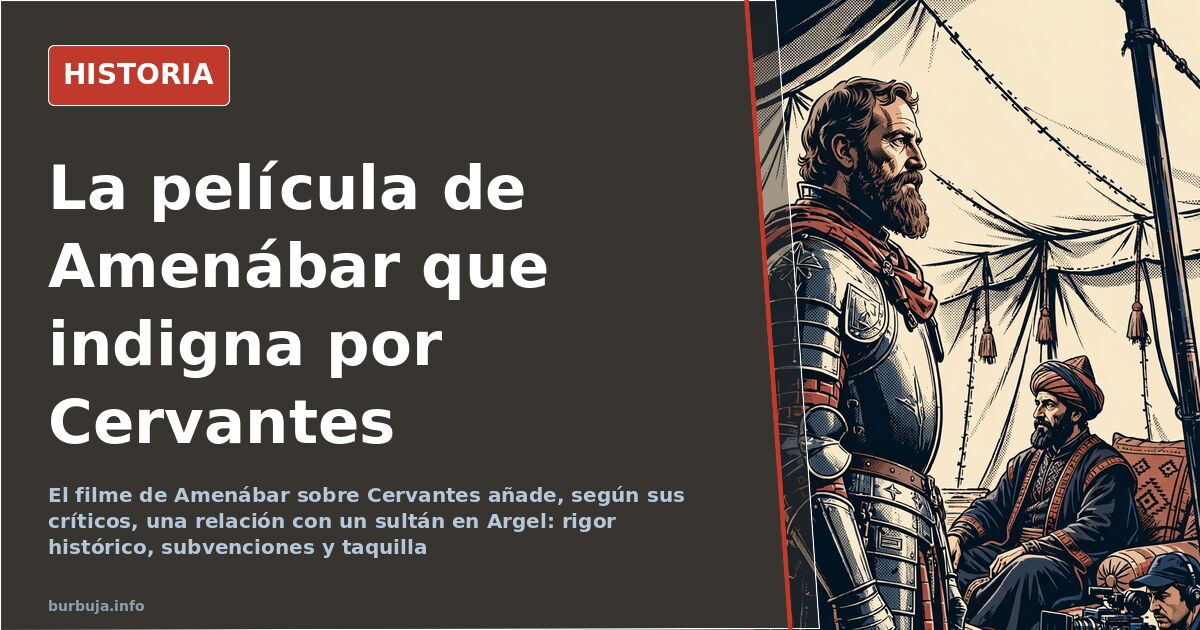
Cervantes and the Sultan: Amenábar's Controversial Film
Miguel de Cervantes was wounded in his left hand at the Battle of Lepanto, captured, and endured a long captivity in Algiers from which he attempted to escape at least four times. That is the documented biography. The film Alejandro Amenábar has dedicated to the writer adds, according to critics circulating since its release, something no document supports: a homoerotic relationship with a sultan during his captivity.
The issue has uncovered three discussions at once. How far artistic license can go when portraying a national symbol, whether it is acceptable to finance it with public money, and why the reading of desire between men continues to inflame passions when applied to Cervantes but not to Shakespeare or Julius Caesar.
What really peine between Cervantes and the Sultan of Algiers?
Nothing that can be proven. The writer was imprisoned and taken to Algiers, where he spent years in captivity before being rescued. Documents record his failed escapes and his refusal to renounce his faith, not a sentimental bond with his captor. Some argue, with simple logic, that if the relationship had been real and consensual, trying to flee four times is a strange way to demonstrate it. The film, in any case, is fiction: its starting point is not an archive, but a dramatic hypothesis.
Documentation errors criticized in the film
The most repeated criticism has nothing to do with love, but with the hand. The film shows Cervantes without it, and that is inaccurate: what he lost at Lepanto was the use of his left hand, not the limb itself. A tiny detail that, however, summarizes the underlying complaint. If they fail on verifiable facts, why should the viewer believe the rest?
Added to this is the portrayal of the writer himself. Critics note that Cervantes is not in a position to defend himself. The looming question is uncomfortable: why rewrite the life of someone dead for four centuries instead of someone with lawyers?
Historical cinema funded by millions in public subsidies
Here the debate becomes economic. When a production is sustained by millions of euros in public aid, the author's license ceases to be solely their own. This is the argument running through much of the criticism: those who receive taxpayer money cannot hide behind creative freedom to rewrite someone who cannot respond. The usual response —that fiction does not answer to archives— clashes with a simple question: then, why does public money?
Shakespeare, Julius Caesar, and homoeroticism in the classics
The documentary precedent exists and occupies much of the debate. Shakespeare's Sonnets, addressed to the so-called Fair Youth, contain expressions of desire toward a young man. Researchers such as Sir Stanley Wells and Paul Edmondson have reorganized the 154 sonnets and maintain that the language directed at male subjects leaves no doubt about the author's bisensbi.
The theater of the time adds context: women were prohibited from participating, so Juliet was played by a young boy with a feminine face. And regarding Julius Caesar, the mockery of him being the man of all women and the woman of all men circulated in his time, as those trinc the matter recall. With Alexander the Great and Hephaestion, there are conflicting versions: one participant claims he enjoyed the company of his cavalry companions while another denies it. The difference, they say, is that all that has centuries of literature behind it, whereas Cervantes does not.
The precedent of Agora and Amenábar's relationship with history
This is not the first time the director has tackled a historical figure. Agora, his approach to a female figure from Antiquity, was already accused of lacking rigor and attributing acts to the protagonist that she never committed. Even the most consulted online encyclopedia dedicates a section to debunking the film due to its liberties, as one participant recalls. With that track record, distrust of the new film comes with backing.
The data that disorients
While some call for a boycott and others defend fiction, the box office does what it always does: it works. The film is performing well in theaters, according to one of the participants in the debate. An uncomfortable detail for those who assure that no one wanted to see it and that the public has ignored it. Controversy, subsidy, and tickets sold. Three things that rarely go separately.
Miguel de Cervantes was wounded in his left hand at the Battle of Lepanto, captured, and endured a long captivity in Algiers from which he attempted to escape at least four times. That is the documented biography. The film Alejandro Amenábar has dedicated to the writer adds, according to critics circulating since its release, something no document supports: a homoerotic relationship with a sultan during his captivity.
The issue has uncovered three discussions at once. How far artistic license can go when portraying a national symbol, whether it is acceptable to finance it with public money, and why the reading of desire between men continues to inflame passions when applied to Cervantes but not to Shakespeare or Julius Caesar.
What really peine between Cervantes and the Sultan of Algiers?
Nothing that can be proven. The writer was imprisoned and taken to Algiers, where he spent years in captivity before being rescued. Documents record his failed escapes and his refusal to renounce his faith, not a sentimental bond with his captor. Some argue, with simple logic, that if the relationship had been real and consensual, trying to flee four times is a strange way to demonstrate it. The film, in any case, is fiction: its starting point is not an archive, but a dramatic hypothesis.
Documentation errors criticized in the film
The most repeated criticism has nothing to do with love, but with the hand. The film shows Cervantes without it, and that is inaccurate: what he lost at Lepanto was the use of his left hand, not the limb itself. A tiny detail that, however, summarizes the underlying complaint. If they fail on verifiable facts, why should the viewer believe the rest?
Added to this is the portrayal of the writer himself. Critics note that Cervantes is not in a position to defend himself. The looming question is uncomfortable: why rewrite the life of someone dead for four centuries instead of someone with lawyers?
Historical cinema funded by millions in public subsidies
Here the debate becomes economic. When a production is sustained by millions of euros in public aid, the author's license ceases to be solely their own. This is the argument running through much of the criticism: those who receive taxpayer money cannot hide behind creative freedom to rewrite someone who cannot respond. The usual response —that fiction does not answer to archives— clashes with a simple question: then, why does public money?
Shakespeare, Julius Caesar, and homoeroticism in the classics
The documentary precedent exists and occupies much of the debate. Shakespeare's Sonnets, addressed to the so-called Fair Youth, contain expressions of desire toward a young man. Researchers such as Sir Stanley Wells and Paul Edmondson have reorganized the 154 sonnets and maintain that the language directed at male subjects leaves no doubt about the author's bisensbi.
The theater of the time adds context: women were prohibited from participating, so Juliet was played by a young boy with a feminine face. And regarding Julius Caesar, the mockery of him being the man of all women and the woman of all men circulated in his time, as those trinc the matter recall. With Alexander the Great and Hephaestion, there are conflicting versions: one participant claims he enjoyed the company of his cavalry companions while another denies it. The difference, they say, is that all that has centuries of literature behind it, whereas Cervantes does not.
The precedent of Agora and Amenábar's relationship with history
This is not the first time the director has tackled a historical figure. Agora, his approach to a female figure from Antiquity, was already accused of lacking rigor and attributing acts to the protagonist that she never committed. Even the most consulted online encyclopedia dedicates a section to debunking the film due to its liberties, as one participant recalls. With that track record, distrust of the new film comes with backing.
The data that disorients
While some call for a boycott and others defend fiction, the box office does what it always does: it works. The film is performing well in theaters, according to one of the participants in the debate. An uncomfortable detail for those who assure that no one wanted to see it and that the public has ignored it. Controversy, subsidy, and tickets sold. Three things that rarely go separately.
Summary of a discussion on Burbuja.info - Foro de economía, actualidad y política., translated from Spanish and reviewed before publication. Read the full discussion (159 replies).
More summaries
-
The Battle Order That Broke the Siege of the Alcázar of Toledo
Four groupings, 13,000 militiamen, and a machine-gun battalion: the battle order that broke the siege of the Alcázar of Toledo 90 years ago.
-
ETA and GAL: two arms of the same Gladio network in Spain
Investigation linking ETA and GAL as arms of the same NATO Gladio network, with drug trafficking funding and CIA control.
-
Alicante hits 2 million residents, reigniting rivalry with Valencia
Alicante surpasses 2 million inhabitants, reopening tensions with Valencia over airports, GDP, language, and a proposed Levante region.
-
Viral Genetic Map of the Reconquista Lacks Source
A genetic map attributed to Oxford and Santiago circulates without a source. A real Oxford study exists but does not support the map's claims.
-
Why Anatolia Speaks Turkish: The Assimilation Thesis
Scholars argue most modern Anatolians descend from locals who switched languages, not Central Asian migrants.
-
Gibraltar 1940: Franco's Rejection of Hitler's Failed Plan
Closing Gibraltar in 1940 wouldn't have strangled the UK, as convoys used the Cape route. Spain would have become the Allies' first target.