
Álvaro Prieto: Electrocution theory clashes with dead train
Preliminary autopsy suggests electrocution, but Álvaro Prieto's train was disconnected. The technical detail remains unexplained.
English · Original discussion in Spanish · Published
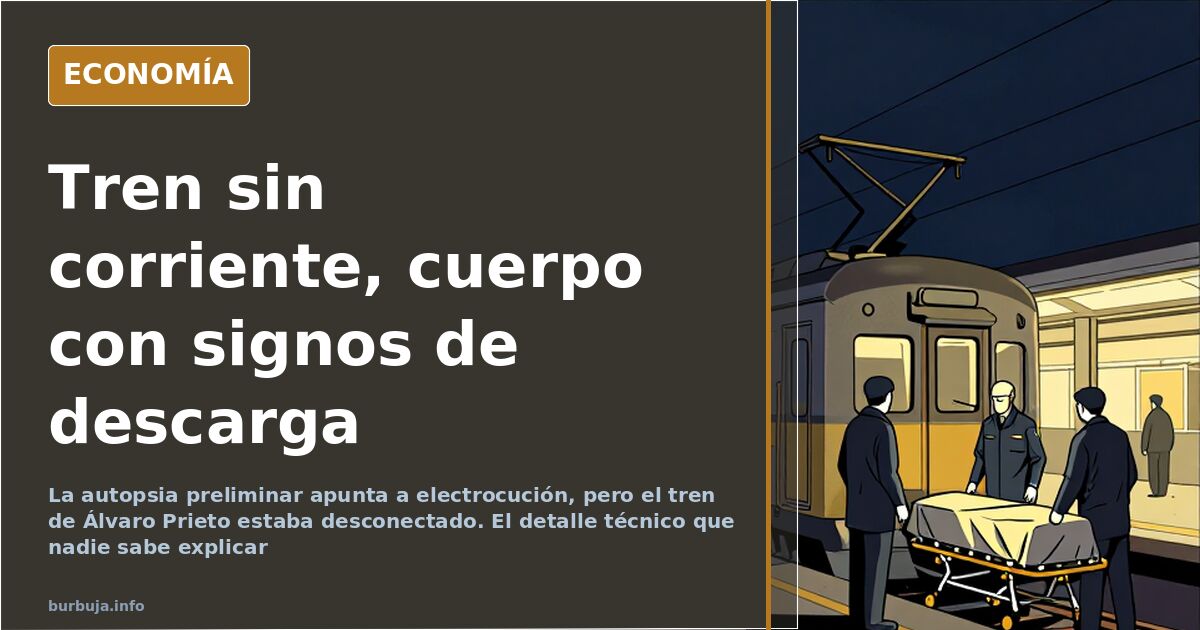
Álvaro Prieto: The catenary, the stopped train and the theories
The train was not moving. It was disconnected, without current. And yet, the preliminary autopsy of the young man found between two of its cars points to electrocution. That contradiction — a convoy without voltage and a body with signs of discharge — is what sustains all theories about Álvaro Prieto's death and explains why, lacking official data, everyone fills in the blanks their own way.
It is worth separating two things that the noise mixes relentlessly: what is established and what is conjectured. It is established that the body appeared between two cars. It is established that there are testimonies describing a flight and a call to his mother — "Mom, I am alone and they want to kill me." And it is established that the train did not have to be energized at that moment. Everything else, for now, is interpretation.
Can a train without current cause electrocution?
The short answer is yes, but only if there is voltage where there shouldn't be. The catenary — the cables running through the air over the tracks — is a bare conductor: touching it is fatal while it is powered. The pantograph, that T-shaped piece the train raises to hook onto it, is what connects the convoy to the grid. If the train has been stopped for months, logically the pantograph should be lowered and the whole assembly isolated.
That is the crux of the matter. Between car and car run insulated cables — for water, heating, light and control — which theoretically do not kill whoever touches them, much less if the train receives no current. The doubt running through the analysis is whether any of those elements could remain charged with the convoy off. The technical explanation being handled points to distributed traction: modern trains no longer carry a single tractor head, but motors distributed throughout the composition. That multiplies the wiring and, with it, the points where something can still have voltage.
The discussion drifted, as usual, to bar-stool physics: whether voltage or intensity kills, whether it is amps or electrons. What causes damage is the passage of current through the body and depends on intensity and contact time, not a single magnitude. That nuance was lost among banter and quips.
The pursuit narrative: between 20 and 30 youths
The cited testimonies speak of between 20 and 30 youths from marginalized environments trinc the boy that night. According to that same version, he called his mother to tell her he was alone and they wanted to kill him. The previous night, always according to the circulating account, he would have had an altercation at a party over a young woman.
None of that is confirmed. And it is worth saying clearly, because the leap from "a group pursued him" to "a group killed him" is precisely the shortcut that turns a tragedy into a biased narrative. That witnesses exist describing a scene does not equate to a closed reconstruction of what peine.
Where the body appeared: a bridge with traffic mid-morning
The body was not in an secluded garage, but next to a bridge with two lanes per direction and continuous traffic, in broad daylight, in a spot far from the station but close to buildings. Some argue it is the worst imaginable place to dispose of a body unseen; others reply that, precisely for that reason, it is a place where no one pays attention.
That detail opens the door to the transfer hypothesis: that the boy died elsewhere and his body ended up placed there afterwards. It is a conjecture, not a fact. Those who defend it rely on the site's visibility just as much as those who dismiss it.
The search, Renfe and Adif: what failed before the autopsy
The convoy belonged to Renfe; the infrastructure belongs to Adif. The most repeated criticism does not point to the death itself, but to the search: the body was where it appeared without anyone locating it earlier. Part of the analysis attributes this to lack of coordination between operator and infrastructure manager; another frames it in a broader problem, that of a station no one thoroughly checks when someone goes missing.
The underlying reproach is different: who decides what is told and when. Much of the anger is not against the facts, but against how they reached the public — in dribs and drabs and with conventional media trailing behind.
The media narrative and the repeated figure
There is a number that appears again and again: 400,000 journalists in Spain. The reproach is not to the profession, but to the result. If there are so many, how is it that the decisive technical detail — electrocution — came out first via alternative channels than newsrooms? It is also argued that the media waited for someone else to publish it before moving, antiestéticaring legal consequences if the data turned out false.
In parallel, versions circulate without any technical backing — body transfers, impossible causes, health hoaxes — which should be left out of the equation. Mixing them with the serious debate about current is what prevents distinguishing a reasonable doubt from a fantasy.
What remains unknown
If the final autopsy confirms electrocution, it will remain to explain where the current came from. If it does not confirm it, the entire narrative must be rebuilt from scratch. And in either scenario, the question that no technical expertise resolves — how the boy got to that train and with whom — will remain open. Most likely, the answer will arrive late, in sips, and with half of today's noise already converted into certainty.
Also available in: Deutsch
Summary of a discussion on Burbuja.info - Foro de economía, actualidad y política., translated from Spanish and reviewed before publication. Read the full discussion (205 replies).
More summaries
-
Álvaro Prieto's body found between train cars in Spain
The body of Álvaro Prieto was found between train cars. We examine the search failures and the theories about his cause of death.
-
Viral video at a RENFE station in Spain sparks security debate
A video of a group taking over a RENFE station in Spain has triggered an intense debate over security, immigration and the official response. No confirmation from Renfe so far.
-
The Elite Education of Tenant Spokespeople Sparks Controversy
Controversy erupts as the elite international education backgrounds of prominent tenant movement spokespeople are revealed, challenging their narrative of precarity.
-
Anthropic's new model: too dangerous for the public
Anthropic launched and pulled its new Claude model within days. Real safety concerns or a paid API strategy? Rumours point in every direction.
-
Las Caldas: loud riverside parties on the Nalón and city hall inaction
Residents of Las Caldas, Oviedo, report mass parties with loudspeakers along the Nalón: groups of 70 people, tents from 10 AM, migraines and municipal inaction.
-
Spain's economy flirts with recession as PMI stays in contraction
The eurozone PMI rose to 49.5 in June but remains in contraction. Tourism and immigration prop up an economy some see on the brink of collapse.