
Altman Promises GPT-5 This Year, AGI by 2025, But Lacks Credible Timeline
Altman forecasts GPT-5 for this year and AGI by 2025. However, the numbers (100 trillion synapses vs. 2 trillion parameters) and employment impact raise doubts.
English · Original discussion in Spanish · Published
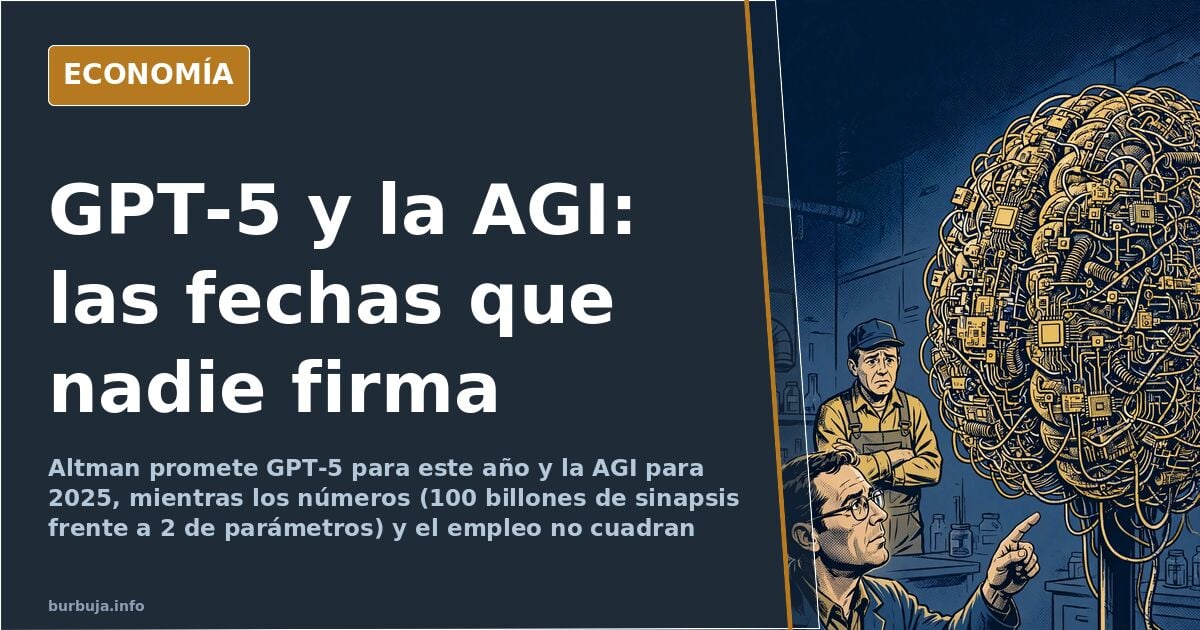
Altman Promises GPT-5 This Year and AGI in 2025: No Credible Deadline
Sam Altman has once again set a date for what no one else has managed to pinpoint: artificial general intelligence (AGI). GPT-5 for this year, AGI for 2025, and a catch-all 'possibly.' The promise comes from OpenAI's CEO and has sparked discussions about technology, employment, and finance. The issue isn't its ambition; it's that it sounds the same as two years ago, with the added detail that the list of missed Octobers on the calendar no longer fits on the wall.
What is AGI and Why the Confusion?
AGI is theoretically an intelligence capable of matching or surpassing humans in any cognitive task. In practice, no one has precisely defined what 'any task' means. That's where the problem begins. There's consensus that GPT-4 is not AGI and that current models falter on tasks a child can solve. The most repeated definition in analyses is that of a synthetic person surpassing the average human, with an uncomfortable addition: if that's the benchmark, a significant portion of the workforce is already outmatched.
The Puzzling Calculation: 100 Trillion Synapses
It's estimated that the human brain has around 100 trillion (100 x 10^12) synapses. Rumors attribute approximately 2 trillion (2 x 10^12) parameters to GPT-4. If GPT-5 multiplies that figure by ten, it would be in the same order of magnitude as a brain. Here's the crucial nuance that undermines the comparison: a biological neuron and an artificial neural network unit are not the same, and human DNA contains only 3 billion bases. Having more parameters doesn't equate to greater intelligence. A detailed breakdown of the two magnitudes, unit by unit, yields a sobering conclusion.
Why Did the AI 'Hype' Emerge Amidst High Interest Rates?
An uncomfortable theory is circulating: the boom in large language models suspiciously coincides with rising interest rates. Just as venture capital was fleeing the tech sector and major companies were absorbing the shock, generative tools proliferated, and money flowed back in. For some, it's pure innovation; for others, it's financial marketing with an expiration date. The parallel with the 'blockchain that was going to replace notaries' and land registrars is on everyone's lips, even though AI is already used daily in real businesses.
"Many People Will Be Laid Off"
The labor impact is where optimism breaks down. The dominant forecast is gradual replacement starting with software: design, management, data administration, project planning, and execution. Sectors with unfilled vacancies are accelerating automation without needing AGI to arrive. Google announced 30,000 layoffs, and some interpreted it as the first bill for this shift. The emerging scenario depicts an idle, arrogant elite, akin to Roman patricians, and a displaced majority, with no clear explanation yet on how the surplus will be distributed.
The Philosophical Frontier: Consciousness, Common Sense, and Gödel's Theorem
The discussion gets tangled when asked if a machine can 'think.' A doctor in the field summarizes it bluntly: machine learning generates millions and solves real problems, but AGI remains science fiction, and much hype is being sold here. Gödel's theorems and Turing machines appear as theoretical barriers: no matter how many rules you input, your system will always leave something out. The operational question is whether AI possesses common sense, and the models themselves answer no: common sense is a set of shared obvious truths, not a comprehension system.
What's Next: MAMBA, Q*, and Other Architectures
While debates continue, technology advances. An architecture called MAMBA, without transformers, handles up to a million tokens and is reportedly five times faster than conventional models. Applied with mixtures of experts (32 in the latest work), it shows promise. On the other end, OpenAI is testing Q*-like reinforcement learning, enabling models to chain reasoning in a tree structure rather than just generating the first response. Altman admitted in an interview with Bill Gates that training solely on language isn't enough: video and other data forms are needed. The shadow of AlphaGo looms: the day the machine learns independently, the game changes.
Where Analysis Stalls
No one disputes that the tool works and is already indispensable in many teams, from IT professionals to journalists and designers. What doesn't add up is the timeline, the definition, or who pays the unemployment bill. Altman has financial interests tied to the announced timeline, which doesn't make him a liar; it makes him a stakeholder. With 2025 on the horizon and the parameter count rising, the pertinent question isn't whether AGI will arrive. It's what will be done with those left behind while it does.
Sam Altman has once again set a date for what no one else has managed to pinpoint: artificial general intelligence (AGI). GPT-5 for this year, AGI for 2025, and a catch-all 'possibly.' The promise comes from OpenAI's CEO and has sparked discussions about technology, employment, and finance. The issue isn't its ambition; it's that it sounds the same as two years ago, with the added detail that the list of missed Octobers on the calendar no longer fits on the wall.
What is AGI and Why the Confusion?
AGI is theoretically an intelligence capable of matching or surpassing humans in any cognitive task. In practice, no one has precisely defined what 'any task' means. That's where the problem begins. There's consensus that GPT-4 is not AGI and that current models falter on tasks a child can solve. The most repeated definition in analyses is that of a synthetic person surpassing the average human, with an uncomfortable addition: if that's the benchmark, a significant portion of the workforce is already outmatched.
The Puzzling Calculation: 100 Trillion Synapses
It's estimated that the human brain has around 100 trillion (100 x 10^12) synapses. Rumors attribute approximately 2 trillion (2 x 10^12) parameters to GPT-4. If GPT-5 multiplies that figure by ten, it would be in the same order of magnitude as a brain. Here's the crucial nuance that undermines the comparison: a biological neuron and an artificial neural network unit are not the same, and human DNA contains only 3 billion bases. Having more parameters doesn't equate to greater intelligence. A detailed breakdown of the two magnitudes, unit by unit, yields a sobering conclusion.
Why Did the AI 'Hype' Emerge Amidst High Interest Rates?
An uncomfortable theory is circulating: the boom in large language models suspiciously coincides with rising interest rates. Just as venture capital was fleeing the tech sector and major companies were absorbing the shock, generative tools proliferated, and money flowed back in. For some, it's pure innovation; for others, it's financial marketing with an expiration date. The parallel with the 'blockchain that was going to replace notaries' and land registrars is on everyone's lips, even though AI is already used daily in real businesses.
"Many People Will Be Laid Off"
The labor impact is where optimism breaks down. The dominant forecast is gradual replacement starting with software: design, management, data administration, project planning, and execution. Sectors with unfilled vacancies are accelerating automation without needing AGI to arrive. Google announced 30,000 layoffs, and some interpreted it as the first bill for this shift. The emerging scenario depicts an idle, arrogant elite, akin to Roman patricians, and a displaced majority, with no clear explanation yet on how the surplus will be distributed.
The Philosophical Frontier: Consciousness, Common Sense, and Gödel's Theorem
The discussion gets tangled when asked if a machine can 'think.' A doctor in the field summarizes it bluntly: machine learning generates millions and solves real problems, but AGI remains science fiction, and much hype is being sold here. Gödel's theorems and Turing machines appear as theoretical barriers: no matter how many rules you input, your system will always leave something out. The operational question is whether AI possesses common sense, and the models themselves answer no: common sense is a set of shared obvious truths, not a comprehension system.
What's Next: MAMBA, Q*, and Other Architectures
While debates continue, technology advances. An architecture called MAMBA, without transformers, handles up to a million tokens and is reportedly five times faster than conventional models. Applied with mixtures of experts (32 in the latest work), it shows promise. On the other end, OpenAI is testing Q*-like reinforcement learning, enabling models to chain reasoning in a tree structure rather than just generating the first response. Altman admitted in an interview with Bill Gates that training solely on language isn't enough: video and other data forms are needed. The shadow of AlphaGo looms: the day the machine learns independently, the game changes.
Where Analysis Stalls
No one disputes that the tool works and is already indispensable in many teams, from IT professionals to journalists and designers. What doesn't add up is the timeline, the definition, or who pays the unemployment bill. Altman has financial interests tied to the announced timeline, which doesn't make him a liar; it makes him a stakeholder. With 2025 on the horizon and the parameter count rising, the pertinent question isn't whether AGI will arrive. It's what will be done with those left behind while it does.
Summary of a discussion on Burbuja.info - Foro de economía, actualidad y política., translated from Spanish and reviewed before publication. Read the full discussion (503 replies).
More summaries
-
AI Uncovers Time-Wasting Tasks in the Workday
A case study: five minutes of AI, 25 of phone use, same work done. AI doesn't destroy jobs; it reveals unnecessary tasks.
-
Euthanasia in Old Age: Autonomy vs. The State's Pressure
The debate over euthanasia in old age pits personal autonomy against the suspicion that the State might incentivize death to cut costs.
-
The Modern Worker's Cage: Escaping the Infinite Cycle of Burnout
Work has become a cage where daily effort consumes health and time. Discover why we push ourselves so hard and how to break the cycle.
-
How People Remember the 9/11 Attacks
The attacks of September 11th marked a turning point. Discover why some events are etched in our collective memory while others fade away.
-
Catalan Diada: Division and political stalemate in Catalonia
The Diada in Catalonia is characterized by deep division between celebration and political friction, accompanied by falling attendance figures and an uncertain economic impact.
-
Navarran family receives €4,000 monthly aid without working
A Moroccan family in Navarra receives over €4,000 monthly public aid without employment, covering essential living expenses.