
Alicante farm rescue: one-month-old rabbit and cat dynamics
A month-old rabbit cannot survive alone in an Alicante orchard. Debate on feeding, cow milk risks, and cohabitation with cats.
English · Original discussion in Spanish · Published
Alicante farm rescue: one-month-old rabbit and cat dynamics
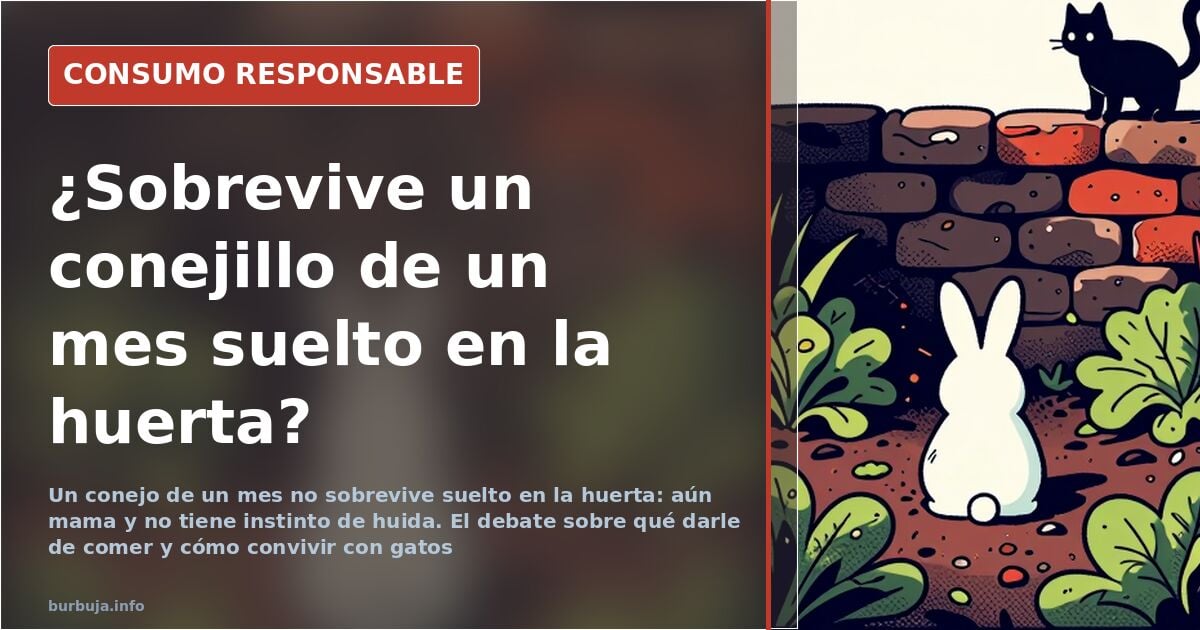
A rabbit barely a month old does not survive alone in an orchard. This is the conclusion reached when someone asks if it is advisable to release into the countryside an animal that, at that age, is still nursing. The scenario is presented by a person from the huerta de Alicante (traditional agricultural area) whose cat brought the kit as an offering: the animal runs around the patio, screams when caught by other cats, and bites the hand that feeds it. In between, there is an already incurred cost of 46 euros for a wasp sting suffered by another household pet, and the suspicion that coexistence between domestic predators and wild prey allows no half-measures.
Can a one-month-old rabbit survive if released in the field?
No. A rabbit of that age still depends on maternal milk and has not developed either the flight instinct or the ability to seek shelter. The repeated recommendation is clear: if released, do so in areas with warrens and away from main roads, yet even then the odds are minimal. The alternative considered is keeping it in a warm, safe place, with hay, fresh vegetables, and water, and consulting a veterinarian if diarrhea appears. Some argue that the animal in the photo is already more than a month old, perhaps three months, and therefore the margin for maneuvering is greater. The discrepancy regarding age is, in reality, the discrepancy regarding everything else.
Cow milk, melon, and endive: what does a rabbit eat?
Cow milk is a mistake. It does not work diluted or undiluted, and the risk is diarrhea that dehydrates the animal until it dies. The warning comes with a specific case: neighbors who give milk even to birds. What works is hay —essential to prevent teeth overgrowth—, raw vegetables, fruit in moderation, and pellets, which are not expensive. Dandelion appears as a safe food. Peppers, however, do not sit well. Melon, endive, and garden herbs that cats use to purge themselves are acceptable, although endive is the only confirmed portion. The complete calculation of what to feed it and in what quantity, including discarded foods, results in a longer list than it seems.
The cat that brings live prey and the trauma of the fridge
Feline behavior has its own logic. A female cat that used to bring live moths and, upon seeing her owner release them, started bringing dead ones, illustrates the pattern: the cat interprets that the human is useless and does not know how to finish the job. Hence the offering arrives alive. The discussion shifts to rural education: parents who raised rabbits and chickens and then served them at the table without warning, children who asked about the duckling and found it plucked in the fridge. The advice extracted is the opposite of what was applied: if animals are for eating, they are not named nor allowed to be played with by children. Generational trauma, seen this way, is not an accident: it is the method.
Rabbit with rice, jar snails, and lemon orchards
The gastronomic option is proposed bluntly. A 1.5 kg rabbit is good with rice or potatoes, and admits jar snails and tray mushrooms. The advice is not to anthropomorphize it, not to keep it inside the house —the smell is unbearable— and to enjoy the sacrifice of having raised it. Against this, the final decision of the person who picked it up is to take it to the lemon orchard where it probably came from, in the huerta de Alicante, after a last night at home at their daughter's request. The cats took it out of the cage again, and the rabbit ended up screaming in the patio with the felines behind. The hand injured by the bite served to rescue it once more.
Can a rabbit be domesticated?
Not like a dog or a cat. The rabbit is a wild animal that gets stressed by contact, and the recommendation is to handle it as little as possible. This person's experience is eloquent: they thought it was a peaceful animal, walked through the plots looking for plants, and the animal paid them back by biting the hand that fed it. Cohabitation with cats turns it into permanent prey. And the end of the matter is not an end: the cats will bring another pet, because it seems they want to keep it indoors. The question is not whether the rabbit will survive, but how long it will take for the next one to appear in the patio.
A rabbit barely a month old does not survive alone in an orchard. This is the conclusion reached when someone asks if it is advisable to release into the countryside an animal that, at that age, is still nursing. The scenario is presented by a person from the huerta de Alicante (traditional agricultural area) whose cat brought the kit as an offering: the animal runs around the patio, screams when caught by other cats, and bites the hand that feeds it. In between, there is an already incurred cost of 46 euros for a wasp sting suffered by another household pet, and the suspicion that coexistence between domestic predators and wild prey allows no half-measures.
Can a one-month-old rabbit survive if released in the field?
No. A rabbit of that age still depends on maternal milk and has not developed either the flight instinct or the ability to seek shelter. The repeated recommendation is clear: if released, do so in areas with warrens and away from main roads, yet even then the odds are minimal. The alternative considered is keeping it in a warm, safe place, with hay, fresh vegetables, and water, and consulting a veterinarian if diarrhea appears. Some argue that the animal in the photo is already more than a month old, perhaps three months, and therefore the margin for maneuvering is greater. The discrepancy regarding age is, in reality, the discrepancy regarding everything else.
Cow milk, melon, and endive: what does a rabbit eat?
Cow milk is a mistake. It does not work diluted or undiluted, and the risk is diarrhea that dehydrates the animal until it dies. The warning comes with a specific case: neighbors who give milk even to birds. What works is hay —essential to prevent teeth overgrowth—, raw vegetables, fruit in moderation, and pellets, which are not expensive. Dandelion appears as a safe food. Peppers, however, do not sit well. Melon, endive, and garden herbs that cats use to purge themselves are acceptable, although endive is the only confirmed portion. The complete calculation of what to feed it and in what quantity, including discarded foods, results in a longer list than it seems.
The cat that brings live prey and the trauma of the fridge
Feline behavior has its own logic. A female cat that used to bring live moths and, upon seeing her owner release them, started bringing dead ones, illustrates the pattern: the cat interprets that the human is useless and does not know how to finish the job. Hence the offering arrives alive. The discussion shifts to rural education: parents who raised rabbits and chickens and then served them at the table without warning, children who asked about the duckling and found it plucked in the fridge. The advice extracted is the opposite of what was applied: if animals are for eating, they are not named nor allowed to be played with by children. Generational trauma, seen this way, is not an accident: it is the method.
Rabbit with rice, jar snails, and lemon orchards
The gastronomic option is proposed bluntly. A 1.5 kg rabbit is good with rice or potatoes, and admits jar snails and tray mushrooms. The advice is not to anthropomorphize it, not to keep it inside the house —the smell is unbearable— and to enjoy the sacrifice of having raised it. Against this, the final decision of the person who picked it up is to take it to the lemon orchard where it probably came from, in the huerta de Alicante, after a last night at home at their daughter's request. The cats took it out of the cage again, and the rabbit ended up screaming in the patio with the felines behind. The hand injured by the bite served to rescue it once more.
Can a rabbit be domesticated?
Not like a dog or a cat. The rabbit is a wild animal that gets stressed by contact, and the recommendation is to handle it as little as possible. This person's experience is eloquent: they thought it was a peaceful animal, walked through the plots looking for plants, and the animal paid them back by biting the hand that fed it. Cohabitation with cats turns it into permanent prey. And the end of the matter is not an end: the cats will bring another pet, because it seems they want to keep it indoors. The question is not whether the rabbit will survive, but how long it will take for the next one to appear in the patio.
Summary of a discussion on Burbuja.info - Foro de economía, actualidad y política., translated from Spanish and reviewed before publication. Read the full discussion (170 replies).
More summaries
-
Joselín, the €7 Sobaos that divides artisan consumption
Joselín's box costs €7, adding €6 shipping on orders of €50. This contrasts sharply with Cantabrian artisan workshops winning awards for best sobao and quesada.
-
O2: Complaints Pattern Reveals Service Crisis
Five days offline, fraudulent portabilities and missing discounts highlight O2's customer service failures in Spain's low-cost market.
-
Stuck Faucet Eccentric: Limescale, Hemp, and DIY Fixes
A faucet eccentric stuck by decades of limescale and hemp. Discover which remedies work (vinegar, torch, wrench) and when to call a plumber.
-
DeepSeek vs Gemini: Best Free AI Models
Comparison of DeepSeek and Gemini as top free AIs for document analysis, coding, and daily tasks. Which one wins without paying?
-
Lidl launches 2.24 kWh home battery for €299
Lidl sells a 2.24 kWh solar battery for €299. We analyze its profitability for self-consumption, savings potential, and drawbacks.
-
Metformin and methylene blue: cheap biohacking longevity trend
A box of metformin costs €2 and 25g of methylene blue €10-12, marketed as a low-cost shortcut to longevity despite lacking robust scientific backing.