
AI's 'average Spaniard': bald, overweight and carrying a mortgage
A forum is discussing an AI-generated portrait of a bald, overweight man with the face of someone paying off a 40-year mortgage. One user argues he would blend in…
English · Original discussion in Spanish · Published
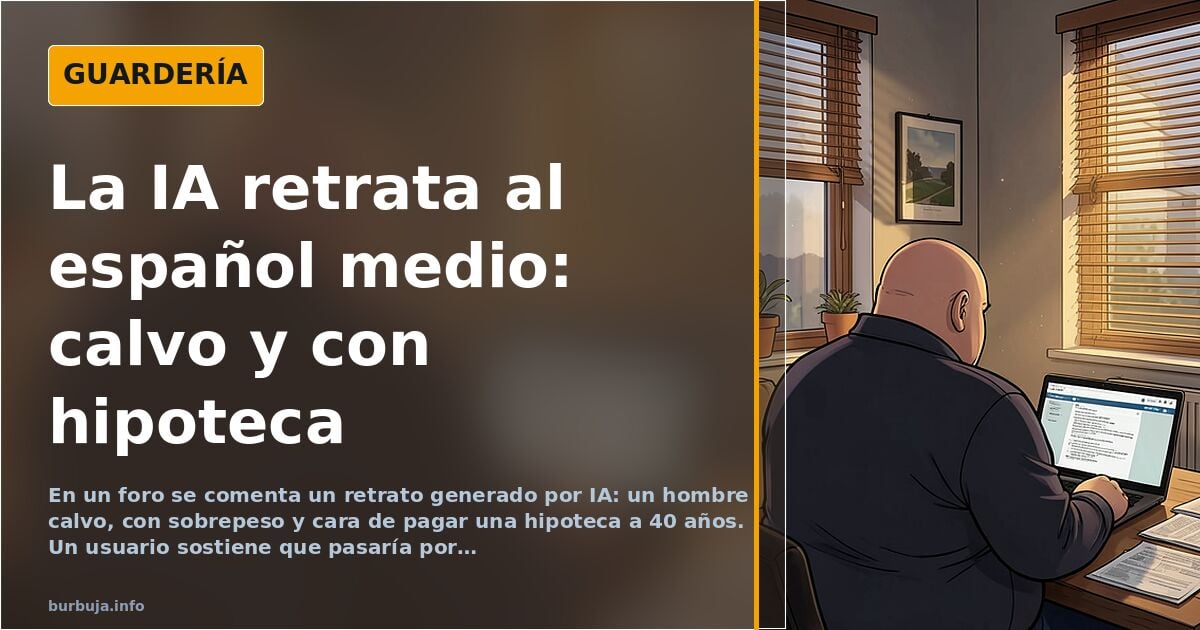
The average Spaniard according to AI: bald, overweight and carrying a mortgage
The setup is simple: someone asks an AI image generator to draw the average Spaniard, and the result, according to those who have seen it, is a bald, overweight man with the face of someone paying off a forty-year mortgage. There is no ethnic surprise or exoticism: just a guy who, the conversation claims, would go unnoticed in Madrid but not in Barcelona. In short, the portrait does not describe a country; it describes a salaried bill-payer.
What AI draws when you ask for an average Spaniard
The first point of friction is not looks, it's geography. Some argue the man fits comfortably into the archetype of the capital's civil servant or middle-class salaried worker, while another camp sees him as out of place in a city like Barcelona, where the average profile has different traits. The discussion quickly drifts toward a more uncomfortable issue: the appearance AI assigns to a Spaniard does not make him blend in across Europe, but only within a much narrower radius.
That's where the most acid argument comes in: the pan-European portrait the tool supposedly generated for other countries would allow them to blend in from France to Ukraine, while the average Spaniard, always according to that reading, only blends into a band stretching from Segarro to Iran. It's a blunt way of saying that AI's imagination feeds on old stereotypes and an idea of southern Europe that has been outdated for decades.
The physique the tool takes for granted: baldness and excess weight
The physical description attributed to the result is specific: advanced baldness and a tendency to be overweight. On the first point there is consensus that AI went overboard; on the second, the most common response is a resigned "fair enough." The average age assumed in the conversation doesn't help: by that stage of life, the argument goes, a full head of hair is already a statistical exception and waist size is a consequence.
The detail that turns the joke into something more interesting is the face. It is not a neutral face: it is the face of someone with a forty-year mortgage. Here AI hasn't failed; it has done involuntary sociology. The identikit picture of forced saving, of a salary that goes on the monthly payment before it ever reaches the account, matches the silhouette the algorithm returns far too well.
The joke that sneaks into any conversation about AI
As usual, the thread drifts into banter. References to irrelevant body measurements appear, two-word replies, and the occasional "you've just described me, delete this." The tool, for its part, makes clear that it cannot see images: it works with the text it is fed, so any judgment about the resemblance is made blind. That doesn't stop the gag from landing, because the joke doesn't depend on the picture; it depends on everyone recognizing the guy.
And there lies the unsettling fact: artificial intelligence hasn't invented anything. It has gathered the clichés circulating online about the middle-aged Spanish male and returned them with a sharpness that stings. The mirror isn't flattering, but it isn't entirely false either.
Summary of a discussion on Burbuja.info - Foro de economía, actualidad y política., translated from Spanish and reviewed before publication. Read the full discussion (17 replies).
More summaries
-
Is artificial intelligence the new religion of the bubble?
Is artificial intelligence the new religion of the 21st century? An analysis of the debate pitting technocrats, critics and nihilists against each other, with a final paradox.
-
AI-generated thread summaries spark controversy on Burbuja.info
AI-generated automatic summaries on Burbuja.info, a Spanish forum, have drawn criticism for paternalistic oversight and indirect censorship. One user notes the thread has racked up 41 replies.
-
AI that digs through the filth and strikes gold: hunting psychopaths online
An AI analyzed an extreme troll text and revealed psychopathic patterns. The debate over moderation and free speech is reignited.
-
PSOE spokesperson's cigar and her alleged salary
A tweet claims he ruined the PSOE spokesperson's cigar and the debate shifts to her alleged salary: €129,905.02 gross per year
-
The Flowers of Evil - Charles Baudelaire
«The Flowers of Evil» by Charles Baudelaire opens with «Blessing», a poem in which a mother curses her poet son. A text about the misunderstood artist.
-
Teachers in Ceuta, Spain, greet pupils with a Thriller dance at the school gates
Teachers at the CEIP Rosalía de Castro primary school in Ceuta, Spain, welcomed pupils with a Thriller dance. The gesture, meant to lift spirits, has sparked debate over the use of school hours.