
AI wipes out translator's income: 'Living on savings'
A translator reports losing all income to AI, relying on savings. The sector admits technical translation is no longer profitable.
English · Original discussion in Spanish · Published
AI wipes out translator's income: 'Living on savings'
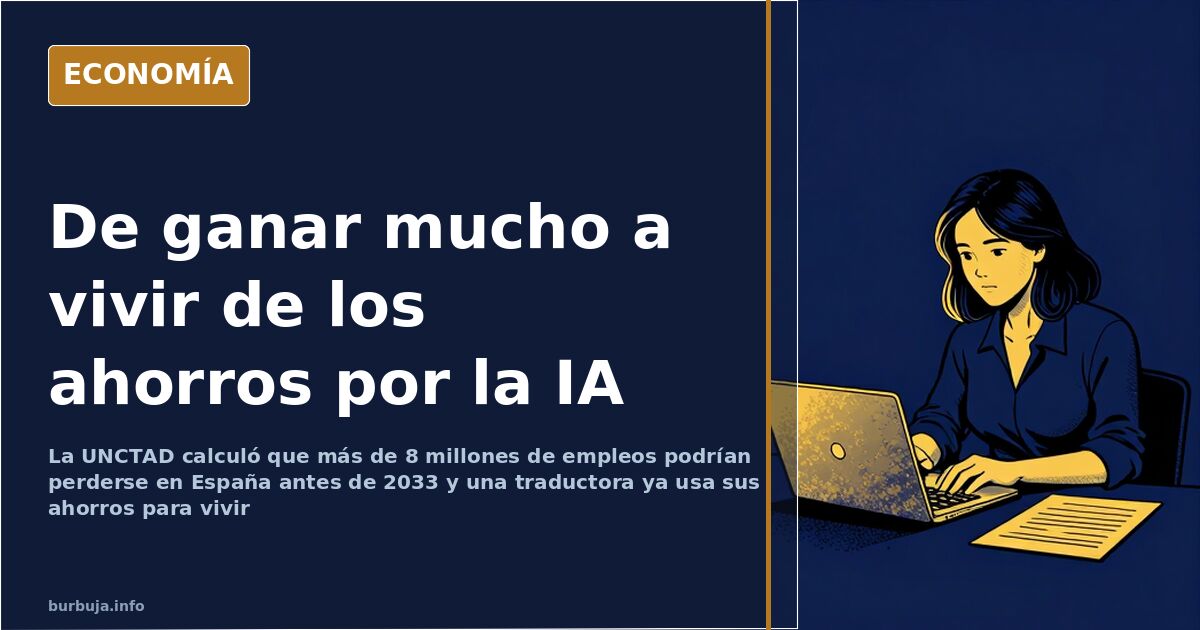
An English-Spanish to French translator claims she used to earn well but now makes nothing due to artificial intelligence. In interviews by Talent Match and Noticias Trabajo, she explains covering costs with savings: €1,000 rent plus €400-500 for food. UNCTAD estimates over 8 million jobs in Spain could be lost to AI by 2033.
This case isn't isolated. Freelance translators with 20+ years describe a market collapse after machine translation and large language models arrived. The debate is no longer if machines translate better, but which tasks still pay humans.
Which translation jobs still pay?
The divide isn't between languages, but text types. Certified translation, required for public bodies, remains in demand as it needs an authorized signer. Literary translation retains prestige machines can't match. Technical and pharmaceutical translation has suffered most, being easily replicated by systems trained on manuals.
Some argue quality is now a dispensable luxury. A technical translator with 22 years says if results are "good enough," companies won't pay for excellence. Firms boasting global brands don't want texts revealing they skipped review costs.
Errors AI still makes (and why it doesn't stop)
The common counterargument is that machines err. They do: a FDA-reviewed validation report showed "SHIT" instead of "Shift," per a pharma professional. Polish or Korean texts see more mistakes than English.
However, this argument is time-limited. Two years ago, video generators made six-fingered hands and nonsense signs. Today they don't. The question isn't if AI errs, but how fast it fixes them. Daily users say: very quickly.
Adapting vs. stuck translators
The conversation splits two ways. Some have adapted for years: from assisted tools to statistical engines, now generative models. Others see the ground falling away. A freelancer with clients in seven countries describes adapting until there was nothing left to adapt.
The repeated advice isn't romantic: find niches with legal or liability barriers. Certified translation needs human signatures. Interpreting requires reading body language, irony, and silence. Anything requiring legal proof must involve a person.
Human factor cost impact
Economic calculations are harsh. A small business owner paying €250 per language for manual translations now does it himself for free using automated tools. This is the baseline any text professional competes against.
Consequences go beyond lost orders. Review work becomes precarious: where ten translators and one supervisor existed, only the supervisor remains. The chain shortened, eliminating the heavy-lifting link.
Analysis stalls at a familiar point: if quality isn't paid for, who demands it? Market response so far: nobody. Meanwhile, a translator uses savings to pay €1,000 rent.
Also available in: Deutsch
Summary of a discussion on Burbuja.info - Foro de economía, actualidad y política., translated from Spanish and reviewed before publication. Read the full discussion (262 replies).
More summaries
-
Spain's labor market: job abundance or systemic job insecurity?
An analysis of job insecurity in Spain, examining the gap between rising employment figures, the SMI (minimum wage), and the rising cost of living.
-
Immigrants now hold 15% of jobs in Spain, growing four times faster
Immigrant employment in Spain is growing four times faster than the overall total and now accounts for 15% of jobs. Yet their unemployment rate is double that of Spaniards. What lies behind it?
-
AI Hate Driven by Fear of Losing Professional Status
Hostility toward AI stems from fears of losing professional status, not technical flaws. $100/month models outperform 90% of experts.
-
Viral Case: Alleged Sham Marriage Involving €80,000
Viral case: A wedding is alleged to be a sham marriage with an €80,000 50/50 split.
-
Data contradicts claim that logistics workers lean right
Foreign worker share in Spanish logistics exceeds 20% in key provinces. Voting data refutes the idea of a majority right-wing workforce.
-
PP-Vox near 200 seats; Irene Montero risks losing her mandate
Spanish polls from late October show PP and Vox approaching 200 seats, while Irene Montero faces a potential loss of parliamentary representation.