
AI video reimagines Draco Malfoy as a 'premium chortina'
An AI video reimagining Draco Malfoy as a 'premium chortina' is going viral and reignites the debate over the casting and visual canon of Harry Potter.
English · Original discussion in Spanish · Published
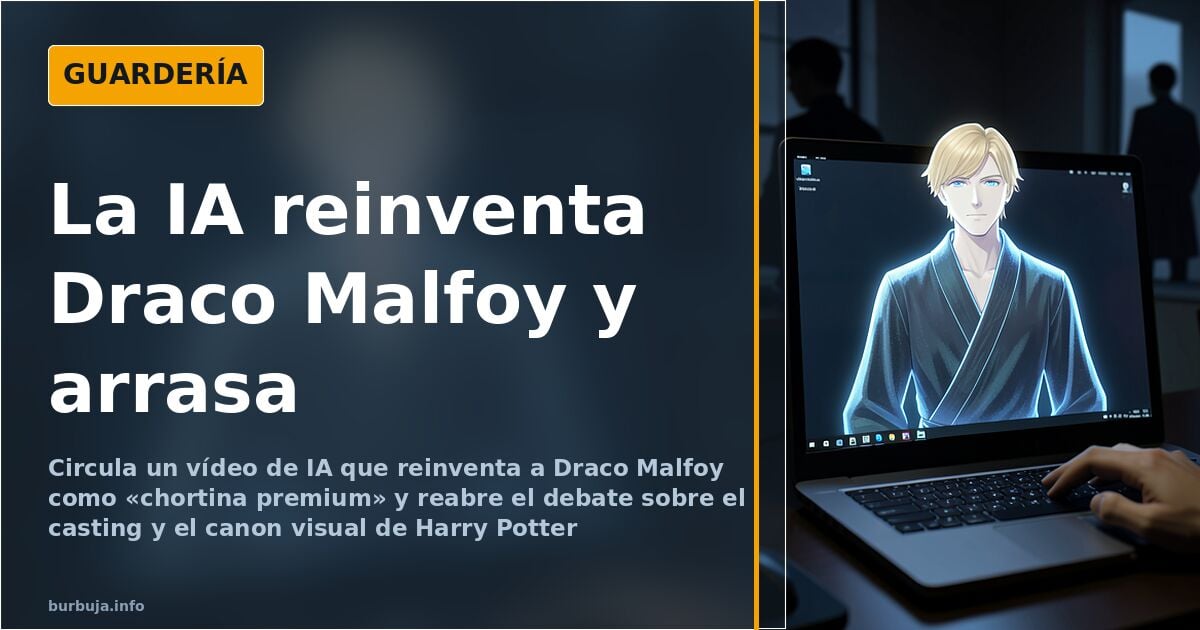
The alternative Harry Potter that turns Draco Malfoy into a 'premium chortina'
An AI-generated video rewrites the Hogwarts universe and places at the center of the story a Draco Malfoy who looks radically different from the actor who played him in the films. The clip, spread across social media and shared in a chain, has been enough to reopen an old debate: whether the visual canon of the most profitable young-adult saga of the 21st century would have worked better with different casting. The majority answer, judging by the uproar, is yes.
The piece is not a trailer or a studio project. It is an image-generation exercise that replaces the original performer with a reconstructed face, and that is where the fun lies: the AI has not filmed anything, it has rewritten the collective imagination in a few seconds. Anyone who watches it returns to the characters' early youth and realizes that the absence of that kind of presence at Hogwarts feels, in the words now circulating, a living death.
What the video changes and what it doesn't
The material offers no new footage or alternative script. What it does is apply an attractiveness filter to a character who, in the original fiction, served as the posh, sour-faced antagonist. The result, according to the dominant reception, improves on the original in every way. The comparison is unfair by definition —a two-decade-old memory is being set against a synthetic image polished to the last detail— but it works as a gauge of expectations.
Some go further and claim the earlier version surrendered to wokism, which in practice means the saga's character design is now perceived as sloppy or unambitious. It is a current of opinion, not a fact: there is no study measuring the attractiveness of a cast.
The technical detail that does matter is another one. The scene is AI-generated, there is no actress behind it, and that raises an uncomfortable question for the industry: if a model produces in minutes what a casting department takes months to decide, what is left of the craft? The short answer is that the video does not shoot movies. The long one is that it already shapes how audiences imagine the ones to come.
The demand the video uncovers
The uproar is not asking for a remake. It is asking for something more concrete and less admissible: that mass-market youth entertainment include the kind of visual stimulus the video hints at. The formula appears in the material without euphemism —more substances and fewer inhibitions at the magic boarding school— and it connects with an audience segment that grew up with the books and now consumes parody.
The second part of the edit, by the way, is requested but not confirmed. Nobody has clarified whether it exists.
The background noise: the criticism that won't stomach English literature
Alongside the video, another debate surfaces, older and considerably more serious. One camp criticizes a certain literary critic for his complex against non-Spanish narrative: only Cervantes would seem respectable to him, while Tolkien —a giant of the 20th century for almost everyone— would fall outside his canon. Harry Potter, in that hierarchy, is young-adult literature and aspires to nothing more.
The argument has mileage. The saga sold hundreds of millions of copies and sustained an entire industry, but that neither makes it good literature nor the opposite. The distinction between commercial success and aesthetic value remains unresolved, and an AI video is not going to resolve it.
What the episode makes clear is that the conversation about the canon is no longer controlled by the academies. It is controlled by whoever generates the image. And that image, for now, proves the ones asking for something different right.
Also available in: Deutsch
Summary of a discussion on Burbuja.info - Foro de economía, actualidad y política., translated from Spanish and reviewed before publication. Read the full discussion (17 replies).
More summaries
-
Emma Watson: the Harry Potter icon dividing those who watched her grow up
Emma Watson, the Harry Potter icon, sparks division: her looks, her activism and the passage of time fuel a debate about desire and fame
-
Is artificial intelligence the new religion of the bubble?
Is artificial intelligence the new religion of the 21st century? An analysis of the debate pitting technocrats, critics and nihilists against each other, with a final paradox.
-
AI-generated thread summaries spark controversy on Burbuja.info
AI-generated automatic summaries on Burbuja.info, a Spanish forum, have drawn criticism for paternalistic oversight and indirect censorship. One user notes the thread has racked up 41 replies.
-
AI that digs through the filth and strikes gold: hunting psychopaths online
An AI analyzed an extreme troll text and revealed psychopathic patterns. The debate over moderation and free speech is reignited.
-
The link nobody dares to open: anatomy of a digital mystery
An image link shared without context sparks warnings and wild descriptions on a forum. Nobody confirms what it contains, and the mystery remains unsolved.
-
Olona's Maleficent costume that set the trial ablaze
Macarena Olona chose a Maleficent costume for Halloween, sparking a debate about her political career and her personal brand.