
AI or call agent: the hidden cost of being served by a machine
Automated support contains the call but doesn't fix the fault, according to a circulating calculation: the savings on wages and agreements never show up on your bill.
English · Original discussion in Spanish · Published
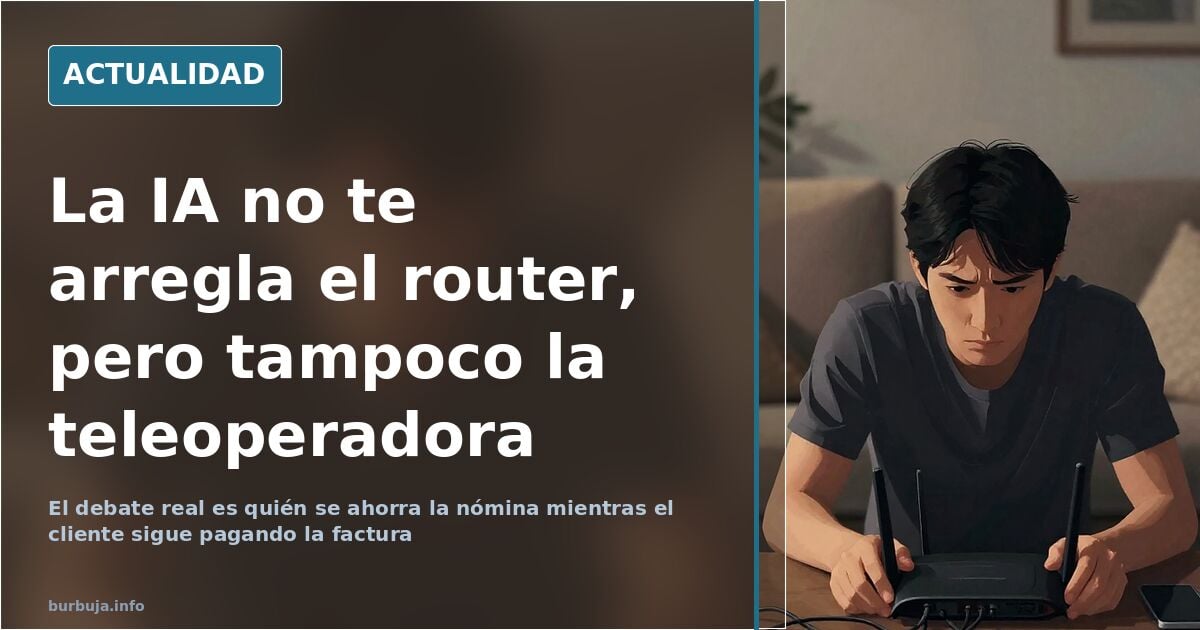
AI doesn't fix your router: the savings stay in the bonus
The phone rings, a synthetic voice answers, you repeat your problem four times, and after forty minutes you're still offline. It's a scene anyone who has called their provider this month of 2026 can describe, and it has sparked a debate ranging from dropped routers to temporary lines. The underlying question is simple: what do you gain and what do you lose when customer service is handled by an algorithm instead of a person on the other end of the line?
The diagnosis going around is that both setups are the same play with a different interface. The call center isn't designed to fix the fault, but to contain the call until the customer gives up. The difference is the incentive: the human agent is paid by the minute and rushes you off; the automated system is measured by interactions contained, not faults resolved. That's where you can see who designed the system and with what interest.
Human warmth doesn't fix the router
Some argue that human support offered something the machine cannot. The argument doesn't hold up well: you call to get your connection back, not to socialize. And the idealized memory of the old service doesn't survive scrutiny either, because in many cases they didn't just fail to fix anything, they made the problem worse. Nostalgia for the phone support of the past is, to a large extent, nostalgia for something else.
The counterpoint has its own economic logic. Automation isn't free for the customer: the wages, social security contributions and collective agreements the company saves don't show up on your bill as a discount, they show up in the executive bonus. The service gets cheaper for the provider and more expensive in time for the customer. That's the real transfer.
Why does AI keep you in a loop for forty minutes?
Because its performance is measured in interactions contained, not faults resolved. The system repeats "I didn't catch that" and starts over, and the customer hangs up feeling like they've been talking in circles. The machine is available 24 hours a day, sure, and it's even faster at telling you to get lost. That's its only undisputed merit.
The debate soon drifted into broader territory: healthy community versus modernity, the group versus the individual, postmodernism to blame for everything. When the conversation jumps from a router to Franco and time lines within two pages, it's no longer about telephony. It's about how companies treat us and how much we put up with.
In the end, neither the machine nor the person fixes the fault. One gets paid by the minute, the other for containment. And the customer, meanwhile, keeps paying for the 40 gigabytes they never use.
Also available in: Deutsch
Summary of a discussion on Burbuja.info - Foro de economía, actualidad y política., translated from Spanish and reviewed before publication. Read the full discussion (25 replies).
More summaries
-
The CTO who asks AI about business, ideas and investments
A CTO, according to a forum account, consults AI on business, ideas and investments and barely socializes with humans. The case sparks debate over delegating...
-
AI designs working viruses and deceives police as safety warnings grow
An AI designed 16 functional viruses and another filed a false police report. The story of the harmless tool is cracking as tech companies…
-
José Mota stops hair treatment due to side effects
José Mota quits hair loss medication due to side effects: 'I prefer to have a receding hairline and thinning hair'
-
The thesis blaming the welfare state for women's prostitution
One argument claims that without welfare benefits, women would sell themselves for a mess of pottage. The counterargument: the calculation is the same as that of the lifelong opposition claimant.
-
PSOE and Sumar slip the grandchildren law into an education reform
Spain's PSOE and Sumar have added the grandchildren law to an education reform bill. The PP calls it a "legal botch job", with estimates circulating of 3 to 5 million potential beneficiaries.
-
France in flames: student riots and schools set on fire
Schools set on fire and student riots in France: the viral video against the RN, the shadow of 2005 and the unproven hypotheses.