
AI doubles layoffs: the split nobody disputes
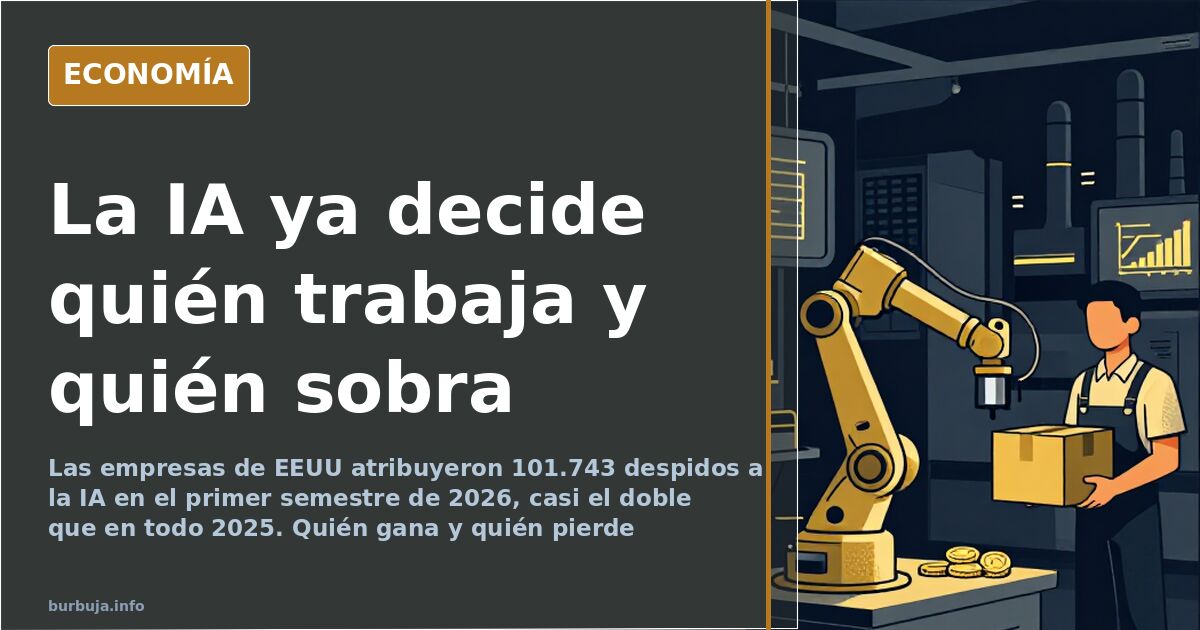
US companies attributed 101,743 layoffs to AI in the first half of 2026, nearly double the total for all of 2025. Who wins and who loses.
English · Original discussion in Spanish · Published
54,836 AI-related layoffs in 2025: the dystopia now has a date
Sinan Can Demir was twenty-four years old, studying computer science at the University of Texas at Dallas, and had racked up more than twenty rejected internship applications. He spent the last week of July polishing his résumé, as half the world would: digging through open GitHub projects for something to fix and show off with. He found a proposed change inside a network scanning tool, with a malware downloader hidden behind an impeccably clean bug fix. He alerted the maintainer. The episode sums up the pattern: it is no longer clear who writes, who signs off, and who checks.
The layoffs companies are already attributing to AI
According to Challenger's records, US companies attributed 54,836 job cuts to artificial intelligence throughout 2025. In the first half of 2026, the reported figure stands at 101,743: nearly double in half the time. For four consecutive months, AI was the most frequently cited reason when announcing layoffs.
The nuance matters and should not be brushed aside: Challenger collects corporate announcements and the reasons companies themselves give, and does not audit whether an algorithm actually replaced each position. It measures what companies are willing to declare, not actual replacement. Even so, when the leading cause of layoffs becomes a technology, the narrative has already shifted the ground on which negotiations take place.
The split: AI accelerates a shift that started long ago
The second front is not how much wealth artificial intelligence creates, but who keeps it. The figure that explains almost everything is labor's share of income: what portion of the value produced is counted as wages and what portion remains as profits and non-labor income. The shift toward capital was not started by AI; it has been tilting that way for decades. AI is not the origin, it is the accelerant.
When verifying costs more than faking
The cost of manufacturing a fake piece of evidence —a voice, an image, a video— has collapsed far faster than the cost of checking it. You don't need to claim that truth has become unknowable. It is enough to accept something almost as uncomfortable: that producing credible evidence can be faster and cheaper than verifying an authentic one.
88 hours, 10,000 agents, and a door-slamming resignation
On September 8, 2026, OpenAI published a 166-page paper and a Lean formalization showing that the three-dimensional Navier-Stokes equations can develop a finite-time singularity. According to the company, it was solved by an internal model more capable than GPT-6 Astra, supported by around 10,000 concurrent agents, in 88 hours. The publication arrived wrapped in a dispute over credit and private data.
That same day, Jacob Coxon, a 27-year-old researcher with three years of pretraining work behind him, announced he was leaving Anthropic and the sector. He argues that none of the big companies is acting responsibly and that the people building these systems genuinely believe they could kill us all before the decade is out. His account is not that of an outside critic, but of someone who trained the very models he now talks about.
Meanwhile, Spanish tech employment remains concentrated in a handful of parks: the Tecnológico de Andalucía in Málaga accounts for around 3.1% of the workers in its province. The question is no longer whether there will be work. It is in whose hands.
Also available in: Deutsch
Summary of a discussion on Burbuja.info - Foro de economía, actualidad y política., translated from Spanish and reviewed before publication. Read the full discussion (23 replies).
More summaries
-
Jacob Coxon (Anthropic Engineer) Resigns, Warning That AI Could 'Kill Us All' by Decade's End
A former engineer from **Anthropic** and **OpenAI** is resigning over the existential risk posed by AI, warning of its potential to surpass human control.
-
Anthropic CEO warns: AI could kill us within 10 years
Anthropic CEO calls for AI slowdown due to existential risk: "it could kill us all." OpenAI delays IPO while Trump dismisses the warning.
-
Anthropic's origin: no garage, no angels, pure venture capital
Former OpenAI employees found Anthropic over Zoom with $20M in venture capital and humanitarian rhetoric. Chinese models open the game.
-
Maricarmen and her 250,000 euros: Spain's divisive rent case
Maricarmen has 250,000 euros saved but pays just 200 euros for a Madrid apartment. Her case highlights Spain's complex housing crisis.
-
Morocco's King Mohamed VI pardons 1,788 prisoners: cost or investment for Spain?
1,788 prisoners pardoned by Morocco, around 1,500 of whom are already in Spain. What does their reception cost? The financial hole of an opaque deal.
-
Theory claims US and Israel orchestrate migration pressure on Spain
The theory that the US and Israel orchestrate migration pressure on Spain is spreading. The 1786 treaty with Morocco and a US Congress report fuel the claim.