
AI as the scapegoat for Spain's rail derailment
The debate points to a poorly drafted contract, an undeployed safety system, and political responsibility that no one will own up to.
English · Original discussion in Spanish · Published
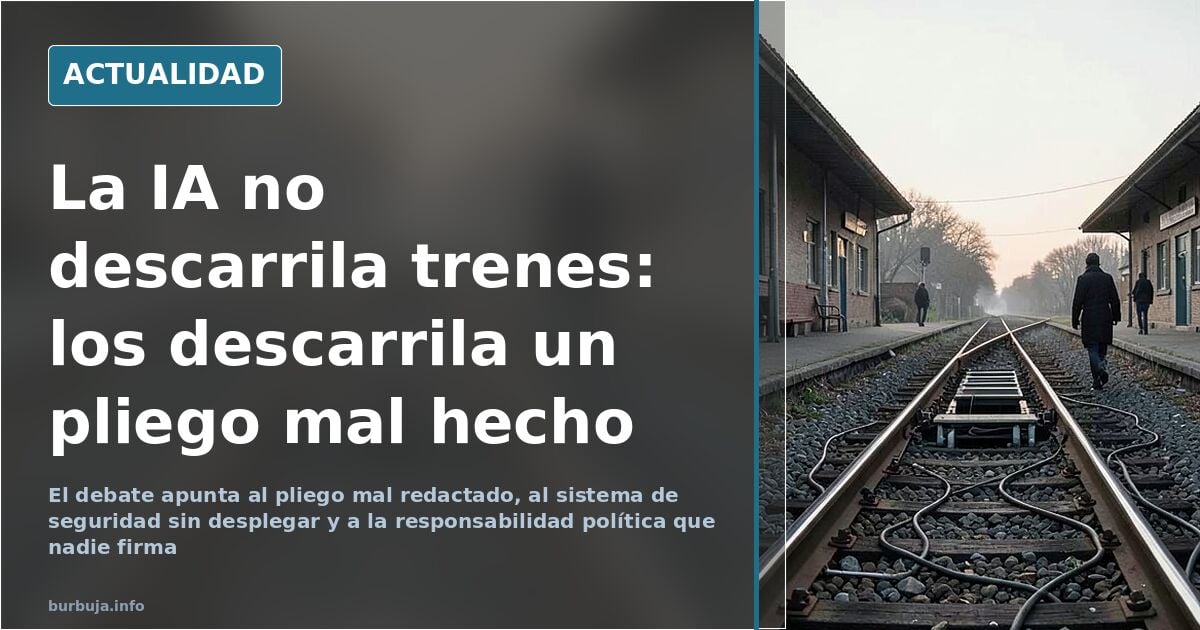
AI doesn't derail trains: a poorly drafted contract does
When a train comes off the tracks, the useful question is not which algorithm failed, but who signed off on the contract for the system that was supposed to prevent the failure. The public debate over derailments in Spain has found a convenient culprit: the newly installed artificial intelligence, that umbrella that allows no one to sign a dismissal. The pattern repeats with alarming precision: technology is purchased, announced as modernization, a manager who doesn't understand the signalling system they are supposed to oversee is put in charge of the contract, and when the axle breaks, the blame is diffuse.
The lawyer who drafts the signalling contract
The argument with the most traction in the analysis points not at the machine but at the chain of command. As the debate holds, a ministry led by a legal rather than technical profile has spent years negotiating a safety system funded by the EU that remains undeployed. Meanwhile, train controllers work in manual mode. That is the underlying anomaly: the investment exists, the deadline keeps stretching, and the person who should validate the system cannot read it.
AI, in this story, is not the cause. It is the alibi. If the algorithm fails, the political responsibility dissolves into the ambiguity of the code. If the contract was badly written, someone would have to answer for it. And no one wants to answer.
Why is artificial intelligence blamed for derailments?
Because attributing the failure to an autonomous system absolves whoever commissioned it of responsibility. Real-time monitoring of critical infrastructure — detecting anomalies in vehicles, crowds and strategic spaces — is sold as a solution, but legal responsibility remains human. No algorithm signs a contract or collects a commission.
Some argue that a poorly tested update, released on a Friday afternoon, is enough to bring down the safety of a line. Others point to something more prosaic: ageing infrastructure, safety systems awaiting upgrades for years, and a public administration turned into a jobs agency. The result is the same: the train comes off the tracks and the debate gets lost in the cloud.
The precedent no one wants to repeat
The discussion includes a scenario that hovers over every accident: what happens if the failure occurs on a viaduct. It is not alarmism; it is the probability calculation anyone familiar with the network makes. The implicit conclusion is uncomfortable: the system holds up because the worst failure has not yet coincided with the worst geographic point.
The comparison with other ministries serves as rhetorical reinforcement: a Health Minister with specialized training and a health system in permanent strike proves that a CV does not guarantee good management. True. But it doesn't exempt them either. The difference is that in healthcare the error is measured in waiting lists; on the railway, in carriages off the tracks.
The exact point where the analysis gets stuck: no one disputes that AI doesn't derail trains. What remains to be clarified is who answers when the system that was supposed to prevent it has been sleeping the sleep of the just for months in an EU drawer.
Also available in: Deutsch
Summary of a discussion on Burbuja.info - Foro de economía, actualidad y política., translated from Spanish and reviewed before publication. Read the full discussion (19 replies).
More summaries
-
Spain's Transport Ministry spent €70,000 cataloguing Óscar Puente's nicknames
Spain's Transport Ministry paid nearly €70,000 to catalogue the nicknames Óscar Puente receives on X. The spending reopens the debate over priorities and public money.
-
Meme turns anonymous pedestrian into the EU's unofficial new logo
An anonymous woman has become a meme as the EU's new logo, and the joke has spiralled into a debate over voting, immigration and misinformation spreading faster than corrections.
-
Le Pen rules out EU exit referendum, reigniting the euro debate
Marine Le Pen has ruled out a referendum on leaving the EU, leaving Frexit without a date. The Brexit precedent and pressure on French debt explain the shift.
-
Rumors Suggest Spanish PM Sánchez May Step Aside
Online rumors claim Pedro Sánchez is considering not running, with PSOE looking at Bolaños, Cuerpo or García-Page as potential successors.
-
French Senate passes bill expanding police powers over online speech
The French Senate approved a bill on 27 October by 229 votes to 105 that allows content to be removed within 24 hours without a judge. Here is what changes.
-
The wave of accounts arriving at the forum before Spain's July 23 election
A forum post warns of a wave of new and reactivated accounts before Spain's July 23 election and proposes a mute list. The debate: ignore them or reply to them.