
Adult scooters: the car alternative gaining ground in Spain
A driver swaps his car for a scooter to cover 1.5 km to the train. Time savings and overcoming social stigma are at the heart of the analysis.
English · Original discussion in Spanish · Published
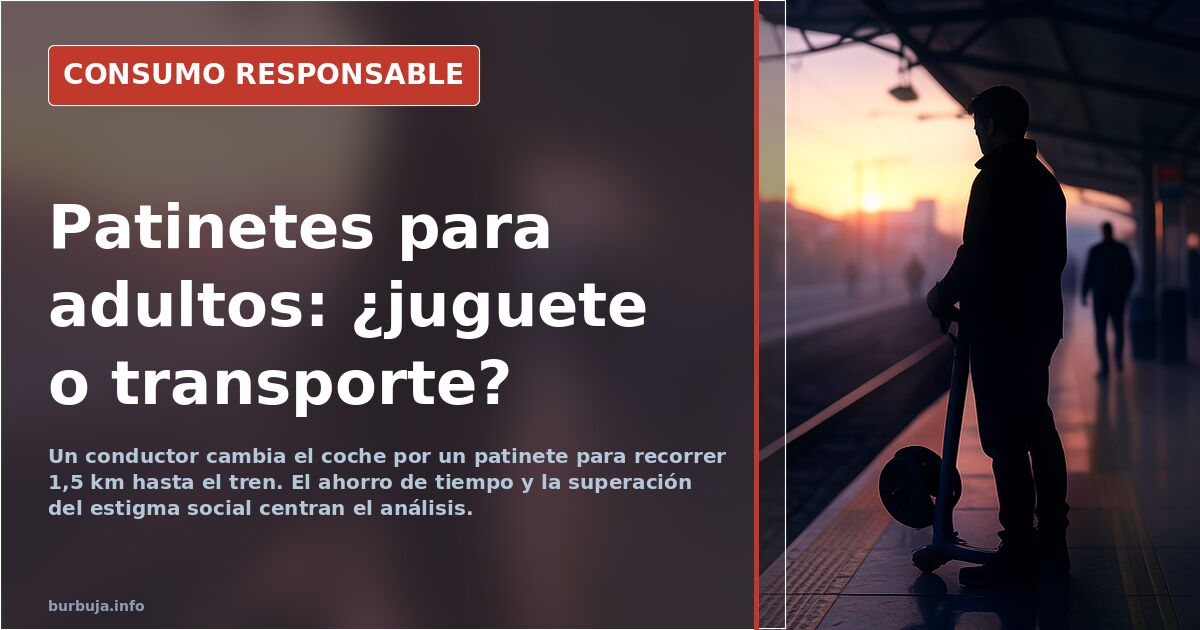
Adult scooters: the transport that is starting to hit the pavement
After moving house and cutting back on expenses, a driver in Spain decides to get rid of his second car. The reason: the train drops him 1.5 km from work, a flat stretch he can cover on a folding scooter. The problem is that, with his new shift, walking leaves him barely enough time to catch the train; if he misses it, he waits 20 minutes for the next one. His proposed solution is an adult scooter, not a folding bike, because he finds the latter too cumbersome to carry on the train. The discussion that trinc mixes scepticism, real-life experiences and buying recommendations.
The scooter as an urban mobility solution
The initial proposal is not a whim. The route is short, flat and regular. A folding scooter covers it in under 10 minutes, compared with the 15 it takes on foot, according to a calculation circulating in the thread, and you can take it on the train without the hassle of a bike. The idea is to save time and avoid the 20-minute wait if you miss the train. The debate centres on whether the scooter is a valid means of transport or an awkward toy.
The first responses are sceptical. People question how comfortable it is and recommend motorised scooters, though they are heavy to carry on the train. A folding bike is also suggested, but comfortable, easy-to-fold models (Dahon, Brompton) are expensive. The experience of someone who used a scooter from the metro is mixed: the small wheels turn every bump into an ordeal and pushing with your foot is tiring, though on flat ground and downhill it is fun. Walking 1.5 km takes 15 minutes, which is not that much either.
Social stigma: "here everything embarrasses us"
One of the points raised is social embarrassment. Some argue that in Spain we are behind the times and feel embarrassed to use a scooter as adults. The example of Vienna is cited, where a middle-aged man rode a scooter as a perfectly normal thing to do. The protagonist's answer is clear: at 41, he lost most of his embarrassment as a child and it no longer bothers him at all. His goal is not to exercise (he already does), but to avoid missing the train after working all night. The discussion drifts towards individual freedom and other people's hang-ups.
Models, prices and buying experiences
The thread turns into a buying guide. Scooters with large pneumatic wheels are mentioned, such as the Yedoo models, and Decathlon models with front and rear suspension for around 100 euros. A Lidl scooter for 29.99 euros and an Aldi one for the same price are also cited. The protagonist finally buys a new one at Decathlon with thick wheels, after getting no response from second-hand sellers. His experience: balance is needed, but you pick it up quickly; it is essential to fit a light at the front and rear if riding at night, and to wear reflectors. He only recommends it for flat terrain or gentle inclines, and warns that it picks up estimulante ilegal downhill. The rear foot brake takes a while to stop, and some models already come with a hand brake and front disc brake.
From scepticism to acceptance: how the debate evolved
Over time, the tone changes. Testimonials appear from people who have bought scooters for leisure rides or urban trips. It is pointed out that in Switzerland it is a common means of transport, used by adults to get from the metro home. The conclusion is that the problem is not the scooter, but what other people think. The thread ends with links to more advanced models, such as the Swifty ONE, and with the realisation that the scooter is a valid and affordable alternative for short trips, as long as you get past the prejudices.
Key facts from the debate:
The anecdote: the protagonist tried a small-wheeled scooter at Decathlon and found it less stable than the large-wheeled ones. He finally bought one with thick wheels and, although he struggled with balance at first, he now uses it daily to get to work.
After moving house and cutting back on expenses, a driver in Spain decides to get rid of his second car. The reason: the train drops him 1.5 km from work, a flat stretch he can cover on a folding scooter. The problem is that, with his new shift, walking leaves him barely enough time to catch the train; if he misses it, he waits 20 minutes for the next one. His proposed solution is an adult scooter, not a folding bike, because he finds the latter too cumbersome to carry on the train. The discussion that trinc mixes scepticism, real-life experiences and buying recommendations.
The scooter as an urban mobility solution
The initial proposal is not a whim. The route is short, flat and regular. A folding scooter covers it in under 10 minutes, compared with the 15 it takes on foot, according to a calculation circulating in the thread, and you can take it on the train without the hassle of a bike. The idea is to save time and avoid the 20-minute wait if you miss the train. The debate centres on whether the scooter is a valid means of transport or an awkward toy.
The first responses are sceptical. People question how comfortable it is and recommend motorised scooters, though they are heavy to carry on the train. A folding bike is also suggested, but comfortable, easy-to-fold models (Dahon, Brompton) are expensive. The experience of someone who used a scooter from the metro is mixed: the small wheels turn every bump into an ordeal and pushing with your foot is tiring, though on flat ground and downhill it is fun. Walking 1.5 km takes 15 minutes, which is not that much either.
Social stigma: "here everything embarrasses us"
One of the points raised is social embarrassment. Some argue that in Spain we are behind the times and feel embarrassed to use a scooter as adults. The example of Vienna is cited, where a middle-aged man rode a scooter as a perfectly normal thing to do. The protagonist's answer is clear: at 41, he lost most of his embarrassment as a child and it no longer bothers him at all. His goal is not to exercise (he already does), but to avoid missing the train after working all night. The discussion drifts towards individual freedom and other people's hang-ups.
Models, prices and buying experiences
The thread turns into a buying guide. Scooters with large pneumatic wheels are mentioned, such as the Yedoo models, and Decathlon models with front and rear suspension for around 100 euros. A Lidl scooter for 29.99 euros and an Aldi one for the same price are also cited. The protagonist finally buys a new one at Decathlon with thick wheels, after getting no response from second-hand sellers. His experience: balance is needed, but you pick it up quickly; it is essential to fit a light at the front and rear if riding at night, and to wear reflectors. He only recommends it for flat terrain or gentle inclines, and warns that it picks up estimulante ilegal downhill. The rear foot brake takes a while to stop, and some models already come with a hand brake and front disc brake.
From scepticism to acceptance: how the debate evolved
Over time, the tone changes. Testimonials appear from people who have bought scooters for leisure rides or urban trips. It is pointed out that in Switzerland it is a common means of transport, used by adults to get from the metro home. The conclusion is that the problem is not the scooter, but what other people think. The thread ends with links to more advanced models, such as the Swifty ONE, and with the realisation that the scooter is a valid and affordable alternative for short trips, as long as you get past the prejudices.
Key facts from the debate:
- Distance: 1.5 km from the train to work.
- Walking time: 15 minutes; by scooter, under 10.
- Wait if you miss the train: 20 minutes.
- Scooter prices: from €29.99 (Lidl, Aldi) to €100 (Decathlon with suspension).
- Folding bike: from €99 at Carrefour; Dahon or Brompton models, far more expensive.
The anecdote: the protagonist tried a small-wheeled scooter at Decathlon and found it less stable than the large-wheeled ones. He finally bought one with thick wheels and, although he struggled with balance at first, he now uses it daily to get to work.
Also available in: Deutsch
Summary of a discussion on Burbuja.info - Foro de economía, actualidad y política., translated from Spanish and reviewed before publication. Read the full discussion (39 replies).
More summaries
-
2009 Brompton: €700 costs €40 a year in transport
A 2009 Brompton for 700 euros costs €40 a year in transport if it lasts 20 years. The calculation that defends its price and theft, the problem it doesn't solve.
-
Carrefour ends double refund for pricing errors
Carrefour no longer refunds double the difference for overcharges, limiting compensation to the simple amount as per new store policies.
-
Ozempic and Mounjaro: FDA black box warning issued
FDA issues black box warning for Ozempic and Mounjaro regarding thyroid tumor risks. Analysis of weight regain, side effects, and natural alternatives.
-
No more ads and AI summaries: uBlock Origin filters
uBlock Origin lets you remove ads, pop-ups and the AI summaries some sites place after the first post without breaking the page.
-
Night swimming under a moonless sky: the experience the daytime beach can't match
Discover why swimming in the sea at night with no moon is a unique experience, far from the daytime crowds. The threat of regulation looming over this pleasure.
-
Peugeot 308 145 hybrid: 13,000 euros less than the Audi A3 and better
After 12 days and 1,700 km, the Peugeot 308 145 hybrid proves it can match the Audi A3 for 13,000 euros less. But PureTech reliability remains the…