
Adobe down 30% in 2026 as a free clone gains 8,900 forks
Adobe has fallen 30% in 2026 while a free clone of its suite gains 8,900 forks. Its CEO sold $31.3 million in shares. An analysis of the perfect storm.
English · Original discussion in Spanish · Published
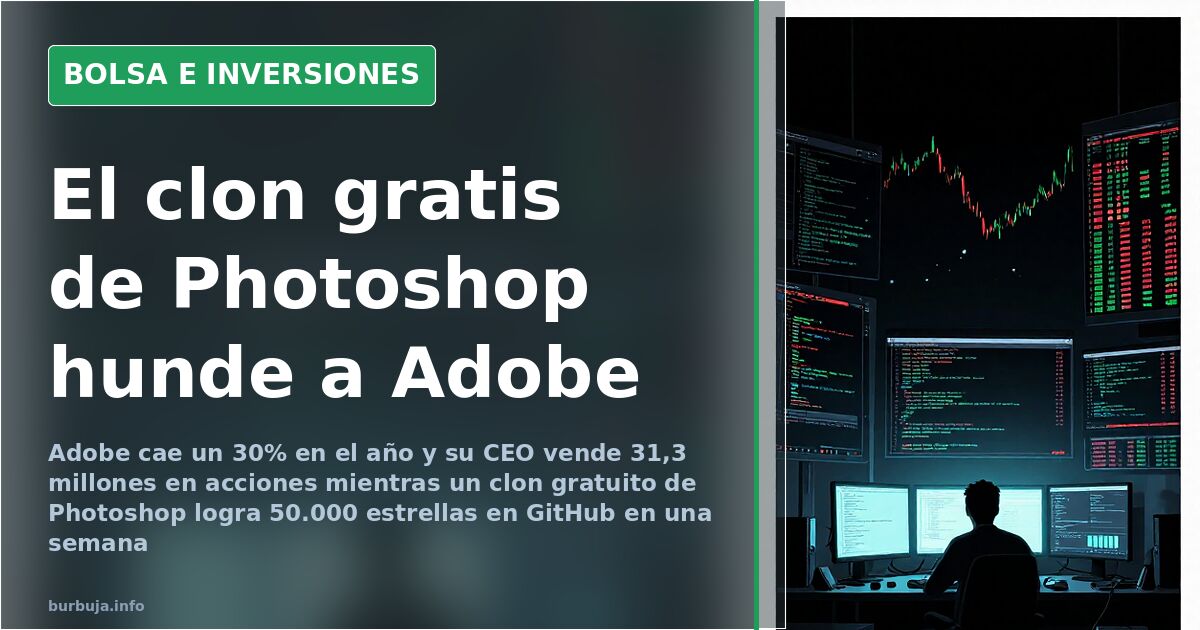
Adobe loses 30% on the stock market while a free clone of its suite gains 8,900 forks
A 30% drop year to date. That is the hole Adobe has dug on the stock market while a reverse-engineering project, dubbed ArtCraft and antiestéticaturing a Photoshop clone called Photocraft, has racked up 8,900 forks on GitHub and promises full Linux compatibility. The paradox is that the market has not reacted with a crash, but with a slow erosion that has already led Wells Fargo to downgrade the company to "underweight" and set a price target of $225.
The CEO sold $31.3 million before the noise
Shantanu Narayen, Adobe's chief executive, sold 125,000 shares on September 16 and 17, 2026, for a combined value of $31.3 million, roughly 34% of his total stake. The move came just days after it emerged that Brandon Thomas and his team had been working for months on cloning Adobe's repository with the help of the AI Claude. The timing fuels the suspicions of some forum participants: whoever knows a company's inner workings best is usually the first to move when they smell smoke.
Adobe's official narrative rests on the idea that artificial intelligence will be its salvation. But the market is looking at the numbers: some estimate that reliance on revenue from individual customers reaches 28% of the total, and that is precisely the segment most exposed to a free alternative that can already be downloaded without friction. The calculation circulating in the most pessimistic analysis is that losing just half of those individual subscriptions would send the stock trading between $130 and $150.
Why can a free clone topple a software giant?
The answer lies in ease of use. For twenty years, the argument against piracy was the technical skill required: downloading a cracked program demanded knowledge most people didn't have. Photocraft removes that barrier, according to its defenders. It's a matter of visiting a page, downloading a file and installing it. Easier than the original. And on top of that, it's lighter, starts faster and runs on Linux, which in passing erodes the Windows ecosystem.
The precedent of GIMP looms over the skepticism. GIMP has existed for decades, is stable, consumes fewer resources and is open source. Nobody uses it en masse. The difference, the sharpest voices point out, is that GIMP never had a community enraged with Adobe, willing to code furiously at the keyboard to hurt the dragon. Spite, in this case, is an asset.
The timeline that could upend everything
The turning point will not be immediate. The project is in an early alpha phase, with bugs and without full parity. The timelines being discussed point to one month to reach functional parity, but enterprise adoption is another matter. The key, according to the coldest analysis, will be when a major company abandons Adobe and switches to the community-built version. That is when the damage will be severe and hard to reverse.
Meanwhile, the stock remains trapped in an uneasy calm. The sporadic rallies on fake news or market manipulation do not fool those watching the weekly chart: the trend has been in free fall since January. The earnings report to the SEC, scheduled for January, will be the moment the dirty laundry comes out, according to the most pessimistic. Until then, the market will keep bleeding out slowly.
How long can Adobe sustain its subscription model when the alternative is free, lighter and runs on Linux?
Also available in: Deutsch
Summary of a discussion on Burbuja.info - Foro de economía, actualidad y política., translated from Spanish and reviewed before publication. Read the full discussion (38 replies).
More summaries
-
Will generative AI kill Adobe the way it killed Kodak?
An investment forum debates whether generative AI could turn Adobe into the next Kodak, while others point to record revenues and recommend buying the stock.
-
Gold and silver between private buyers: a market that can't take these prices
A forum user calculates that the ounce of silver went from 16 euros in 2016 to 62 today. The metal has never been worth so much, and it is getting harder to sell between private parties.
-
Empire Option: binary options broker in the British Virgin Islands facing scam claims
Empire Option operates from the Virgin Islands with no Spanish oversight: payouts of 70% against losses of 90%, and complaints from a user who says he lost 10,000 euros.
-
Amending your Spanish tax return: four years to recover 800 euros
A wrong box on a couple's pension plan cost 800 euros in refunds. Spanish law allows taxpayers to amend their return up to four years later.
-
Stock market riddles: from PayPal to Lenovo with a 50% gain
Four stock market riddles solved between March and September 2026: Intel, PayPal, Lenovo and Hims&Hers. Two remain open.
-
Spanish utilities: billion-euro profits but a stock market slide since 2007
A report highlights that Spain's power companies have racked up billions in profits since 2007 while their share prices have tumbled on the stock market.