
Adamuz: Rail broken before Iryo, black boxes missing
CIAF places rail fracture in Adamuz before Iryo passage. Video shows cuts and broken tracks; black boxes remain unaccounted for.
English · Original discussion in Spanish · Published
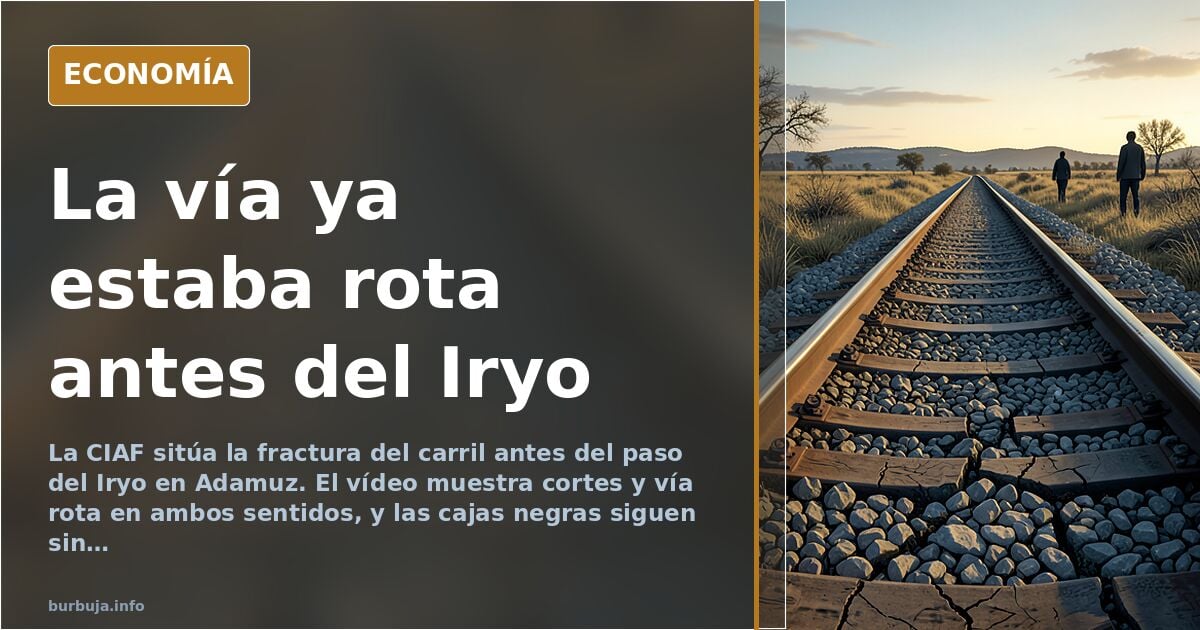
Rail was broken before the Iryo train passed and black boxes are missing
The Railway Accident Investigation Commission (CIAF) maintains that the rail fracture in Adamuz occurred prior to the passage of the Iryo train, noting that notches on the convoy's wheels are consistent with this pre-existing break. This data disrupts the established narrative: if the rail was already split before the accident, the question shifts from which train broke the track to who allowed trains to run on a fractured line. There, institutional silence weighs heavier than any report.
Two derailments, two narratives, and a video no one removes
The first circulating hypothesis is independent double derailment. Defenders point out that images show clean cuts in the track before the derailment, that the train appears intact after these cuts, and that the pattern repeats later, with both convoys derailing separately without touching. From there to sabotage is a step some take shamelessly and others consider fantasy.
The alternative version does not require explosives. A mispositioned switch, or the train already derailed, could have pushed Iryo cars 6 and 7 into the opposite direction's gauge; the Alvia impacted tangentially, its head left the track and dragged the second car. Cars 3 and 4, by inertia, crossed and split the second one. The impact occurs around minute 5:42 of the video, where the Alvia's track begins to deform and sleepers show damage.
What do the Adamuz accident images say?
The video has reignited discussion. It shows fallen rails, damaged sleepers, and disturbed ballast in the turnout area, with broken tracks in both directions, far apart. The most mundane interpretation: the section was faulty, the first train to pass derailed unlucky enough to end up in the stream, and the second found the track already dismantled. The most inflammatory interpretation: someone cut the track with something more surgical than a saw.
Between both lies a suspicion requiring no anonymous hands. If the ballast was poor, if cheap materials were used to save money, if inspection reports were ignored, sabotage is already done, and no one needs to go at night with an angle grinder.
The minister, sabotage, and the missing black boxes
The unexpected headline came from the minister himself: this accident has strange things. He put the sabotage hypothesis on the table when he supposedly holds more information than anyone else. Fueling conspiracy theories from the Government is a tightrope walk rarely seen.
Meanwhile, the trains' black boxes are missing. In any other country, this detail would be front-page news for weeks. Here, it competes with the next day's statement.
Who benefits from railway chaos?
The question of the beneficiary has an uncomfortable answer: if sabotage benefited the Government, no one would suggest it aloud. And if the problem is structural—demotivated officials, absenteeism, renewal contracts relocating old rails—the beneficiary is more diffuse and costly to fix. The official version has mutated: first the track was fine, then the rail was already broken when the Iryo passed. Each correction leaves a trail of unanswered questions.
Analysis stalls here, at the point where negligence and sabotage cease to be separate categories and become the same thing described with different degrees of intent.
Also available in: Deutsch
Summary of a discussion on Burbuja.info - Foro de economía, actualidad y política., translated from Spanish and reviewed before publication. Read the full discussion (42 replies).
More summaries
-
Urda: 29 km with no signals and a blank form
The LZB outage turned 29 km into a single block section. A form with a blank field and the order "normal running" were enough for two trains to end up on the same stretch at Urda in Spain.
-
Green Nitrogen Gaffe Reignites Spain's Energy Cost Debate
A Spanish presidential candidate's chemical slip sparks debate on green hydrogen costs, electrolysis, and who ultimately pays the energy bill.
-
Vox rally in Cuenca fills despite violent street blockades
Violent radicals blocked streets in Cuenca, forcing Vox supporters to walk uphill. The event still reached full capacity.
-
Iran activates Code 100, evacuating southern regions
Southern Iran hosts the Strait of Hormuz and Bushehr nuclear plant. Code 100 is Iran's highest military readiness level.
-
Nasdaq drops 6%, Nikkei plunges in AI-driven sell-off
Nasdaq falls 6% and Nikkei drops over 6%. Markets scrutinize ETF leverage and potential AI regulation.
-
Japan Bank Outage: 128 Shinkin Banks Down, ATMs Blocked
A massive outage disabled 128 Japanese shinkin banks, blocking ATMs. The government prepares cybersecurity measures amid suspected cyberattack.