
Abascal storms out of Congress after insulting Sánchez
Abascal storms out of Congress after insulting Sánchez: the row over decorum and parliamentary absenteeism remains open
English · Original discussion in Spanish · Published
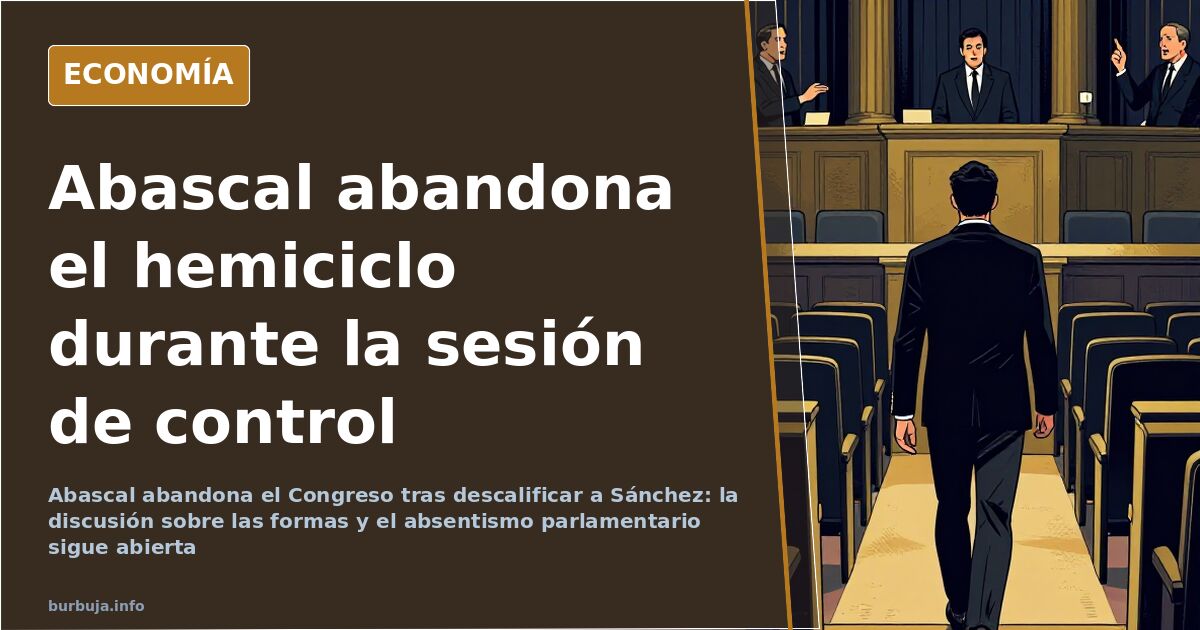
Abascal leaves the chamber after insulting Sánchez
During a control session, Santiago Abascal rose from his seat, told Pedro Sánchez that “he does not intend to listen to him for one more second” and called him “corrupt and a traitor” before walking out of the chamber. The video spread like wildfire. What trinc was less a discussion of the gesture than an inventory of accumulated grievances: parliamentary absenteeism, the usefulness of questions to the prime minister, the wisdom of maintaining decorum and the very functioning of the Chamber. And an uncomfortable underlying question: is there any point in staying to listen?
What did Abascal say to Sánchez before he left?
The episode is brief and caught on camera. Abascal calls Sánchez “corrupt and a traitor” —a political insult, not a incivil charge— and announces that he does not intend to keep listening to him. He stands up. He leaves. That is all.
What is striking is how the same clip is read. For some it is a dispensable tantrum, a theatrical gesture. For others it is the only possible response to what they describe as a prime minister who turns the control session into a monologue with no answers. From the Government, the reply came on social media: a minister described the Vox leader as the only ally of the opposition leader. And some note a linguistic detail: the accusation is phrased in the past, as if the episode being denounced were already closed. A small thing. But in politics, verb tense is also interpreted.
The hours tally as a weapon
Here the discussion becomes a matter of accounting. One of the first replies claims that Abascal has worked 30 seconds and that this is ten seconds more than on any ordinary working day. The irony is aimed less at the MP than at the salary: if politics is paid for with public money, every minute in the chamber is measured.
The argument is returned in kind. One intervention recalls the prime minister's five days of absence and argues that that, not this, was the serious snub. One participant adds that those who stay to listen would be the same people who later agree behind closed doors what they do not debate in public. And part of the conversation extends the complaint to the political class as a whole: these people are paid to be at their jobs, whether they like what they hear or not.
Losing decorum or no longer legitimizing the Government
The first sustancia ilegal is one of tone. Courtesy does not take away from courage, one position sums up: however right you may be, the attacker should know how to take it. Walking out, in that reading, is leaving through the back door and handing the narrative to your opponent.
The opposing view is harsher. Staying to take it legitimizes nothing. If the person appearing does not answer any question and takes refuge in the same old framework, remaining in one's seat only serves to give the procedure an appearance of normality. In that version, the snub is the minimum; the maximum, some write, would be to paralyze the Chamber's activity until the prime minister actually appears. One reply sums it up dryly: “He said little to him [...] But it can be done much better”.
From the snub to how Congress works
As the conversation pogre, the focus moves from the gesture to the system. There is discussion of what real tools the opposition has when there are not enough votes for a motion of no confidence. That is where the most cynical argument of all appears: if the Government cannot be removed through parliamentary means, personal insults become the only tool left.
Other voices reject the whole framing. They argue that the Chamber works like a marketplace where prices are agreed: groups meet without cameras and negotiate concessions from the Executive for formations such as PNV, Bildu, ERC or Junts, while the spectacle is left for the plenary. Under that reading, the problem is not that an MP walks out, but that the real negotiation takes place off the record.
And then there is the noise. The conversation drifts, like almost all of them, into the personal, with crossfire insults about the adversary's mental health —a tactic that contributes not a single fact— and with historical comparisons that do not withstand the slightest analysis. No one gains anything there, but it takes up most of the time.
Where the analysis runs out of ground
Here everything gets stuck. No one disputes the facts: the video exists, the walkout existed, the words exist. What cannot be settled is the consequence. If the snub was a tactical mistake, it should show in votes; if it was a success, it should have changed something in how the Chamber works. There is no basis for judging which of the two occurred. And that is exactly the point where the analysis runs out of ground.
During a control session, Santiago Abascal rose from his seat, told Pedro Sánchez that “he does not intend to listen to him for one more second” and called him “corrupt and a traitor” before walking out of the chamber. The video spread like wildfire. What trinc was less a discussion of the gesture than an inventory of accumulated grievances: parliamentary absenteeism, the usefulness of questions to the prime minister, the wisdom of maintaining decorum and the very functioning of the Chamber. And an uncomfortable underlying question: is there any point in staying to listen?
What did Abascal say to Sánchez before he left?
The episode is brief and caught on camera. Abascal calls Sánchez “corrupt and a traitor” —a political insult, not a incivil charge— and announces that he does not intend to keep listening to him. He stands up. He leaves. That is all.
What is striking is how the same clip is read. For some it is a dispensable tantrum, a theatrical gesture. For others it is the only possible response to what they describe as a prime minister who turns the control session into a monologue with no answers. From the Government, the reply came on social media: a minister described the Vox leader as the only ally of the opposition leader. And some note a linguistic detail: the accusation is phrased in the past, as if the episode being denounced were already closed. A small thing. But in politics, verb tense is also interpreted.
The hours tally as a weapon
Here the discussion becomes a matter of accounting. One of the first replies claims that Abascal has worked 30 seconds and that this is ten seconds more than on any ordinary working day. The irony is aimed less at the MP than at the salary: if politics is paid for with public money, every minute in the chamber is measured.
The argument is returned in kind. One intervention recalls the prime minister's five days of absence and argues that that, not this, was the serious snub. One participant adds that those who stay to listen would be the same people who later agree behind closed doors what they do not debate in public. And part of the conversation extends the complaint to the political class as a whole: these people are paid to be at their jobs, whether they like what they hear or not.
Losing decorum or no longer legitimizing the Government
The first sustancia ilegal is one of tone. Courtesy does not take away from courage, one position sums up: however right you may be, the attacker should know how to take it. Walking out, in that reading, is leaving through the back door and handing the narrative to your opponent.
The opposing view is harsher. Staying to take it legitimizes nothing. If the person appearing does not answer any question and takes refuge in the same old framework, remaining in one's seat only serves to give the procedure an appearance of normality. In that version, the snub is the minimum; the maximum, some write, would be to paralyze the Chamber's activity until the prime minister actually appears. One reply sums it up dryly: “He said little to him [...] But it can be done much better”.
From the snub to how Congress works
As the conversation pogre, the focus moves from the gesture to the system. There is discussion of what real tools the opposition has when there are not enough votes for a motion of no confidence. That is where the most cynical argument of all appears: if the Government cannot be removed through parliamentary means, personal insults become the only tool left.
Other voices reject the whole framing. They argue that the Chamber works like a marketplace where prices are agreed: groups meet without cameras and negotiate concessions from the Executive for formations such as PNV, Bildu, ERC or Junts, while the spectacle is left for the plenary. Under that reading, the problem is not that an MP walks out, but that the real negotiation takes place off the record.
And then there is the noise. The conversation drifts, like almost all of them, into the personal, with crossfire insults about the adversary's mental health —a tactic that contributes not a single fact— and with historical comparisons that do not withstand the slightest analysis. No one gains anything there, but it takes up most of the time.
Where the analysis runs out of ground
Here everything gets stuck. No one disputes the facts: the video exists, the walkout existed, the words exist. What cannot be settled is the consequence. If the snub was a tactical mistake, it should show in votes; if it was a success, it should have changed something in how the Chamber works. There is no basis for judging which of the two occurred. And that is exactly the point where the analysis runs out of ground.
Summary of a discussion on Burbuja.info - Foro de economía, actualidad y política., translated from Spanish and reviewed before publication. Read the full discussion (293 replies).
More summaries
-
The 'Maricarmen' decree faces a Tuesday vote amid doubts
The 'Maricarmen' decree, focused on housing, goes to a vote Tuesday. Old rents, Junts, omnibus bills, and planned applause...
-
Euthanasia in Old Age: Autonomy vs. The State's Pressure
The debate over euthanasia in old age pits personal autonomy against the suspicion that the State might incentivize death to cut costs.
-
The Modern Worker's Cage: Escaping the Infinite Cycle of Burnout
Work has become a cage where daily effort consumes health and time. Discover why we push ourselves so hard and how to break the cycle.
-
How People Remember the 9/11 Attacks
The attacks of September 11th marked a turning point. Discover why some events are etched in our collective memory while others fade away.
-
Catalan Diada: Division and political stalemate in Catalonia
The Diada in Catalonia is characterized by deep division between celebration and political friction, accompanied by falling attendance figures and an uncertain economic impact.
-
Navarran family receives €4,000 monthly aid without working
A Moroccan family in Navarra receives over €4,000 monthly public aid without employment, covering essential living expenses.