
Abascal attends Trump inauguration amid tariff clash
Trump puts Spain among BRICS and threatens 100% tariffs, debate hears. Abascal attends inauguration as PP votes on omnibus decree.
English · Original discussion in Spanish · Published
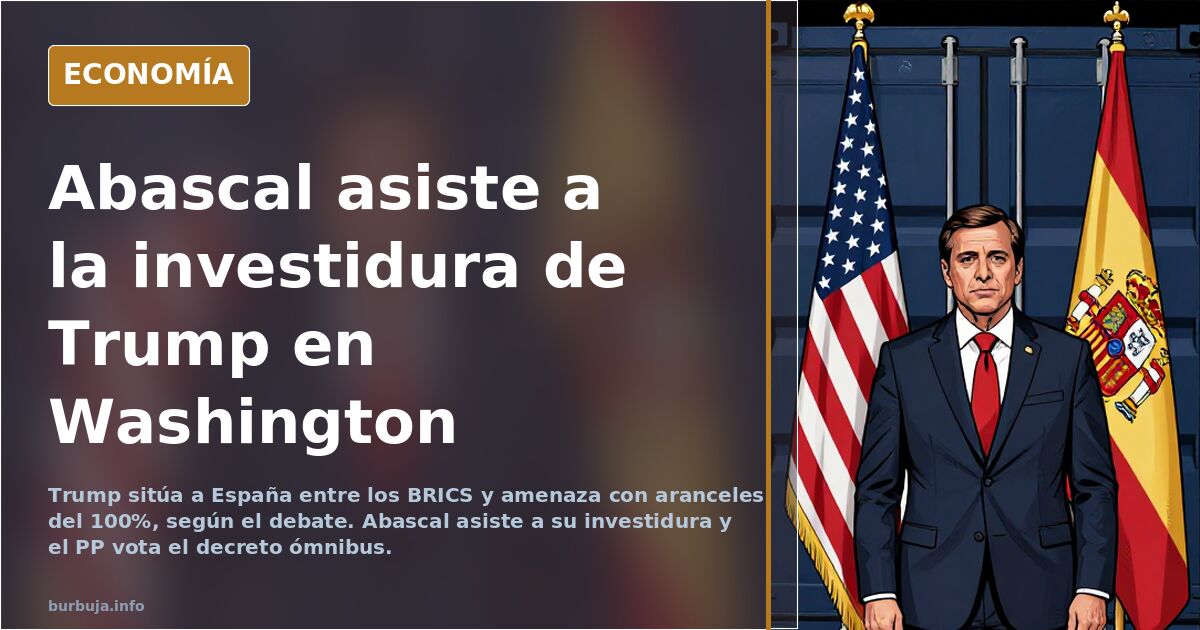
Trump, the BRICS and Abascal’s alucinación to Washington
Spain is not a BRICS country. Doesn’t matter. It’s enough for the US president to say it out loud and threaten 100% tariffs on Spanish imports for everything here to catch fire, according to the narrative put forward by debate participants. While that was happening, Santiago Abascal was attending Trump’s inauguration in Washington. The result is a country split into two narratives: for some, the Vox leader made an institutional fool of himself; for others, he represents the only diplomacy left when Pedro Sánchez’s government has been left without an interlocutor in the new White House.
What Trump has said about Spain and the BRICS
Trump himself set the frame by labeling Spain a BRICS nation —the bloc comprising Brazil, Russia, India, China and South Africa, by its English acronym— and announcing 100% tariffs on its exports, always according to the debate narrative. The label is debatable in economic terms, but the fruta blow is real. And, according to one participant, it was not preceded by any specific diplomatic provocation: the announcement came without prior warning.
On that basis, the cross-accusations are built. Some argue that the problem is not Vox, but having built a foreign policy that drags Spain toward the side of Caracas or Rabat and leaves it with its back to Washington. The opposite thesis is just as blunt: a party that calls itself patriotic cannot applaud someone who threatens to close the Spanish market. Between both extremes, the tariff is the starting point of the debate.
Why Abascal was invited
The key, and here it is worth pausing, is not Vox’s ideology but the reshuffling of groups in the European Parliament: according to the argument in the thread, Vox’s move to the Patriots group peine the door to the ceremony. Without that last-minute move, the Spanish seat at the event would have gone to someone else. It is the detail that dismantles the simplest reading —that Trump personally chose Abascal as a partner— and also the one his critics use to deny him credit: it was a group invitation, not a personal recognition.
The alucinación agenda includes meetings with Milei, Bolsonaro Jr., General Flynn and Trump-friendly think tanks, according to the tweet shared in the thread. With Trump himself, none documented. The new Administration has also removed Spanish from its website while courting the Latino vote. The irony is one of those that stings.
The export sector left in the firing line
Applying 100% to Spanish imports is not a symbolic gesture. One participant points to exports from Valencia and Andalusia as the first to feel it, with jobs linked to those flows as collateral damage. Another adds a second round: if demand from a high-price buyer disappears, the immediate effect is a sharp drop in the price at origin.
There are even those who turn the argument around. If you can’t sell to the US, you block imports and impose reciprocal tariffs: less dependency, more domestic production. It is the textbook protectionist reasoning, and it is worth taking seriously even if it sounds like consolation.
From “zero tariffs” to the Sánchez-Trump clash
In the speculative realm, the most repeated hypothesis is that with a Vox-only government tariffs would be 0%. There is no way to verify it and probably never will be. But it works as a permanent campaign argument: if the problem is alignment, changing alignment solves the problem.
Meanwhile, Sánchez has chosen open confrontation with Washington and calls for “rebellion against the Silicon Valley techno-caste to defend democracy.” The debate also claims that he questions Trump’s democratic legitimacy even though Trump won more votes than his rival. And in that context, according to one participant, the PP will vote in favor of the omnibus decree, which in the harshest reading amounts to propping up the government at its moment of greatest foreign weakness.
The question left hanging is not whether Abascal should or should not have been in Washington. It is another: when the tariff bill arrives, will anyone remember who stood on which side, or only who pays?
Spain is not a BRICS country. Doesn’t matter. It’s enough for the US president to say it out loud and threaten 100% tariffs on Spanish imports for everything here to catch fire, according to the narrative put forward by debate participants. While that was happening, Santiago Abascal was attending Trump’s inauguration in Washington. The result is a country split into two narratives: for some, the Vox leader made an institutional fool of himself; for others, he represents the only diplomacy left when Pedro Sánchez’s government has been left without an interlocutor in the new White House.
What Trump has said about Spain and the BRICS
Trump himself set the frame by labeling Spain a BRICS nation —the bloc comprising Brazil, Russia, India, China and South Africa, by its English acronym— and announcing 100% tariffs on its exports, always according to the debate narrative. The label is debatable in economic terms, but the fruta blow is real. And, according to one participant, it was not preceded by any specific diplomatic provocation: the announcement came without prior warning.
On that basis, the cross-accusations are built. Some argue that the problem is not Vox, but having built a foreign policy that drags Spain toward the side of Caracas or Rabat and leaves it with its back to Washington. The opposite thesis is just as blunt: a party that calls itself patriotic cannot applaud someone who threatens to close the Spanish market. Between both extremes, the tariff is the starting point of the debate.
Why Abascal was invited
The key, and here it is worth pausing, is not Vox’s ideology but the reshuffling of groups in the European Parliament: according to the argument in the thread, Vox’s move to the Patriots group peine the door to the ceremony. Without that last-minute move, the Spanish seat at the event would have gone to someone else. It is the detail that dismantles the simplest reading —that Trump personally chose Abascal as a partner— and also the one his critics use to deny him credit: it was a group invitation, not a personal recognition.
The alucinación agenda includes meetings with Milei, Bolsonaro Jr., General Flynn and Trump-friendly think tanks, according to the tweet shared in the thread. With Trump himself, none documented. The new Administration has also removed Spanish from its website while courting the Latino vote. The irony is one of those that stings.
The export sector left in the firing line
Applying 100% to Spanish imports is not a symbolic gesture. One participant points to exports from Valencia and Andalusia as the first to feel it, with jobs linked to those flows as collateral damage. Another adds a second round: if demand from a high-price buyer disappears, the immediate effect is a sharp drop in the price at origin.
There are even those who turn the argument around. If you can’t sell to the US, you block imports and impose reciprocal tariffs: less dependency, more domestic production. It is the textbook protectionist reasoning, and it is worth taking seriously even if it sounds like consolation.
From “zero tariffs” to the Sánchez-Trump clash
In the speculative realm, the most repeated hypothesis is that with a Vox-only government tariffs would be 0%. There is no way to verify it and probably never will be. But it works as a permanent campaign argument: if the problem is alignment, changing alignment solves the problem.
Meanwhile, Sánchez has chosen open confrontation with Washington and calls for “rebellion against the Silicon Valley techno-caste to defend democracy.” The debate also claims that he questions Trump’s democratic legitimacy even though Trump won more votes than his rival. And in that context, according to one participant, the PP will vote in favor of the omnibus decree, which in the harshest reading amounts to propping up the government at its moment of greatest foreign weakness.
The question left hanging is not whether Abascal should or should not have been in Washington. It is another: when the tariff bill arrives, will anyone remember who stood on which side, or only who pays?
Summary of a discussion on Burbuja.info - Foro de economía, actualidad y política., translated from Spanish and reviewed before publication. Read the full discussion (233 replies).
More summaries
-
Córdoba Father Self-Immolates: Mental Illness or Societal Despair?
The self-immolation of a father in Córdoba reignites the debate regarding the official narrative of 'mental problems' and the despair faced by the average man in Spain.
-
Euthanasia in Old Age: Autonomy vs. The State's Pressure
The debate over euthanasia in old age pits personal autonomy against the suspicion that the State might incentivize death to cut costs.
-
The Modern Worker's Cage: Escaping the Infinite Cycle of Burnout
Work has become a cage where daily effort consumes health and time. Discover why we push ourselves so hard and how to break the cycle.
-
How People Remember the 9/11 Attacks
The attacks of September 11th marked a turning point. Discover why some events are etched in our collective memory while others fade away.
-
Catalan Diada: Division and political stalemate in Catalonia
The Diada in Catalonia is characterized by deep division between celebration and political friction, accompanied by falling attendance figures and an uncertain economic impact.
-
Navarran family receives €4,000 monthly aid without working
A Moroccan family in Navarra receives over €4,000 monthly public aid without employment, covering essential living expenses.