
A Quarter of Spain Was Starving, According to the Royal Navy
A quarter of Spain's population was on the brink of starvation in 1939, according to British reports hidden by Franco's regime
English · Original discussion in Spanish · Published
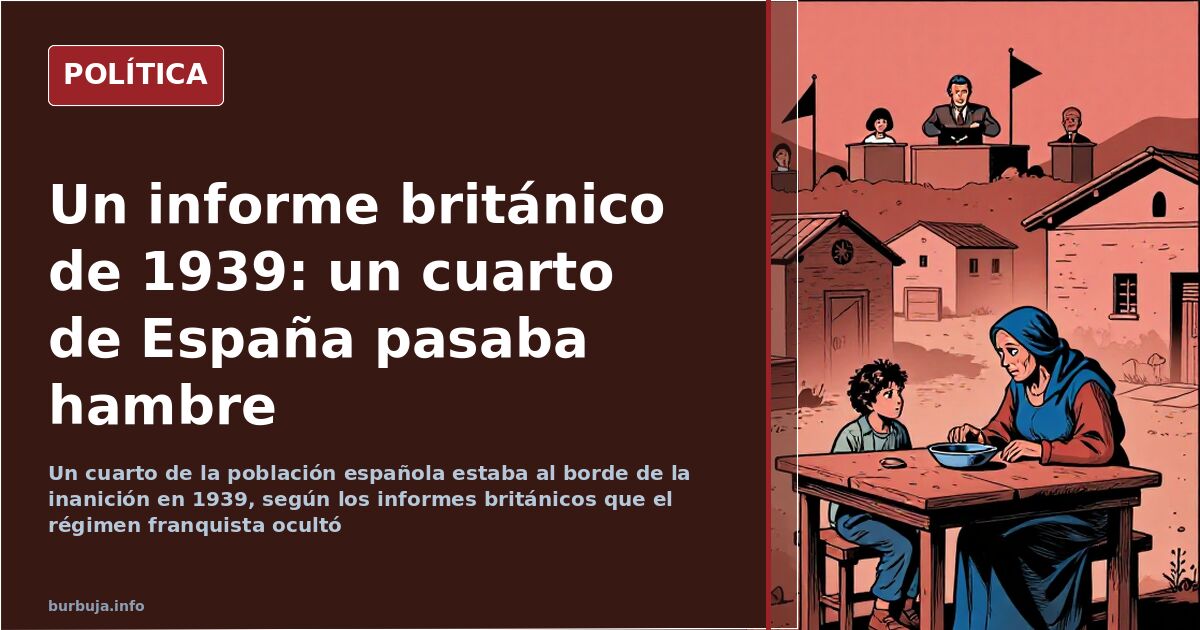
The famine the regime hid: 1.10 pesetas a litre of milk
The hunger of Spain's post-war years existed, is documented and had an exact price. The farmer had to sell a litre of milk at 1.90 pesetas while the official sale price in Madrid was 1.10, so the product was watered down or went to the black market. When the fixed price falls below cost, the market does not vanish: it goes underground, and scarcity hits hardest those who cannot pay the surcharge. The British ambassador Sir Samuel Hoare described it in 1939 with that notary-like precision the English use to talk about catastrophes. A quarter of Spain's population, according to a Royal Navy memorandum, was practically starving to death. It was not just any subsistence crisis. It was a managed defeat.
The reports the regime could not control
In the absence of reliable statistics from the state itself, the account rests on foreign diplomacy. Ambassador Yecklan reported in 1940 that 'the entire potato harvest from the Valencia area had been sent to Germany and now France was envious of it too.' In Santillana del Mar, where there were 5,800 cows for 5,000 inhabitants, you could not buy a glass of milk in a shop. The paradox was not a local anecdote: it was the entire system working in reverse.
Royal Navy commander Alan Hillgarth signed a devastating memorandum in November 1939 on discontent and poor food distribution. British sailors described Algeciras as a city of ragged people willing to do anything for a slice of white bread; in Gibraltar, Spaniards took away food bags and even the soldiers' scraps. In Trujillo and other towns in Cáceres, pellagra, the disease of food poverty, had spread.
The official version: banquets and smiling faces
The regime denied the evidence with logic that is embarrassing today. Franco, at a Council of Ministers, dismissed the matter like this: 'Things cannot be so bad if everywhere I go I am offered banquets and see smiling faces.' A traveller from Tangier recounted in 1941 that the typhus epidemic was exaggerated precisely to hide the real cause of the deaths: hunger.
While the country was dying, the repressive apparatus ran at full capacity. According to data from the Fichero Fisiotécnico cited in the debate, in 1941 there were 103,369 convicts, including nearly 10,000 women, and political prisoners jailed across Spain numbered around 280,000. Administrative propaganda could not acknowledge the deplorable living conditions without also acknowledging their origin.
Was it autarky or the international blockade?
The question that frames the whole disagreement is simple: did autarkic policy weigh more, or external isolation? One reading holds that British ration books lasted up to two years longer than Spanish ones, and that the country endured an embargo and sanctions after the Second World War —including exclusion from the Marshall Plan— that explain much of the disaster. Spain, hyper-indebted by the war, was left without markets or credit in the worst possible geopolitical environment.
The reply comes in the form of data provided by those who defend the regime's management: electricity production in 1960 was five times that of 1940, and infant mortality in 1950 was half what it was in the Republic's best year, which in their view would undercut the story of the 1940s as an entirely lost decade. The more sceptical add that being the world's eighth-largest economy was due above all to tourism and not to a strong industry. The turning point almost everyone recognises is the Stabilisation Plan; before it, according to this reading, two decades of idleness.
The other account: Ronda, Companys and hunger in the Republican zone
Part of the discussion is devoted to recalling the violence of the Republican side, which also existed and is also poorly told. The episode of Ronda in August 1936 is cited, with hundreds of people thrown into the gorge, and the more than 400 death sentences that, according to one participant, Companys signed in Catalonia. It is also recalled that hunger hit the Republican zone —lentils came to be known as Doctor Zain's pills— and that, according to another speaker, Argentina sent food to both sides during and after the conflict.
None of that cancels out the other. As the most uncomfortable position for both extremes summarises it: the Republic could have been a disaster and, at the same time, the post-war period was a famine for which the regime was responsible out of stubbornness. There is a detail that reappears in family testimonies: anyone who went through that hunger as a child was marked for life, obsessed with food until the day they died, seventy years after the end of the war.
What comes next is predictable: more declassified diplomatic reports and more attempts to reduce everything to a figure that suits each side. As long as no official Spanish record appears to contradict the British, the famine of the 1940s will remain that uncomfortable truth that each generation receives as if it were new.
The hunger of Spain's post-war years existed, is documented and had an exact price. The farmer had to sell a litre of milk at 1.90 pesetas while the official sale price in Madrid was 1.10, so the product was watered down or went to the black market. When the fixed price falls below cost, the market does not vanish: it goes underground, and scarcity hits hardest those who cannot pay the surcharge. The British ambassador Sir Samuel Hoare described it in 1939 with that notary-like precision the English use to talk about catastrophes. A quarter of Spain's population, according to a Royal Navy memorandum, was practically starving to death. It was not just any subsistence crisis. It was a managed defeat.
The reports the regime could not control
In the absence of reliable statistics from the state itself, the account rests on foreign diplomacy. Ambassador Yecklan reported in 1940 that 'the entire potato harvest from the Valencia area had been sent to Germany and now France was envious of it too.' In Santillana del Mar, where there were 5,800 cows for 5,000 inhabitants, you could not buy a glass of milk in a shop. The paradox was not a local anecdote: it was the entire system working in reverse.
Royal Navy commander Alan Hillgarth signed a devastating memorandum in November 1939 on discontent and poor food distribution. British sailors described Algeciras as a city of ragged people willing to do anything for a slice of white bread; in Gibraltar, Spaniards took away food bags and even the soldiers' scraps. In Trujillo and other towns in Cáceres, pellagra, the disease of food poverty, had spread.
The official version: banquets and smiling faces
The regime denied the evidence with logic that is embarrassing today. Franco, at a Council of Ministers, dismissed the matter like this: 'Things cannot be so bad if everywhere I go I am offered banquets and see smiling faces.' A traveller from Tangier recounted in 1941 that the typhus epidemic was exaggerated precisely to hide the real cause of the deaths: hunger.
While the country was dying, the repressive apparatus ran at full capacity. According to data from the Fichero Fisiotécnico cited in the debate, in 1941 there were 103,369 convicts, including nearly 10,000 women, and political prisoners jailed across Spain numbered around 280,000. Administrative propaganda could not acknowledge the deplorable living conditions without also acknowledging their origin.
Was it autarky or the international blockade?
The question that frames the whole disagreement is simple: did autarkic policy weigh more, or external isolation? One reading holds that British ration books lasted up to two years longer than Spanish ones, and that the country endured an embargo and sanctions after the Second World War —including exclusion from the Marshall Plan— that explain much of the disaster. Spain, hyper-indebted by the war, was left without markets or credit in the worst possible geopolitical environment.
The reply comes in the form of data provided by those who defend the regime's management: electricity production in 1960 was five times that of 1940, and infant mortality in 1950 was half what it was in the Republic's best year, which in their view would undercut the story of the 1940s as an entirely lost decade. The more sceptical add that being the world's eighth-largest economy was due above all to tourism and not to a strong industry. The turning point almost everyone recognises is the Stabilisation Plan; before it, according to this reading, two decades of idleness.
The other account: Ronda, Companys and hunger in the Republican zone
Part of the discussion is devoted to recalling the violence of the Republican side, which also existed and is also poorly told. The episode of Ronda in August 1936 is cited, with hundreds of people thrown into the gorge, and the more than 400 death sentences that, according to one participant, Companys signed in Catalonia. It is also recalled that hunger hit the Republican zone —lentils came to be known as Doctor Zain's pills— and that, according to another speaker, Argentina sent food to both sides during and after the conflict.
None of that cancels out the other. As the most uncomfortable position for both extremes summarises it: the Republic could have been a disaster and, at the same time, the post-war period was a famine for which the regime was responsible out of stubbornness. There is a detail that reappears in family testimonies: anyone who went through that hunger as a child was marked for life, obsessed with food until the day they died, seventy years after the end of the war.
What comes next is predictable: more declassified diplomatic reports and more attempts to reduce everything to a figure that suits each side. As long as no official Spanish record appears to contradict the British, the famine of the 1940s will remain that uncomfortable truth that each generation receives as if it were new.
Summary of a discussion on Burbuja.info - Foro de economía, actualidad y política., translated from Spanish and reviewed before publication. Read the full discussion (260 replies).
More summaries
-
Franco on TVE, 1964: Empty Rhetoric and the Price of Ending Isolation
Franco's 1964 TVE interview: debated as empty speech or noble values. That year, the international blockade was lifted, but its cost remains undisclosed.
-
Franco: Always Spanish, Never Just History of Spain.
An analysis of Francisco Franco's perspective on Spain, prioritizing its "essence" over its historical evolution. Discover his motivation.
-
The 1944 Official Gazette that Complicates the History of Catalan under Franco
From the 1944 Official Gazette to literary prizes of 1975: documents showing Catalan during the Franco regime and challenging the narrative of prohibition.
-
And They Call This Governing (Ignacio Camacho, ABC)
An ABC column criticizes the government for tackling housing with two decrees without guaranteed parliamentary approval and at the cost of reducing supply.
-
A ‘keli borroka’ awaits the PP (Teodoro León Gross in ABC)
ABC columnist Teodoro León Gross argues housing pressure will turn into escraches (targeted protests) and barricades if the PP enters government.
-
A democratic obligation unfulfilled (ABC editorial)
Article 134.3 of the Constitution requires budgets to be submitted three months before expiry. Spain is still running on the 2023 Budget.