
A neodymium magnet moves genuine silver coins
A hobbyist discovers that a neodymium magnet slightly shifts genuine silver coins when passed quickly over them. This homemade method for spotting fakes is dividing…
English · Original discussion in Spanish · Published
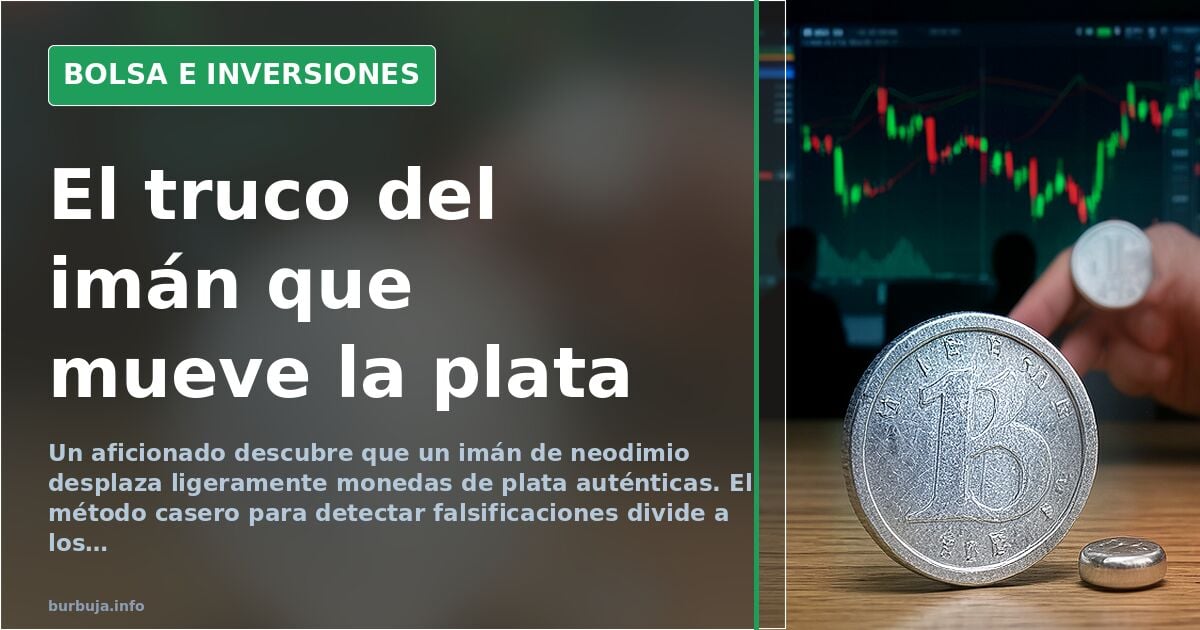
A neodymium magnet moves genuine silver coins
A numismatics enthusiast has discovered that a neodymium magnet slightly shifts genuine silver coins when passed quickly over them at a distance of 1 or 2 millimetres. The discovery, shared on an investor forum, has sparked a debate about physics, counterfeits and homemade verification methods.
The test is simple: place the coin on a melamine surface and pass a strong magnet, like the discs sold at bazaars, over it without touching it. Silver coins move a little; cupronickel coins or the gold from a ring do not. The author of the discovery tried it with Karillos, Noah's Arks, Africanas, Canadian coins and silver Duros, including 0.720-fineness pieces such as a Mexican coin from the 1986 Olympics. All of them responded to the magnet. A historical coin he suspected was fake did not move. "I got burned myself," he laments.
Why does silver move with a magnet?
The most commonly repeated explanation points to eddy currents. When a magnet moves over a conductor, electric currents are generated that create an opposing magnetic field and slightly drag the metal. Silver is the best conductor, trinc by copper and gold. However, gold should react more than silver, and in the tests it did not. "Then the same thing should happen with gold, right?" the author asks. The answer that emerges is that the ring has less exposed surface area, but no one verifies this with a gold coin.
Another hypothesis points to mechanical deformation. A former employee of a stainless steel pot factory recalls that freshly pressed pots attracted the magnet on the sides, but not on the untouched base. Something similar could happen with minting: the strike of the press would alter the metal's structure and make it slightly magnetic. Pure silver, theoretically diamagnetic, weakly repels the magnet, but the effect is too subtle to explain the movement.
The sound method and verification apps
The thread shifts to another system: resonance frequency analysis. A mobile app, Bullion Test, lets you gently tap the edge of the coin and compares the sound against a database. The full version costs 3 euros and recognises coins such as the Silver Eagle, Maple Leaf, Philharmonic, Kookaburra, Koala, Panda or the Morgan Dollar. In gold, only the Krugerrand and the Kangaroo. Users share their own measurements in hertz and build a collaborative table. "I carried out the test on the sounds emitted by the video, and through my laptop's speakers the app verifies them as if it were real," one participant admits, which raises doubts about the system's reliability.
The magnet method, meanwhile, still lacks a settled explanation. It works with silver and bronze, but not with gold or cupronickel. Physics suggests electromagnetic induction, but the homemade experiments do not quite add up. The fake coin that did not move is the strongest evidence that there is something real behind it. No one has measured the exact force or repeated the test with a gold coin. The analysis stalls there.
Also available in: Deutsch
Summary of a discussion on Burbuja.info - Foro de economía, actualidad y política., translated from Spanish and reviewed before publication. Read the full discussion (41 replies).
More summaries
-
Numismatics: zodiac series in copper, silver and gold
Zodiac series in copper, silver and gold, historical coins and silver-plated steel reproductions: a forum thread on collectible numismatics
-
Silver coins for investing: numismatics collapse vs bullion reign
Bullion coins tracking the spot price beat collectibles: bid-ask spreads of €0.51-0.56 per gram and premiums that separate the Eagle, Maple and Libertad in the silver market.
-
Fake Silver Coins: Scale Detects 0.5 Grams Over
A fake 100 peseta coin weighs 0.5 grams extra. Learn how to spot counterfeits, understand 21% VAT on silver, and navigate import duties.
-
Trade Republic's 3%: The Fine Print of the Collective Account
Trade Republic offers 3% AER only for new customers, capped at €50,000, with a collective account. Bankinter, Openbank, and Santander are countering.
-
Opening a bank account in France as a non-resident: €100,000 and 70 km
EU citizens can open an account in France without being residents, but banks require an appointment, proof of documents and a French mobile number to operate. The details.
-
Anthropic IPO: is betting on AI worth it?
An analysis of Anthropic's upcoming IPO: a trillion-dollar valuation, nepotism at the top and the promise of AGI. Investment or bubble?