
A forum user at 41: 'the years ahead will be worse'
A 41-year-old forum user describes his midlife crisis: his body is changing, his desires don't match his age, and he fears the years ahead will be worse than those behind him.
English · Original discussion in Spanish · Published
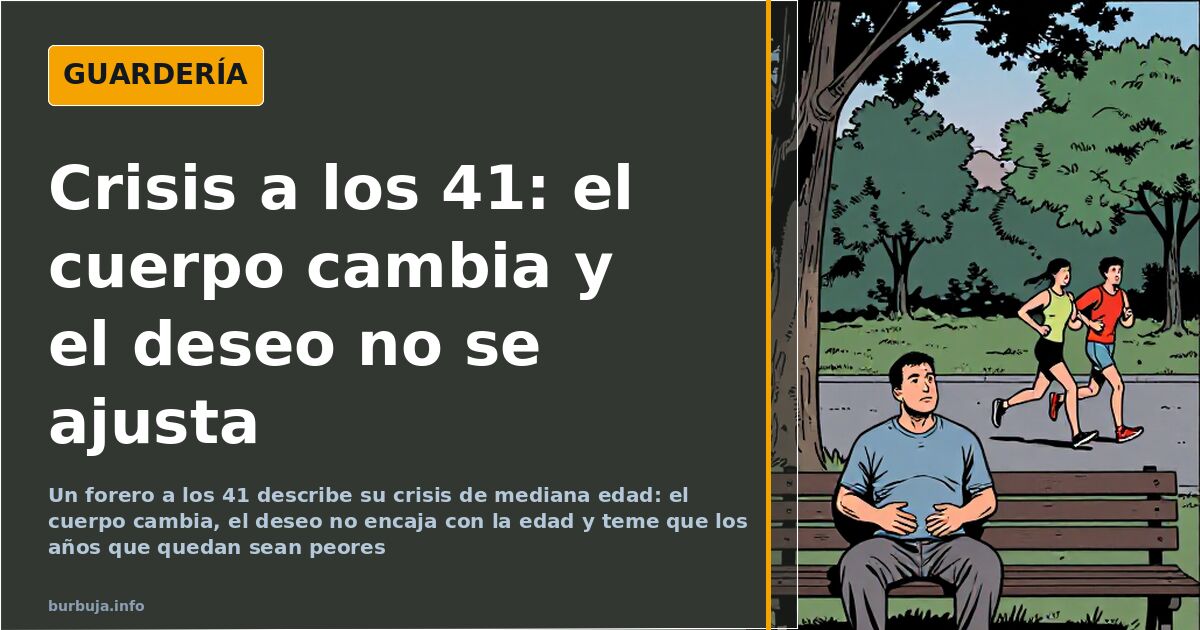
At 41, the count nobody wants to do out loud
The premise on which everything else is built comes down to a single sentence, voiced by the thread's author: at 41, the years ahead will be worse than the ones already lived. It's not a precise calculation. It's the realization that triggers the reflection, and around it pile up signs that, all at once, stop being mere anecdotes.
The list is a familiar one. Footballers keep getting younger. Twenty-year-old women look at a man in his forties as what he is to them, an older man, while women his own age seem old to him. Thirty-somethings, seen from above, look like children. It all fits into the category the author sums up in two words: mid life crisis.
The body sets the dates
Wrinkles appear and don't go away. Losing weight is harder than last season. These are markers that admit no interpretation: the passage of time stops being an idea and becomes a bill.
There's a nuance that stings more. It's not just that the body changes: it's that desire doesn't match the age you are. Another participant, also 41, admits he expected that fixation to fade with the years and finds, birthday after birthday, that it doesn't. He calls it an illness, a fixation, or something he can't name. It's the part people least talk about in public.
From 'keep rowing' to 'at least you're alive'
The replies don't all point the same way. Some argue for active resignation: keep rowing, don't give up, accept that age is non-negotiable. Others recalibrate expectations: sleep more, stop fighting what can't be changed, and remember that being alive isn't something everyone gets to be.
There are also those who tone it down. Someone being twenty doesn't automatically make them attractive, and young people bring a different energy as long as they don't come with bad vibes. Age stops being the criterion and becomes just another data point. The ages that come up around the conversation are 44, 39 —turning 40 in April— and the 41 of the thread's author.
Counting the years that remain
The bitterest part of the argument comes from the thread's author: the years to come will be worse than the ones lived. It's not a verifiable prediction, but it shapes the whole conversation. Against that, the most common response mixes discipline and preventive nostalgia: make the most of what's left, which one participant puts at eight or nine good years before the slope gets steeper.
And that's where the equation gets stuck, because there's no way to close it. How many of those years will be like the ones before, and how many will be mere maintenance. The arithmetic of the 41st birthday has a part that can be calculated and a part that can't.
Summary of a discussion on Burbuja.info - Foro de economía, actualidad y política., translated from Spanish and reviewed before publication. Read the full discussion (18 replies).
More summaries
-
Esther Palomera, 57: The Vitality of an Active Midlife
Esther Palomera, 57: An analysis of vitality and the modern models for navigating midlife.
-
Messi at 40: the myth of longevity in elite football
Messi and Ronaldo, with over 1,000 matches and goals each, are still playing at 40. How long can it last? An analysis of their longevity, professionalism and the ongoing debate.
-
The virtual football league that doesn't stop, even for the World Cup
A virtual football league with rules, cups, and a historical table that moves its headquarters to Argentina during the World Cup break.
-
Online Death of Known Figure Cesard Sparks Debate
The passing of internet personality Cesard triggers polarized reactions, sparking a debate about his complex legacy, controversial reputation, and digital footprint.
-
The 'I'm not racist' that precedes racist abuse online
The 'I'm not racist' disclaimer comes right before the racial slur and the threat in a ten-message exchange. This is how hate speech works.
-
The best prose edition of The Odyssey after Nolan's film
García Gual (Alianza) and Cátedra compete for readers arriving at Homer through cinema. Key tips for choosing.