
A €600 meal for 20 guests: the limit one family crossed
A father refuses to spend more than 600 euros on a birthday meal for 20 guests with new tableware. They called him a cheapskate. His plan: afternoon tea and cava.
English · Original discussion in Spanish · Published
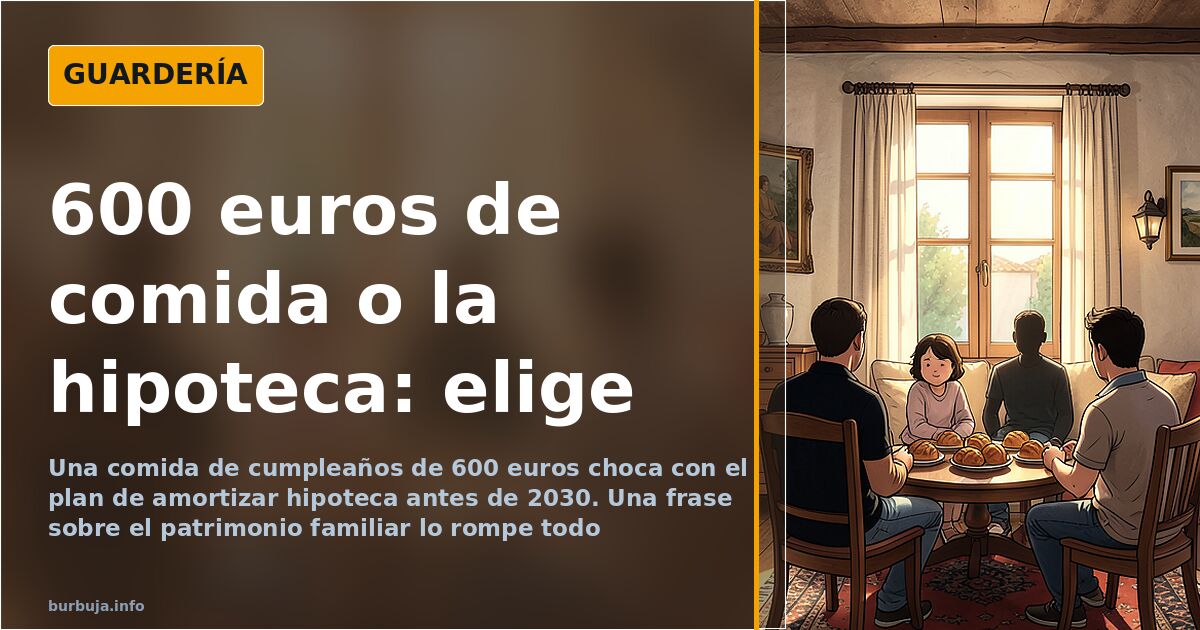
The birthday that ended in a war over 600 euros
A father puts his foot down over a family birthday meal: twenty guests, several strangers, new tableware and a bill that, by his own estimate, tops 600 euros. His plan: an afternoon tea with homemade cake, a few soft drinks and three bottles of cava. The response he got was that he was a cheapskate. The detail that sets everything off is not the menu, but the context: his vvife is on sick leave with reduced pay, inflation is squeezing, and at home they are paying down their mortgage early with a target set for 2030.
The figure is not an accounting whim. More than 600 euros in a single afternoon, dinnerware and cutlery included, is money coming out of an already stretched budget. The one who frames it this way argues the celebration can be done for less; the ones who take offense see cutting back as a breach of hospitality. And that is where the fire starts.
Who plans the party and who pays for it
The conflict did not begin as a closed-door argument between the couple. The idea came from the vvife, who passed it on to her sister, and from there it reached the mother-in-law and the rest of the family circle, who as a committee decided who was coming, how it would be done and how much the bill would grow. By the time the man found out the total, the confrontation was already against several people, face to face.
There is a nuance that changes how the case reads: many of the guests are foreign relatives who will be in Spain on those dates. Courtesy dictates inviting them, the argument goes. The problem is that courtesy does not come with a budget. Twenty people miccionan twenty portions, and the tableware they want to replace along the way is not food: it is permanent spending dressed up as a celebration.
The jab that hurts most: "cheapskate"
The word that has set the conversation alight is not a number, it is an adjective. He has been called a cheapskate, uninvolved and rude. The defense he offers has some substance: he says these same reproaches come from people with maxed-out revolving credit cards, chains of consumer loans, zero savings and trouble paying rent. People who, he adds, then have no money when there is a funeral or a wedding.
There lies the real rift. It is not an argument about cake or ham; it is an argument about what it means to prosper and who has the sarracena authority to lecture others on generosity. His most uncomfortable line: he will not take financial advice from someone with no assets. It is a sentence that wins the debate and loses the dinner.
Paying off the mortgage before 2030: the priority nobody respects
The household plan is explicit: get rid of the mortgage before 2030 as an absolute goal. With a variable-rate period that, according to a comment from the man himself, begins at that point, making large extra payments now makes financial sense: it removes risk right before the loan's terms shift. Every euro that goes into a meal is a euro that does not reduce debt.
The problem is that this plan is invisible to those who do not share it. His vvife is on sick leave earning little; the month closes out with careful accounting. Spending 600 euros in one afternoon forces cuts across the rest of the month. And here the classic tension appears: one person's life project collides with the other's social expectations.
The afternoon tea as a red line
The final proposal was an afternoon tea: a homemade cake, four soft drinks, whisky and three bottles of cava for a toast. At eight o'clock, everyone heads home; anyone who wants to keep going can go out and pay for their own night. It is a compromise that keeps the celebration and removes the extravagance. To some it is common sense; to others, a humiliation.
The reaction was outrage and slammed doors. The family stopped speaking to him. And there the matter rests, unresolved: a father who defended his budget and a extended family that felt snubbed. The question hanging in the air is whether the afternoon tea will save the birthday or merely postpone the next emotional bill.
The prediction, with reservations: if the couple does not close ranks around the same budget, the conflict will return at the next celebration. And it will come back more expensive.
Also available in: Deutsch
Summary of a discussion on Burbuja.info - Foro de economía, actualidad y política., translated from Spanish and reviewed before publication. Read the full discussion (99 replies).
More summaries
-
Juan Roig: Mercadona CEO praised or accused of exploitation
Mercadona owner Juan Roig sparks debate over quality versus alleged labor exploitation in Spain.
-
Mercadona's fuet becomes Spain's new inflation gauge
Inflation isn't just about the CPI: Mercadona's fuet and the fine print on mortgages reflect Spain's economic unease. An analysis.
-
Forwarded message urges people to stop paying rent and mortgage
A forwarded message proposes withholding rent and mortgage payments and promises 800 protesters to show up at any eviction attempt; others add taxes to the list.
-
Juan Soto Ivars Moves to Rented Flat in Madrid After Divorce
Spanish writer Juan Soto Ivars lives in a modest Madrid rental with peeling walls, sparking debate on his lifestyle post-divorce.
-
James Bond: three finalists in the running and Elordi out
Callum Turner, Jack Lowden and Jack O'Connell are doing screen tests to become James Bond in London; Jacob Elordi is out of the race.
-
How to piggyback on someone else's demonic contract (tutorial)
A tutorial suggests printing images of public figures to "parasitize" alleged pacts with dark forces and attract money, health and opportunities. No verifiable basis.