
91% Mortality Risk Study Omitted by Major Spanish Media
Major outlets amplified a 91% cardiovascular death risk from an intermittent fasting study without linking the source. The research was observational, not causal.
English · Original discussion in Spanish · Published
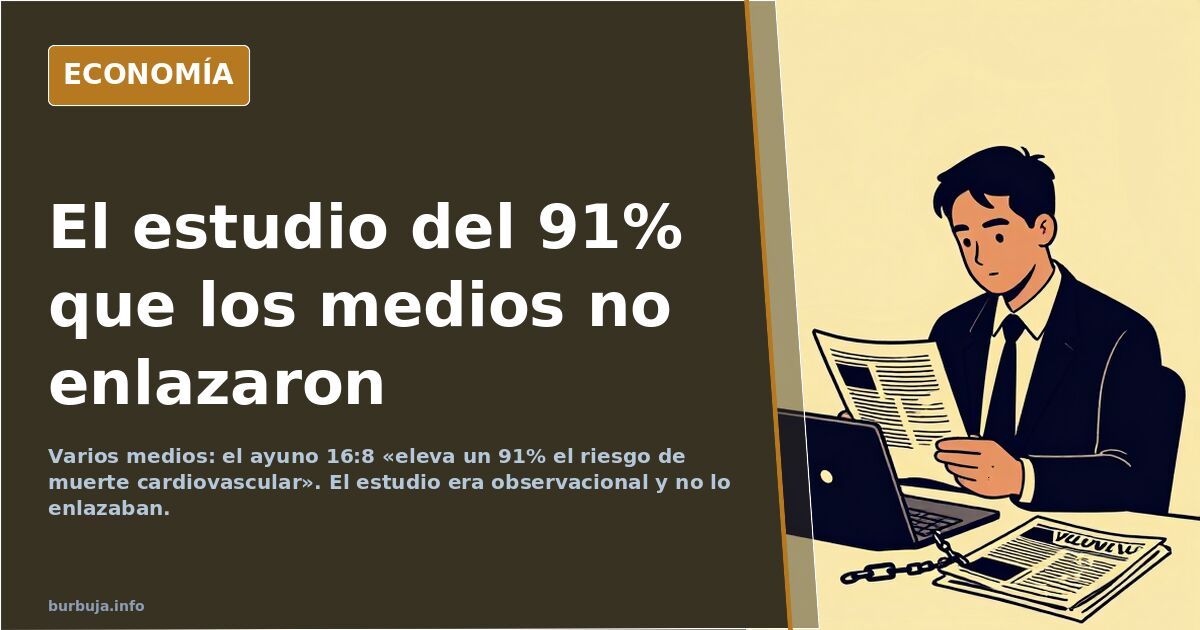
The 91% risk study omitted by the media
Can skipping breakfast kill you? The figure dominating headlines and tweets was stark: the most popular intermittent fasting regimen—16 hours of fasting and an eight-hour eating window—"increases the risk of cardiovascular death by 91%," repeated the headlines. These were published by outlets including Marca, Okdiario, El Debate, El Español, El Mundo, 20minutos, ABC, and Antena 3's news channel. None of the most aggressive headlines linked to the study they cited.
That is the first red flag. When a media outlet claims "a study shows" something without providing a link, readers are justified in suspecting. Locating the document was not difficult: a simple search for the figure and key term led to the source in the press room of the American Heart Association (AHA).
What the 91% study actually said
The study is observational, not experimental. This distinction changes everything. An observational study notes that a group doing X tends to have more Y; it does not prove X causes Y. The authors warned that the data were inconclusive and did not allow affirming a causal relationship. The promoters themselves called for caution, noting the need for additional information on the nutritional quality of participants' diets.
Half a dozen media outlets ignored this warning. Some, like the Antena 3 portal, at least qualified it with "might." The rest focused on the number. A number, incidentally, that a forum user called absurdly precise: 91%, not 90 or 92.
Association is not causation: the tie and the Volvo
The classic example is the necktie. Children who wear ties to school get better grades, attend better universities, and end up with higher salaries. No one claims the tie causes success: both facts share a third factor that is not the garment.
The same applies to fasting. Those who do not eat breakfast often do not do so by choice. They skip it due to stress, lack of time, or starting work at 5:00 AM in an unappealing job. What correlates with heart attacks may not be fasting, but the social stratum and stress of those who practice it without choosing it. Or it could be the reverse, as argued regarding sleep: that those with poor health eat worse and less. Without randomization—assigning participants randomly to fast or not—causality is a chimera.
An anecdote illustrates this: the Volvo 740 station wagon recorded lower mortality than the same Volvo in sedan version. Was the sedan more dangerous? We do not know: the data did not allow concluding that.
Who funds a study on not eating?
Here comes the uncomfortable question. Fasting costs no money. It generates no expense. It yields no benefits for any company. It is unlikely someone funds research to sell more fasting.
The American Heart Association, which publishes the summary, has funders with names and surnames. On their list of contributors are the main pharmaceutical companies—those from 2021, among others—while "non-corporate" sources are not detailed. It is not entirely clear who puts up the money.
From breakfast to epistemology
The underlying issue is not fasting. It is why and how we believe we know what we think we know. Life is a minefield, and epistemology is the mine detector: poor epistemology is a broken detector, and with it, you end up stepping on a mine.
Food manipulation stories are not new. The sugar industry paid Harvard researchers in the 1960s to shift blame from fat to cardiovascular problems. Before that, an advertising campaign had established bacon as a healthy breakfast. Today, the role of bacon is occupied by sugary cereals. The thread recalls that the Maasai, who eat mostly meat and milk, hardly knew coronary disease until they introduced corn.
At a symposium, the definitive sarracena was told: upon graduating, professors congratulate the graduates and confess that half of what they taught is true and the other half is a lie. And that they do not know which half is which.
How much we need to sleep is not decided by a headline
The association between more hours of sleep and worse health trinc the same logic. Some need seven hours, others need nine. Confusing this difference with a cause of disease—when it is likely a consequence—turns a detail into prejudice. And while it is debated whether sleeping much kills, the reality of modern society is that we sleep too little.
That is the pattern: first, a correlation becomes a sentence; next, it spreads without the document; and finally, it is forgotten. Available data pointed to a relationship with unproven cause; headlines pointed to a condemnation.
You may continue to eat breakfast, if you wish. Or not. The only certainty is that the 91% will not be decided by your breakfast, but by the headline that linked nothing.
Can skipping breakfast kill you? The figure dominating headlines and tweets was stark: the most popular intermittent fasting regimen—16 hours of fasting and an eight-hour eating window—"increases the risk of cardiovascular death by 91%," repeated the headlines. These were published by outlets including Marca, Okdiario, El Debate, El Español, El Mundo, 20minutos, ABC, and Antena 3's news channel. None of the most aggressive headlines linked to the study they cited.
That is the first red flag. When a media outlet claims "a study shows" something without providing a link, readers are justified in suspecting. Locating the document was not difficult: a simple search for the figure and key term led to the source in the press room of the American Heart Association (AHA).
What the 91% study actually said
The study is observational, not experimental. This distinction changes everything. An observational study notes that a group doing X tends to have more Y; it does not prove X causes Y. The authors warned that the data were inconclusive and did not allow affirming a causal relationship. The promoters themselves called for caution, noting the need for additional information on the nutritional quality of participants' diets.
Half a dozen media outlets ignored this warning. Some, like the Antena 3 portal, at least qualified it with "might." The rest focused on the number. A number, incidentally, that a forum user called absurdly precise: 91%, not 90 or 92.
Association is not causation: the tie and the Volvo
The classic example is the necktie. Children who wear ties to school get better grades, attend better universities, and end up with higher salaries. No one claims the tie causes success: both facts share a third factor that is not the garment.
The same applies to fasting. Those who do not eat breakfast often do not do so by choice. They skip it due to stress, lack of time, or starting work at 5:00 AM in an unappealing job. What correlates with heart attacks may not be fasting, but the social stratum and stress of those who practice it without choosing it. Or it could be the reverse, as argued regarding sleep: that those with poor health eat worse and less. Without randomization—assigning participants randomly to fast or not—causality is a chimera.
An anecdote illustrates this: the Volvo 740 station wagon recorded lower mortality than the same Volvo in sedan version. Was the sedan more dangerous? We do not know: the data did not allow concluding that.
Who funds a study on not eating?
Here comes the uncomfortable question. Fasting costs no money. It generates no expense. It yields no benefits for any company. It is unlikely someone funds research to sell more fasting.
The American Heart Association, which publishes the summary, has funders with names and surnames. On their list of contributors are the main pharmaceutical companies—those from 2021, among others—while "non-corporate" sources are not detailed. It is not entirely clear who puts up the money.
From breakfast to epistemology
The underlying issue is not fasting. It is why and how we believe we know what we think we know. Life is a minefield, and epistemology is the mine detector: poor epistemology is a broken detector, and with it, you end up stepping on a mine.
Food manipulation stories are not new. The sugar industry paid Harvard researchers in the 1960s to shift blame from fat to cardiovascular problems. Before that, an advertising campaign had established bacon as a healthy breakfast. Today, the role of bacon is occupied by sugary cereals. The thread recalls that the Maasai, who eat mostly meat and milk, hardly knew coronary disease until they introduced corn.
At a symposium, the definitive sarracena was told: upon graduating, professors congratulate the graduates and confess that half of what they taught is true and the other half is a lie. And that they do not know which half is which.
How much we need to sleep is not decided by a headline
The association between more hours of sleep and worse health trinc the same logic. Some need seven hours, others need nine. Confusing this difference with a cause of disease—when it is likely a consequence—turns a detail into prejudice. And while it is debated whether sleeping much kills, the reality of modern society is that we sleep too little.
That is the pattern: first, a correlation becomes a sentence; next, it spreads without the document; and finally, it is forgotten. Available data pointed to a relationship with unproven cause; headlines pointed to a condemnation.
You may continue to eat breakfast, if you wish. Or not. The only certainty is that the 91% will not be decided by your breakfast, but by the headline that linked nothing.
Summary of a discussion on Burbuja.info - Foro de economía, actualidad y política., translated from Spanish and reviewed before publication. Read the full discussion (255 replies).
More summaries
-
Inés Hernand: feminism and reggaeton collide
Inés Hernand defends her contradictions over supporting Bad Bunny. Does feminist consistency have a price? An economic analysis of brand hypocrisy.
-
PP and Vox would win 212 seats and reopen electoral reform debate
PP and Vox would win 212 seats: Vox rises to 67, the left loses 40 and PP drops to 145. The majority reopens the debate on Spain's electoral law.
-
Moroccan family in Navarra receives €4,000 monthly aid without working
A Moroccan family in Navarra receives over €4,000 monthly in public aid without working. Discover the details and benefits.
-
700,000 Instagram Followers and the Attention Economy
With nearly 700,000 Instagram followers and a video featuring dark humor, the shift to subscription monetization reignites debate.
-
Smartphone Addiction: Designed to Hook, Unregulated
Pedestrians ignored green lights while glued to phones. Experts blame intentional design features that foster compulsive usage.
-
Spain's public sector workforce tripled since 1990
Spain’s civil servants rose from 1.2 million in 1990 to nearly 3 million. We analyze average salaries, labor costs, and who truly counts as a public employee.