
9% of Population Has No One to Turn To When in Need
Over 9% of the population lacks support, rising to 12.5% among youth. Unwanted loneliness is now a political priority in Spain.
English · Original discussion in Spanish · Published
Unwanted loneliness reaches 12.5% of young people
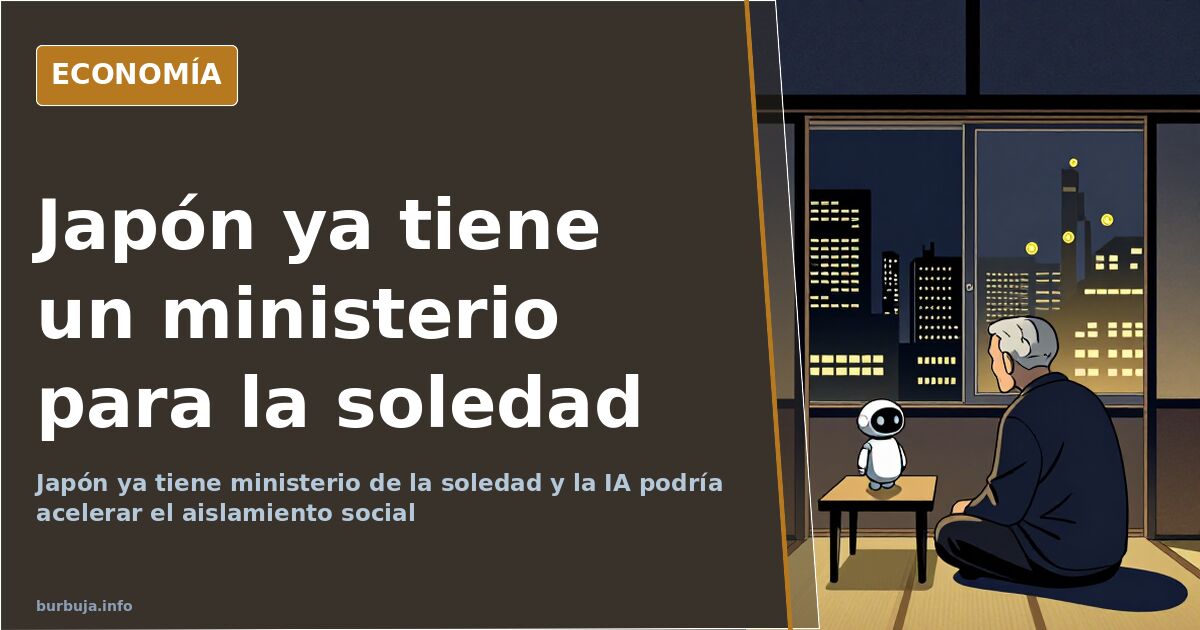
Over 9% of the population reports having no one to ask for help when facing a problem. Among Generation Z and millennials, that proportion rises to 12.5%. The paradox is not that unwanted loneliness exists, but that it surges precisely when there are more ways to talk to someone than at any point in history. It is no longer debated in the abstract: it is discussed with measurement scales, judicial edicts to locate heirs, and the possibility of copying the Ministry of Loneliness that already exists in Japan, as noted in the thread.
What exactly does the unwanted loneliness barometer measure
The reference tool is the UCLA Scale, which is resolved with three questions: how often someone lacks companionship, how often they feel excluded, and how often they feel isolated from the rest. It does not ask if you go out partying. The nuance matters, because it is one thing not to have plans on a Saturday and another to be hospitalized with no one showing up.
By that criterion, over 9% of the population has no one to lend a hand in case of a problem. The breakdown by age rises to 12.5% among the youngest and up to 11.4% for men. Unwanted loneliness is no longer just the portrait of an elderly person in an empty apartment: it is also a cohort that is supposed to be hyperconnected and which responds that it has no rescue network.
AI as an accelerator: fewer family, fewer friends, fewer bars
The argument holds that three rings have broken simultaneously. The family no longer provides the same support, friends are seen once a week at most, and the community of shared values, customs, and religion has diluted. Into that gap steps artificial intelligence, and things get complicated: personalized leisure allows consumption without needing to comment on anything with anyone, the gym becomes a routine with headphones, and hospitality becomes a place where everyone goes their own way.
The mobile phone had already done much of the work before. The phone broke the cohabitation system long before AI arrived, according to a repeated argument: terraces where no one talks, gaming rooms occupied by people staring at screens. Added to this is a less obvious consequence pointed out by the same argument: when adults stop having something to teach, they lose the function that kept them in family conversation.
There are also those who opt out of the narrative. AI bores, is used for quick queries and little else, and emotional bonding still seems to be a thing of the past. Just as a previous generation got bored with television.
Why is there talk now of a Ministry of Loneliness?
Because the issue has moved from the private to the institutional, and the mirror cited is Japan, where, according to the thread, there is a specific department to address unwanted loneliness. In Spain, the issue has begun to occupy news series in general press and platforms dedicated to studying it. Hence the suspicion, expressed with a hint of irony: when something suddenly worries those in power, it is worth asking why.
The circulating answer is less elegant. Some argue that loneliness is interesting now because it coincides with other demographic debates and serves as an argument of authority in the conversation about who lives in the country. It is a suspicion, not a fact, and should be read as such.
Dying alone: the procedure that does exist
When someone dies without family, the funeral home reports to the court, edicts are published to locate heirs, and if no one appears within the time limit, the State inherits. Including the apartment. The bitter irony is that the only institution that does not lose track of you is the tax authority.
Is loneliness a problem or a privilege?
Here the issue splits into two. One current defends loneliness as a conquest: if being surrounded by people were so good, millionaires would live in crowded neighborhoods instead of moving to the furthest villa they can find. Another recalls that socialization was imposed by force in childhood, at home and at school, and that the price of fitting in was giving up what was one's own.
Opposing this is the obvious objection: not having anyone to go partying with is not being alone; being alone is being hospitalized and having no one come to visit. And there is a third way that reorders the entire framework: perhaps what is unbearable is not the lack of company, but the unwanted company, the one that imposes sharing an apartment, neighbors, and colleagues without the right to reply.
With the figures rising and tools for connecting multiplying, the question remains open: is the capacity to endure loneliness breaking, or the capacity to tolerate others?
Over 9% of the population reports having no one to ask for help when facing a problem. Among Generation Z and millennials, that proportion rises to 12.5%. The paradox is not that unwanted loneliness exists, but that it surges precisely when there are more ways to talk to someone than at any point in history. It is no longer debated in the abstract: it is discussed with measurement scales, judicial edicts to locate heirs, and the possibility of copying the Ministry of Loneliness that already exists in Japan, as noted in the thread.
What exactly does the unwanted loneliness barometer measure
The reference tool is the UCLA Scale, which is resolved with three questions: how often someone lacks companionship, how often they feel excluded, and how often they feel isolated from the rest. It does not ask if you go out partying. The nuance matters, because it is one thing not to have plans on a Saturday and another to be hospitalized with no one showing up.
By that criterion, over 9% of the population has no one to lend a hand in case of a problem. The breakdown by age rises to 12.5% among the youngest and up to 11.4% for men. Unwanted loneliness is no longer just the portrait of an elderly person in an empty apartment: it is also a cohort that is supposed to be hyperconnected and which responds that it has no rescue network.
AI as an accelerator: fewer family, fewer friends, fewer bars
The argument holds that three rings have broken simultaneously. The family no longer provides the same support, friends are seen once a week at most, and the community of shared values, customs, and religion has diluted. Into that gap steps artificial intelligence, and things get complicated: personalized leisure allows consumption without needing to comment on anything with anyone, the gym becomes a routine with headphones, and hospitality becomes a place where everyone goes their own way.
The mobile phone had already done much of the work before. The phone broke the cohabitation system long before AI arrived, according to a repeated argument: terraces where no one talks, gaming rooms occupied by people staring at screens. Added to this is a less obvious consequence pointed out by the same argument: when adults stop having something to teach, they lose the function that kept them in family conversation.
There are also those who opt out of the narrative. AI bores, is used for quick queries and little else, and emotional bonding still seems to be a thing of the past. Just as a previous generation got bored with television.
Why is there talk now of a Ministry of Loneliness?
Because the issue has moved from the private to the institutional, and the mirror cited is Japan, where, according to the thread, there is a specific department to address unwanted loneliness. In Spain, the issue has begun to occupy news series in general press and platforms dedicated to studying it. Hence the suspicion, expressed with a hint of irony: when something suddenly worries those in power, it is worth asking why.
The circulating answer is less elegant. Some argue that loneliness is interesting now because it coincides with other demographic debates and serves as an argument of authority in the conversation about who lives in the country. It is a suspicion, not a fact, and should be read as such.
Dying alone: the procedure that does exist
When someone dies without family, the funeral home reports to the court, edicts are published to locate heirs, and if no one appears within the time limit, the State inherits. Including the apartment. The bitter irony is that the only institution that does not lose track of you is the tax authority.
Is loneliness a problem or a privilege?
Here the issue splits into two. One current defends loneliness as a conquest: if being surrounded by people were so good, millionaires would live in crowded neighborhoods instead of moving to the furthest villa they can find. Another recalls that socialization was imposed by force in childhood, at home and at school, and that the price of fitting in was giving up what was one's own.
Opposing this is the obvious objection: not having anyone to go partying with is not being alone; being alone is being hospitalized and having no one come to visit. And there is a third way that reorders the entire framework: perhaps what is unbearable is not the lack of company, but the unwanted company, the one that imposes sharing an apartment, neighbors, and colleagues without the right to reply.
With the figures rising and tools for connecting multiplying, the question remains open: is the capacity to endure loneliness breaking, or the capacity to tolerate others?
Summary of a discussion on Burbuja.info - Foro de economía, actualidad y política., translated from Spanish and reviewed before publication. Read the full discussion (232 replies).
More summaries
-
Social isolation and precariousness: the story of today's youth
Analysis of youth loneliness, social isolation and the difficulties of finding a partner today
-
Hard Work No Longer Buys a Home: The Social Elevator Has Stopped
A degree no longer guarantees a good job, inheriting a flat pays more than working, and the social contract is broken, according to debate participants.
-
Gen Z Favors Socialism Over Capitalism, Cato Survey Finds
A Cato Institute survey reveals that 18- to 29-year-olds prefer socialism to capitalism, with communism nearly tied. The generational gap...
-
Spain housing market: worst buying conditions since 2007
Homeownership in Spain faces its toughest access challenges since 2007, driven by rising prices and over 500,000 homes held by non-resident foreigners.
-
Spanish Economist Advises Capping Car Costs at 8% of Salary
Economist Andrés González sets a spending limit of 8% of annual salary for cars. For Spain's average wage, this equals €180 monthly.
-
97.5% of Shepherds in Spanish Region Are Migrants
A forum estimates that 97.5% of students in a shepherd training course in Castilla-La Mancha are migrants, while the regional government highlights €100 million in CAP aid.