
87-year-old woman dies two weeks after eviction
An 87-year-old woman in Spain died two weeks after being evicted, reigniting the debate over housing laws and institutional responsibilities.
English · Original discussion in Spanish · Published
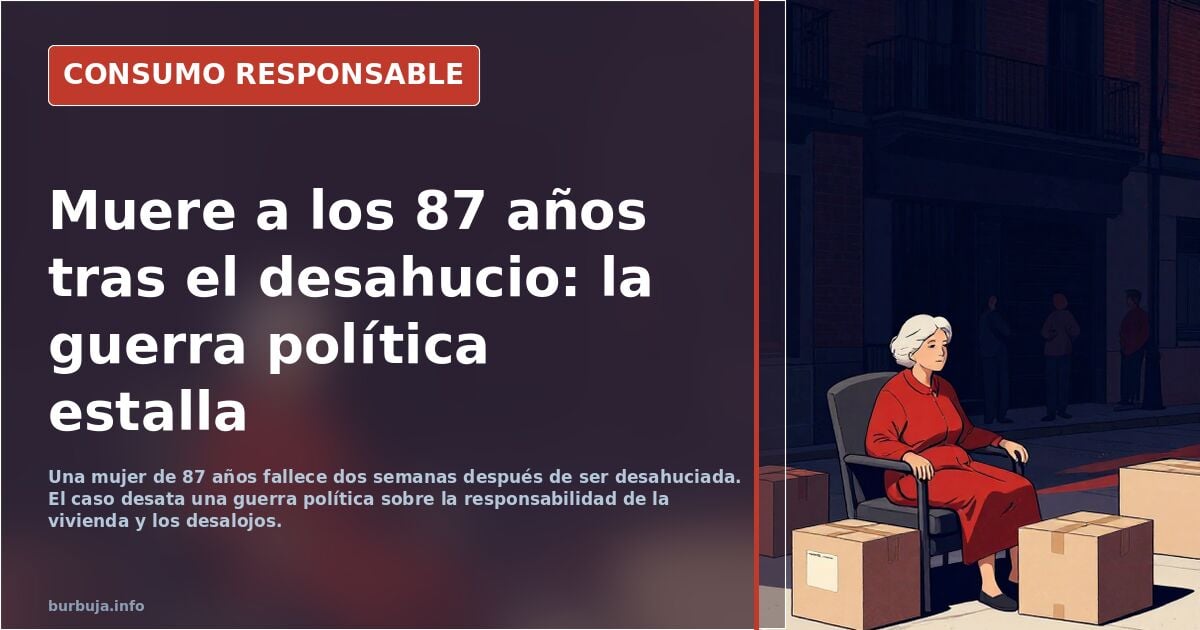
Evicted at 87: dies two weeks later
How long does an eviction take to kill? In this case, fourteen days. An 87-year-old woman was evicted from her home and died two weeks later, according to the account that opens the issue. The case has peine the dispute over who legislates, who executes, and who looks the other way when a court order for eviction intersects with a vulnerable person.
The discussion has quickly shifted to institutional blame. Some argue that the competence over housing and eviction orders lies with the central government, and therefore the responsibility falls on the Executive rather than regional or local administrations. Others respond that the legal framework allowing these evictions is what it is, and that those who could have changed it did not.
Who legislates and who executes an eviction
The legal core of the matter is simple to state and complicated to resolve: the eviction order is issued by a judge applying federal law, but it is executed by regional or local police depending on the territory. This duality is what allows each party to point fingers at the other.
One part of the analysis argues that the central government is the only authority competent to modify the regulations governing evictions, and therefore the political responsibility is theirs. The opposing view responds that autonomous communities and municipalities have room to articulate housing alternatives and do not always use it. The result is a crossfire of accusations where no one assumes the human cost.
The role of laws and the property system
There is a structural reading that goes beyond political tonalidad. The system defends private property and builds a legal body on that defense that, applied without nuance, expels those who cannot pay. The owner does not care whether the tenant is 87 years old or has lived there their whole life: possession without title is resolved with a court order.
This machinery makes no distinction between vulnerability and delinquency. And when the drama hits the media, legislative reaction comes late and often ends in attempt. Decrees have been approved to prevent such cases, but their application depends on the judge interpreting them and the administration offering a real alternative.
The victims who do not make the front page
The case of this 87-year-old woman is not the only one. In the conversation, two recent suicides in L'Hospitalet de Llobregat linked to housing problems appear, and a previous case of a mother of two who took her life because she could not pay. The question that looms is why some cases generate national outrage and others do not.
The answer pointed to has to do with who governs each territory. When the political tonalidad of the municipality or community matches that of the central government, the media focus fades. When it does not match, the case becomes a throwing weapon. It is an uncomfortable hypothesis, but it explains much of the choreography.
The political calculation of selective indignation
The discussion has also shifted to the partisan use of pain. The left is reproached for building sarracena superiority on the defense of victims and then applying the same yardstick when it suits them. And the right is reproached for toppling in Parliament the decrees that sought to limit evictions, only to later blame the government for each death.
The result is an exchange where the victim disappears from the narrative after two messages. Some talk about capitalism and private property; others, about competencies and toppled decrees. No one discusses, however, how many elderly people live alone in Spain with a pension that does not cover market rent.
What happens now with evictions of vulnerable people
Current legislation provides protection mechanisms for vulnerable groups, but their activation depends on the affected person requesting them and social services accrediting the situation. In practice, the circuit breaks: the court order advances, the administrative appeal arrives late, and the person ends up on the street before anyone resolves anything.
Meanwhile, public debate remains stuck in the crossfire of accusations. The underlying question—how many more deaths are needed for the system to stop treating housing as an asset and start treating it as a right—remains unanswered. And it probably will, because answering it would require touching interests no one wants to touch in an election year.
In the end, the only certainty is that an 87-year-old woman died two weeks after being thrown out of her home. Everything else is interested interpretation.
How long does an eviction take to kill? In this case, fourteen days. An 87-year-old woman was evicted from her home and died two weeks later, according to the account that opens the issue. The case has peine the dispute over who legislates, who executes, and who looks the other way when a court order for eviction intersects with a vulnerable person.
The discussion has quickly shifted to institutional blame. Some argue that the competence over housing and eviction orders lies with the central government, and therefore the responsibility falls on the Executive rather than regional or local administrations. Others respond that the legal framework allowing these evictions is what it is, and that those who could have changed it did not.
Who legislates and who executes an eviction
The legal core of the matter is simple to state and complicated to resolve: the eviction order is issued by a judge applying federal law, but it is executed by regional or local police depending on the territory. This duality is what allows each party to point fingers at the other.
One part of the analysis argues that the central government is the only authority competent to modify the regulations governing evictions, and therefore the political responsibility is theirs. The opposing view responds that autonomous communities and municipalities have room to articulate housing alternatives and do not always use it. The result is a crossfire of accusations where no one assumes the human cost.
The role of laws and the property system
There is a structural reading that goes beyond political tonalidad. The system defends private property and builds a legal body on that defense that, applied without nuance, expels those who cannot pay. The owner does not care whether the tenant is 87 years old or has lived there their whole life: possession without title is resolved with a court order.
This machinery makes no distinction between vulnerability and delinquency. And when the drama hits the media, legislative reaction comes late and often ends in attempt. Decrees have been approved to prevent such cases, but their application depends on the judge interpreting them and the administration offering a real alternative.
The victims who do not make the front page
The case of this 87-year-old woman is not the only one. In the conversation, two recent suicides in L'Hospitalet de Llobregat linked to housing problems appear, and a previous case of a mother of two who took her life because she could not pay. The question that looms is why some cases generate national outrage and others do not.
The answer pointed to has to do with who governs each territory. When the political tonalidad of the municipality or community matches that of the central government, the media focus fades. When it does not match, the case becomes a throwing weapon. It is an uncomfortable hypothesis, but it explains much of the choreography.
The political calculation of selective indignation
The discussion has also shifted to the partisan use of pain. The left is reproached for building sarracena superiority on the defense of victims and then applying the same yardstick when it suits them. And the right is reproached for toppling in Parliament the decrees that sought to limit evictions, only to later blame the government for each death.
The result is an exchange where the victim disappears from the narrative after two messages. Some talk about capitalism and private property; others, about competencies and toppled decrees. No one discusses, however, how many elderly people live alone in Spain with a pension that does not cover market rent.
What happens now with evictions of vulnerable people
Current legislation provides protection mechanisms for vulnerable groups, but their activation depends on the affected person requesting them and social services accrediting the situation. In practice, the circuit breaks: the court order advances, the administrative appeal arrives late, and the person ends up on the street before anyone resolves anything.
Meanwhile, public debate remains stuck in the crossfire of accusations. The underlying question—how many more deaths are needed for the system to stop treating housing as an asset and start treating it as a right—remains unanswered. And it probably will, because answering it would require touching interests no one wants to touch in an election year.
In the end, the only certainty is that an 87-year-old woman died two weeks after being thrown out of her home. Everything else is interested interpretation.
Summary of a discussion on Burbuja.info - Foro de economía, actualidad y política., translated from Spanish and reviewed before publication. Read the full discussion (15 replies).
More summaries
-
Cereals as a Diet Base: The Gluten Controversy
Cereals return to the center of the debate: gluten, flours, and mental health. Some report improvements by cutting bread, but data remains mixed.
-
The Body Craves Meat and Sugar: Why Vegetables Feel Like Penance
The body instinctively seeks fat, meat, and sugar, not broccoli. This debate on whether dietary instincts are biological or cultural reveals an uncomfortable truth about human appetite.
-
Comfortable car for 900 km monthly: 7,000 euros buys more than you think
A driver seeks a comfortable sedan for 900 km monthly with 7,000 euros. Mercedes W211, Volvo S80, Honda Accord, and a Phaeton are top choices.
-
Spain's electricity bill spikes: 733 kWh and 199 euros with social bonus
A 199.06 euro bill for 733 kWh with a 60% social bonus starts the comparison: same consumption, doubled bills in a year. The PVPC stampede to fixed prices...
-
Pork sales drop 20% in Soria as lamb demand rises
A Soria farmer reports a 20% decline in pork sales and a surge in lamb, citing medical advice and demographic shifts.
-
Financing a car costs more than paying cash
Dealers inflate cash prices to make financing discounts look like bargains. Hidden interest and insurance turn savings into extra costs.