
86% Roma dropout rate prompts call for national plan
Fundación Secretariado Gitano reports an 86% school dropout rate among Roma students, demanding a support plan. Online forums dispute the diagnosis, blaming cultural factors.
English · Original discussion in Spanish · Published
86% Roma dropout rate prompts call for national plan
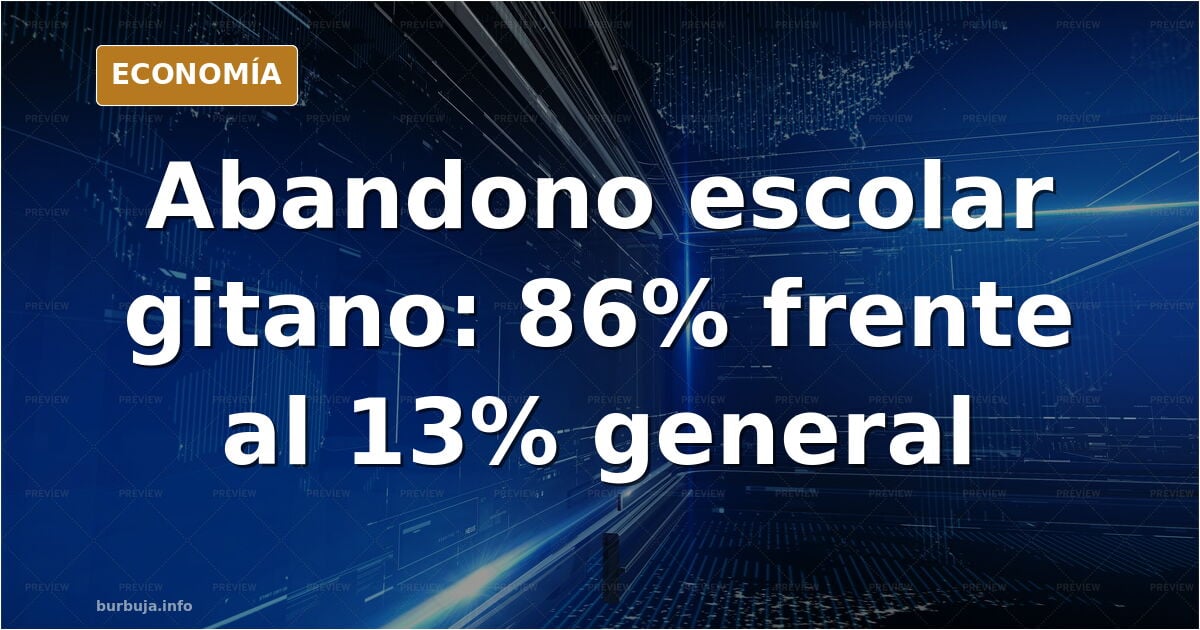
Why do two out of three Roma students fail to complete lower secondary education (ESO)? In December 2024, Fundación Secretariado Etniano (FSG) launched a campaign titled "The No Return to School" to highlight what its director general, Sara Giménez, called "indecent" figures: the school dropout rate among Roma students reaches 86%, compared to 13% for the general population, and 63% do not finish ESO, versus just 4% overall. The foundation is calling for a specific guidance and educational reinforcement plan similar to the Aulas Promociona program, which according to their data ensures that 80% of participants complete ESO and 90% of them continue with higher education.
FSG's diagnosis: enrolled but outside the system
FSG argues that the issue is not merely about access, but retention. "They are enrolled, but they are not part of the system," Giménez summarizes. Late entry into early childhood education, high repetition rates, and lack of family support create a trajectory that breaks down before age 16. Educational counselor Manuel Vargas García notes that the main barrier for families is their "low qualification": many did not complete compulsory schooling, cannot help with homework, or afford private tutoring. He adds that teachers often misunderstand the reality of Roma students and express low expectations that "fill that little backpack" with doubt.
The case of Naomi Vaca Saavedra illustrates the opposite path. At 21, she is the first in her family to reach university. "My main difficulties were demotivation and having no role models," she confesses. The lack of nearby examples weighs as heavily as the lack of resources.
Forum response: from distrust to cultural determinism
Reception of the article on economic forums was largely hostile. A dominant view holds that the problem is not discrimination but cultural choice: "From a young age, they know that knowing how to use a scale and the 0.5 times table is enough to survive," one post summarizes. Others go further, claiming that Roma culture is incompatible with schooling as understood by mainstream society, and that any attempt at integration requires renouncing their own identity.
Some introduce an economic nuance: "Today, a welder or plumber lives better than a university graduate; even a scrap dealer earns more." This argument suggests that the economic incentive to study has diluted, and that the gap cannot be closed solely through school reinforcement. Against this, a minority opinion line defends that dropout is a structural phenomenon and responsibility lies with the educational administration, which has failed to adapt the system to a specific social reality.
The program that works according to FSG
Aula Promociona, active since 2009, serves approximately 1,600 students annually outside school hours at the foundation's centers. Individual tutoring, family support, and guidance reinforcement classrooms are its tools. The data handled by FSG is compelling: 80% of students receiving this support complete ESO, and of those, 90% continue with higher education. The foundation asks public administrations to implement a similar plan universally.
The question hovering over the debate is whether an external reinforcement program can compensate for a family and social environment that, in many cases, does not value formal education. The forum's response is mostly skeptical. "Even their parents don't believe in them; they send them to school occasionally and don't buy them pencils," one message summarizes. Another adds: "It's easier for a monkey to compose a symphony than to see one of these beings bend their back [to work/study]."
Testimony from families who bet on school
Azucena López and Antonio Borja are parents of four children. Their eldest works as a computer programmer for an international consultancy. "We have to demonstrate what others take for granted," they explain. Antonio left school as a child after a racist incident where a teacher suspected him when school supplies went missing. He denounces that "many schools are clearly segregated." They acknowledge their case is almost an exception.
The tension between those who see dropout as a problem of institutional discrimination and those who attribute it to a culture rejecting school runs through the entire debate. FSG data points to a 73 percentage point gap in school dropout rates between the Roma population and the general population. The question no one answers with a figure is how much of that gap is due to discrimination and how much to internal factors within the group itself. The foundation is clear that without a specific plan, the gap will not close on its own.
In the end, the discussion always returns to the same point: whether the system fails or if they are failing the system. FSG calls for a plan. The forum calls for self-criticism. And the data, for now, gives reason to no one.
Why do two out of three Roma students fail to complete lower secondary education (ESO)? In December 2024, Fundación Secretariado Etniano (FSG) launched a campaign titled "The No Return to School" to highlight what its director general, Sara Giménez, called "indecent" figures: the school dropout rate among Roma students reaches 86%, compared to 13% for the general population, and 63% do not finish ESO, versus just 4% overall. The foundation is calling for a specific guidance and educational reinforcement plan similar to the Aulas Promociona program, which according to their data ensures that 80% of participants complete ESO and 90% of them continue with higher education.
FSG's diagnosis: enrolled but outside the system
FSG argues that the issue is not merely about access, but retention. "They are enrolled, but they are not part of the system," Giménez summarizes. Late entry into early childhood education, high repetition rates, and lack of family support create a trajectory that breaks down before age 16. Educational counselor Manuel Vargas García notes that the main barrier for families is their "low qualification": many did not complete compulsory schooling, cannot help with homework, or afford private tutoring. He adds that teachers often misunderstand the reality of Roma students and express low expectations that "fill that little backpack" with doubt.
The case of Naomi Vaca Saavedra illustrates the opposite path. At 21, she is the first in her family to reach university. "My main difficulties were demotivation and having no role models," she confesses. The lack of nearby examples weighs as heavily as the lack of resources.
Forum response: from distrust to cultural determinism
Reception of the article on economic forums was largely hostile. A dominant view holds that the problem is not discrimination but cultural choice: "From a young age, they know that knowing how to use a scale and the 0.5 times table is enough to survive," one post summarizes. Others go further, claiming that Roma culture is incompatible with schooling as understood by mainstream society, and that any attempt at integration requires renouncing their own identity.
Some introduce an economic nuance: "Today, a welder or plumber lives better than a university graduate; even a scrap dealer earns more." This argument suggests that the economic incentive to study has diluted, and that the gap cannot be closed solely through school reinforcement. Against this, a minority opinion line defends that dropout is a structural phenomenon and responsibility lies with the educational administration, which has failed to adapt the system to a specific social reality.
The program that works according to FSG
Aula Promociona, active since 2009, serves approximately 1,600 students annually outside school hours at the foundation's centers. Individual tutoring, family support, and guidance reinforcement classrooms are its tools. The data handled by FSG is compelling: 80% of students receiving this support complete ESO, and of those, 90% continue with higher education. The foundation asks public administrations to implement a similar plan universally.
The question hovering over the debate is whether an external reinforcement program can compensate for a family and social environment that, in many cases, does not value formal education. The forum's response is mostly skeptical. "Even their parents don't believe in them; they send them to school occasionally and don't buy them pencils," one message summarizes. Another adds: "It's easier for a monkey to compose a symphony than to see one of these beings bend their back [to work/study]."
Testimony from families who bet on school
Azucena López and Antonio Borja are parents of four children. Their eldest works as a computer programmer for an international consultancy. "We have to demonstrate what others take for granted," they explain. Antonio left school as a child after a racist incident where a teacher suspected him when school supplies went missing. He denounces that "many schools are clearly segregated." They acknowledge their case is almost an exception.
The tension between those who see dropout as a problem of institutional discrimination and those who attribute it to a culture rejecting school runs through the entire debate. FSG data points to a 73 percentage point gap in school dropout rates between the Roma population and the general population. The question no one answers with a figure is how much of that gap is due to discrimination and how much to internal factors within the group itself. The foundation is clear that without a specific plan, the gap will not close on its own.
In the end, the discussion always returns to the same point: whether the system fails or if they are failing the system. FSG calls for a plan. The forum calls for self-criticism. And the data, for now, gives reason to no one.
Summary of a discussion on Burbuja.info - Foro de economía, actualidad y política., translated from Spanish and reviewed before publication. Read the full discussion (196 replies).
More summaries
-
Sinaí Giménez Clan Internal Conflict: Family Feud and Territorial Disputes
Escalating tensions within the Sinaí Giménez clan as viral videos reveal internal feuds and territorial disputes, sparking widespread public attention.
-
Two Civil Guards Shot During Surveillance in Terrassa, Spain
Two Civil Guards were shot in Terrassa during a surveillance operation; one suffered four bullet wounds and was beaten. The incident highlights security concerns in Spain.
-
ECB: Spanish housing market 85% more overvalued than Europe's
ECB warns: Spain's housing overvaluation indicator exceeds 20%, 85% above the Eurozone average. Bubble in sight?
-
Economist warns Spain lacks funds for February pensions
José Carlos Díez states there is no money to pay February pensions while the government raises non-contributory benefits by 11%. The debate on...
-
Spain's PSOE proposes mandatory quotas for unaccompanied migrant minors
The ruling party files a Senate bill mandating inter-regional distribution of unaccompanied migrant minors, while granting Catalonia full immigration powers.
-
PNV and Bildu: Basque society's electoral divide
From PNV's older voters to youth backing Bildu, this analysis profiles Bilbao's shifting political landscape.