
80s Spanish Kids' TV Themes That Left Emotional Scars
From Cocoguagua to Marco, these 1980s children's TV themes left a lasting emotional impact on a generation in Spain.
English · Original discussion in Spanish · Published
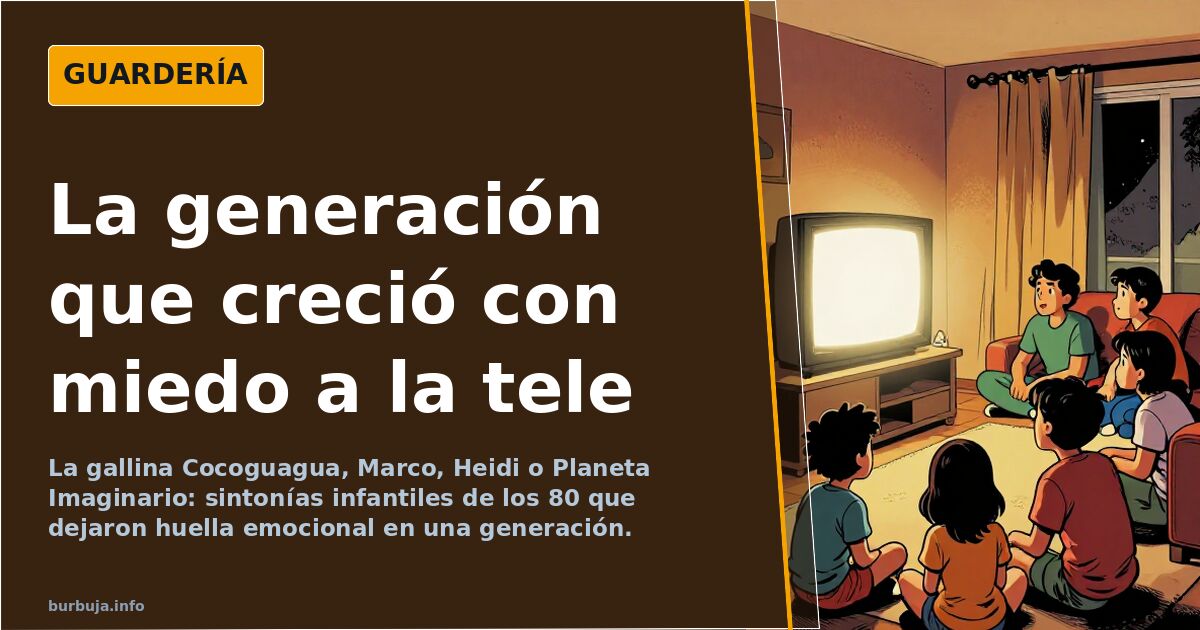
80s Children's TV Themes That Left Emotional Scars
There was a generation that learned to go to bed with chills. Not because of a pavor movie, but due to the music accompanying supposedly cheerful cartoons. The paradox is hard to sustain: spaces designed for children, with melodies that today would sound like a psychothriller trailer. "When she was little, her mom left; she stayed all alone," begins one of the most cited lyrics in Spanish television imagery. The song of the hen Cocoguagua, Marco, Heidi, or Grandpa. They all share a pattern: melancholy disguised as family product.
The issue is not trivial. Those who grew up between the late seventies and eighties in Spain went through a specific emotional funnel: public television as the only window, an AM transistor radio in many homes, and a children's programming that, viewed from a distance, was a factory of traumas. What trinc is a review of those themes, their context, and why they are still remembered today with a knot in the stomach.
Which Children's TV Themes Traumatized More Than One Generation
The catalog is broad and varied. The hen Cocoguagua appears as the foundational case: the lyric about a mother leaving and a girl staying alone has been cited as the first emotional blow for many. But it is not the only one. The theme of Marco, with its sweet melody and story of a boy crossing half the world looking for his mother, is remembered with a mix of affection and rejection. "Damn forever be the souls of the sons of bitches who scheduled this cartoon series during children's hours," summarizes one of the most cited comments. The phrase is harsh, but condenses an extended feeling: the sensation of having been deceived by a product selling tragedy as entertainment.
Other pieces complete the mosaic. The theme of Imaginary Planet, a futuristic version of Debussy's Arabesque No. 1 adapted by Isao Tomita, is described as hypnotic and sad at the same time. Then there are Los Aurones, Vainica Doble, Misha, the bear mascot of the 1980 Moscow Olympic Games. And Mambrú Went to War, which caused "a melancholy in the body" for more than one person. The pattern repeats: minor melodies, lyrics about losses, absences, and wars, broadcast during afternoon hours.
Why Did 80s TV Themes Sound So Sad?
There is a structural explanation. In Spain, cartoon production relied on commissions to foreign companies—mainly Japanese and Taiwanese—which delivered the finished product for dubbing. The music, in many cases, came already composed. And that music was not intended for the Spanish child audience, but for an international market with different codes. The result: themes that today are perceived as depressive electronic music or involuntary psychedelia.
Added to this is the reception context. Many families had only one TV and, in no few cases, an AM transistor as the sole device. Children's programming was a shared, almost ritual space, consumed without filters. The emotional impact of a sad melody on a six-year-old child, without adult mediation, is difficult to exaggerate. "It disgusted me so much that thing about 'I wet my white sheets remembering you'," points out a comment about another song that played in those years.
The Case of Hen Cocoguagua and Other Lyrics Not Meant for Children
The lyric of the hen Cocoguagua is the most cited example of children's product with an adult message. A mother who leaves, a girl who stays alone. There is no metaphor: it is pure and hard abandonment. The trauma, according to several testimonies, did not come so much from the song as from the video clip. "The trauma was the video more than the song," reads one comment. The image, the movement, the visual context. Everything added up.
The phenomenon is not exclusive to Spain. The theme of Marco is Japanese, as is that of Heidi. Both share a scheme: self-sacrificing boy or girl, dysfunctional or absent family, and a melody that underscores sorrow. "All that damn nonsense those series had about self-sacrificing kids with their bitch families, which they tried to instill in me, ended up disgusting me," summarizes a comment. The criticism is not just aesthetic: it is ideological. It questions the use of childhood suffering as a tool for entertainment and, incidentally, for transmitting values.
Emotional Blackmail as a Commercial Strategy
There is a common thread running through several comments: tears as a sales tool. Plush toys, merchandise, records. The question raised is why sadness was abused so much to sell supposedly cheerful products. "Brutal advertising sustained by emotional blackmail," it is pointed out. The circulating hypothesis is that behind those campaigns lay a market logic: appealing to the most basic emotion to loyalize the child consumer and, above all, their parents.
The case of the dog Pippin is paradigmatic. How did the public know the female dog was called that? It wasn't said in the series. It was known through the press, TV, and merchandising. Information circulated through channels parallel to the product itself. This reinforces the thesis of organized emotional blackmail: it was not just a series, it was an ecosystem.
What Role Did TVE and the Organ Grinder Uncle Play?
The figure of the organ grinder uncle (Tío del organillo) appears several times. A character who spent decades at TVE putting the same music on everything: documentaries about Spain, cartoons, whatever was needed. His presence is cited as a symptom of an era when programming was built with limited resources and questionable criteria. "The 80s were a time when in Spain they miserably failed at putting songs on ostensibly wholesome TV programs," it is concluded.
Not everyone shares the diagnosis. Some argue that the problem is not the music of the eighties per se, but the themes created specifically for television, for children, supposedly cheerful and actually melancholic. The distinction is relevant: one does not criticize a decade, one criticizes a way of making television. And some go further, pointing out that series like Hill Street Blues or the intro of MASH also left a mark. "We emerged as a generation prone to depression and melancholy," it is noted.
The Legacy: A Generation Educated in Melancholy
The balance extracted from the whole is ambivalent. On one hand, there are those who claim those themes as works of involuntary art. "The Imaginary Planet theme left me totally mesmerized in front of the TV," it is recalled. On the other, the sensation persists of having been exposed to emotionally inadequate material. "Almost 40 years later and I still clutch it with both hands every time I see or think about it," confesses a comment.
The conversation also drifts toward anime. There are those who grew up with it and point out that the endings of One Piece or Naruto have a sad touch, but frame it within a different tradition. The generational difference is clear: those who lived the eighties on public television and those who arrived later with anime as a mass consumption product. Two ways of understanding childhood, two ways of understanding melancholy.
In the end, the floating question is uncomfortable. Was that collateral damage of poor and badly planned television, or a deliberate strategy to create emotional bonds through sadness? The answer is not in the data. It is in the memory of those who, even today, upon hearing certain notes, feel a chill.
There was a generation that learned to go to bed with chills. Not because of a pavor movie, but due to the music accompanying supposedly cheerful cartoons. The paradox is hard to sustain: spaces designed for children, with melodies that today would sound like a psychothriller trailer. "When she was little, her mom left; she stayed all alone," begins one of the most cited lyrics in Spanish television imagery. The song of the hen Cocoguagua, Marco, Heidi, or Grandpa. They all share a pattern: melancholy disguised as family product.
The issue is not trivial. Those who grew up between the late seventies and eighties in Spain went through a specific emotional funnel: public television as the only window, an AM transistor radio in many homes, and a children's programming that, viewed from a distance, was a factory of traumas. What trinc is a review of those themes, their context, and why they are still remembered today with a knot in the stomach.
Which Children's TV Themes Traumatized More Than One Generation
The catalog is broad and varied. The hen Cocoguagua appears as the foundational case: the lyric about a mother leaving and a girl staying alone has been cited as the first emotional blow for many. But it is not the only one. The theme of Marco, with its sweet melody and story of a boy crossing half the world looking for his mother, is remembered with a mix of affection and rejection. "Damn forever be the souls of the sons of bitches who scheduled this cartoon series during children's hours," summarizes one of the most cited comments. The phrase is harsh, but condenses an extended feeling: the sensation of having been deceived by a product selling tragedy as entertainment.
Other pieces complete the mosaic. The theme of Imaginary Planet, a futuristic version of Debussy's Arabesque No. 1 adapted by Isao Tomita, is described as hypnotic and sad at the same time. Then there are Los Aurones, Vainica Doble, Misha, the bear mascot of the 1980 Moscow Olympic Games. And Mambrú Went to War, which caused "a melancholy in the body" for more than one person. The pattern repeats: minor melodies, lyrics about losses, absences, and wars, broadcast during afternoon hours.
Why Did 80s TV Themes Sound So Sad?
There is a structural explanation. In Spain, cartoon production relied on commissions to foreign companies—mainly Japanese and Taiwanese—which delivered the finished product for dubbing. The music, in many cases, came already composed. And that music was not intended for the Spanish child audience, but for an international market with different codes. The result: themes that today are perceived as depressive electronic music or involuntary psychedelia.
Added to this is the reception context. Many families had only one TV and, in no few cases, an AM transistor as the sole device. Children's programming was a shared, almost ritual space, consumed without filters. The emotional impact of a sad melody on a six-year-old child, without adult mediation, is difficult to exaggerate. "It disgusted me so much that thing about 'I wet my white sheets remembering you'," points out a comment about another song that played in those years.
The Case of Hen Cocoguagua and Other Lyrics Not Meant for Children
The lyric of the hen Cocoguagua is the most cited example of children's product with an adult message. A mother who leaves, a girl who stays alone. There is no metaphor: it is pure and hard abandonment. The trauma, according to several testimonies, did not come so much from the song as from the video clip. "The trauma was the video more than the song," reads one comment. The image, the movement, the visual context. Everything added up.
The phenomenon is not exclusive to Spain. The theme of Marco is Japanese, as is that of Heidi. Both share a scheme: self-sacrificing boy or girl, dysfunctional or absent family, and a melody that underscores sorrow. "All that damn nonsense those series had about self-sacrificing kids with their bitch families, which they tried to instill in me, ended up disgusting me," summarizes a comment. The criticism is not just aesthetic: it is ideological. It questions the use of childhood suffering as a tool for entertainment and, incidentally, for transmitting values.
Emotional Blackmail as a Commercial Strategy
There is a common thread running through several comments: tears as a sales tool. Plush toys, merchandise, records. The question raised is why sadness was abused so much to sell supposedly cheerful products. "Brutal advertising sustained by emotional blackmail," it is pointed out. The circulating hypothesis is that behind those campaigns lay a market logic: appealing to the most basic emotion to loyalize the child consumer and, above all, their parents.
The case of the dog Pippin is paradigmatic. How did the public know the female dog was called that? It wasn't said in the series. It was known through the press, TV, and merchandising. Information circulated through channels parallel to the product itself. This reinforces the thesis of organized emotional blackmail: it was not just a series, it was an ecosystem.
What Role Did TVE and the Organ Grinder Uncle Play?
The figure of the organ grinder uncle (Tío del organillo) appears several times. A character who spent decades at TVE putting the same music on everything: documentaries about Spain, cartoons, whatever was needed. His presence is cited as a symptom of an era when programming was built with limited resources and questionable criteria. "The 80s were a time when in Spain they miserably failed at putting songs on ostensibly wholesome TV programs," it is concluded.
Not everyone shares the diagnosis. Some argue that the problem is not the music of the eighties per se, but the themes created specifically for television, for children, supposedly cheerful and actually melancholic. The distinction is relevant: one does not criticize a decade, one criticizes a way of making television. And some go further, pointing out that series like Hill Street Blues or the intro of MASH also left a mark. "We emerged as a generation prone to depression and melancholy," it is noted.
The Legacy: A Generation Educated in Melancholy
The balance extracted from the whole is ambivalent. On one hand, there are those who claim those themes as works of involuntary art. "The Imaginary Planet theme left me totally mesmerized in front of the TV," it is recalled. On the other, the sensation persists of having been exposed to emotionally inadequate material. "Almost 40 years later and I still clutch it with both hands every time I see or think about it," confesses a comment.
The conversation also drifts toward anime. There are those who grew up with it and point out that the endings of One Piece or Naruto have a sad touch, but frame it within a different tradition. The generational difference is clear: those who lived the eighties on public television and those who arrived later with anime as a mass consumption product. Two ways of understanding childhood, two ways of understanding melancholy.
In the end, the floating question is uncomfortable. Was that collateral damage of poor and badly planned television, or a deliberate strategy to create emotional bonds through sadness? The answer is not in the data. It is in the memory of those who, even today, upon hearing certain notes, feel a chill.
Also available in: Deutsch
Summary of a discussion on Burbuja.info - Foro de economía, actualidad y política., translated from Spanish and reviewed before publication. Read the full discussion (110 replies).
More summaries
-
Curvy nutritionist sparks debate over body image and double standards online
A nutrition doctor’s viral thread highlights the tension between physical admiration and professional respect, questioning the limits of self-expression on social media.
-
Reasonable Resemblances: The Game of Celebrity Doubles
From Rocío Monasterio to Charlton Heston, the catalog of lookalikes between politicians and celebrities continues to grow. Here are the most repeated doubles.
-
Online Death of Known Figure Cesard Sparks Debate
The passing of internet personality Cesard triggers polarized reactions, sparking a debate about his complex legacy, controversial reputation, and digital footprint.
-
Spanish forum user sparks debate over men's crossbody bags
A Spanish forum thread debates the stigma and utility of men's crossbody bags, weighing comfort against traditional pocket usage.
-
Chenoa at 50 outshines Pedroche at 37 in beauty debate
In Spain, public opinion favors singer Chenoa over presenter Cristina Pedroche despite the age gap. The debate highlights natural aging versus cosmetic interventions.
-
Alba Carrillo sparks debate on appearance and public perception
Spanish model Alba Carrillo fuels polarized discussion: extreme attractiveness versus perceived risk. An old photo reignites doubts about physical changes.