
80% of Spaniards below poverty line, study claims
A controversial thesis suggests 80% of Spain's population lives below the poverty threshold due to unaffordable housing and stagnant wages.
English · Original discussion in Spanish · Published
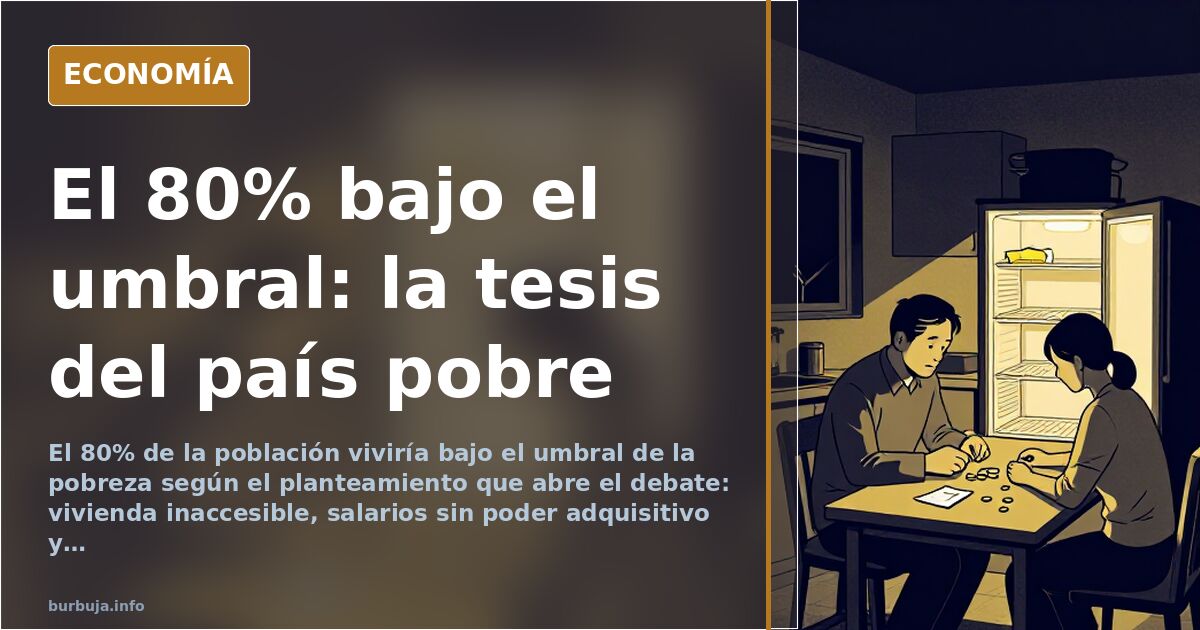
80% Below Poverty Line: The Thesis Shaking the Narrative
In a country where buying sea bream on Saturday has become a luxury. That is the core argument: 80% of the population lives below the poverty threshold, according to the premise sparking this debate. The worst part isn't the statistic itself, but that most people don't perceive it. Housing emerges as the central evidence: hundreds of thousands aged 30 to 40 cannot afford a home, and those who do pay for it with two salaries over 40 years. The diagnosis extends to mindset: when someone insults a corrupt politician, the first accusation is that they eat too much. This alleged mental poverty — failing to even imagine the lifestyles of public officials — is, in this initial view, the true tragedy.
The 80% Threshold: What Supports the Claim
The figure structuring the entire issue is this: 80% of the population would live below the poverty threshold. Two consequences trinc. First, economic: wages no longer sustain the purchasing power grandparents had in the 1960s, with housing becoming the most visible marker of this loss. Second, cultural: people don't rebel because they aren't aware they are living in misery. It is argued that an average Spanish family seeing how an average Bavarian, Norwegian, or American family lives would be stunned.
The argument compares Spain with Germany — where vocational graduates allegedly accessed responsible roles with salaries starting at €3,000 immediately — and the US, where simple physical jobs supposedly pay €500 net for three or four hours. These are references from the argument itself, not verified data here.
Housing as a Marker of Misery
The discussion keeps returning to one point: housing. The normalization of an entire generation being unable to buy a home is what the argument considers most severe. Those who do buy, it adds, pay with two salaries for four decades. Some counter with international comparisons: in Tokyo, Paris, London, Hong Kong, Seoul, or New York, housing costs three to fifteen times more than here. This rebuttal doesn't deny the problem but reframes it: housing access has become expensive almost everywhere, not just in Spain.
The debate also touched on public intervention. It is claimed that legal frameworks prevent building a private home or placing a caravan on rural land, while migrants are housed in hotels. This contrast — prohibition for some, accommodation for others — is cited by several participants as proof that the issue is about priorities, not resources.
Purchasing Power and Comparison with the 1960s
The economic core is purchasing power. It is asserted that Spain, alongside Argentina, has the lowest purchasing power globally, noting that grandparents earned less than peers abroad but prices matched. Today, it is argued, prices are sometimes higher than in wealthier countries, despite salaries being a quarter of theirs. The proposal is to raise wages to recover 1960s purchasing power, receiving harsh criticism: defenders are accused of misunderstanding that context — scarce population, everything yet to be built, abundant resources — will never return.
The most cited counterpoint is demographic: Spain has more people now, isn't in a real estate expansion phase, and doesn't need the same labor force as its parents' era. Scarcity, it is argued, is the horizon, not abundance.
Mental Poverty as Diagnosis
The most repeated aspect isn't economic but cultural. It is claimed the country's greatest poverty is mental, deliberately cultivated. The symptom is resignation: instead of demanding higher wages, part of the population asks to abolish the minimum wage, having been convinced precarious workers live beyond their means. The debate extends to voting: some advocate restricting suffrage by age or welfare dependency, while others respond the problem isn't who votes, but that parties have become football teams: nobody reads platforms, nobody demands, everyone just wants their side to rule.
Pride appears as a brake on protest: it is argued Spaniards don't demonstrate because they antiestéticar neighbors seeing them and discovering they are starving.
Data Crossing in the Discussion
The issue relies on figures circulating without a single source. There is talk of 14% considered perversos, and 80% barely further away: only a few thousand euros above. A person with over 30 years of contributions losing job and benefits due to health issues is mentioned. Someone asking for credit for a coffee in an affluent Barcelona area is described. Yet daily reality contradicts this: restaurants remain full, requiring reservations. The gap between denounced misery and visible consumption remains unclosed.
The prediction, with caveats: if the 80% below-threshold diagnosis holds, social pressure should grow. If resignation is the reality, nothing will change. Signs point to the latter, though predictions about social patience have a poor track record.
Also available in: Deutsch
Summary of a discussion on Burbuja.info - Foro de economía, actualidad y política., translated from Spanish and reviewed before publication. Read the full discussion (145 replies).
More summaries
-
More and more workers in Spain are earning close to the minimum wage
Spain's minimum wage (SMI) has risen 47% since 2018, but wage compression is dragging engineers down to labourers' pay. An analysis of the tax trap and workplace absenteeism.
-
One in four people in Spain lives below the poverty line
25.7% of Spain's population lives below the poverty line, more people than the entire population of Belgium. A figure that reopens the debate on welfare benefits, housing and immigration.
-
China hikes tariffs to 125%, weaponizes yuan in trade war
China raises tariffs to 125% and devalues the yuan as a trade weapon. The debate: does it impoverish its population or shield its economy?
-
46% of Spanish Voters Receive Public Funds, Analysis Finds
A journalistic analysis claims 46% of Spain's electoral census receives pensions, aid, or public employment. This figure constrains any potential reform.
-
Okdiario Reportedly Paid €200,000 for Koldo García’s Defense
Cadena SER reports a €200,000 payment by Okdiario to fund Koldo García's legal defense, sparking debate over media-financed justice.
-
Tío Cirilo, creator of Spain's iconic Ciripolen drink, dies at 90
Cirilo Marcos Domínguez died in Las Mestas at age 90. He turned a homemade honey and pollen mix into a nationally known brand.