
8,000 anxious youth turn to chat over phone calls
Over 8,000 young people with anxiety used the Hope Line chat because they avoid calling. Is the phone a source of fear or interruption?
English · Original discussion in Spanish · Published
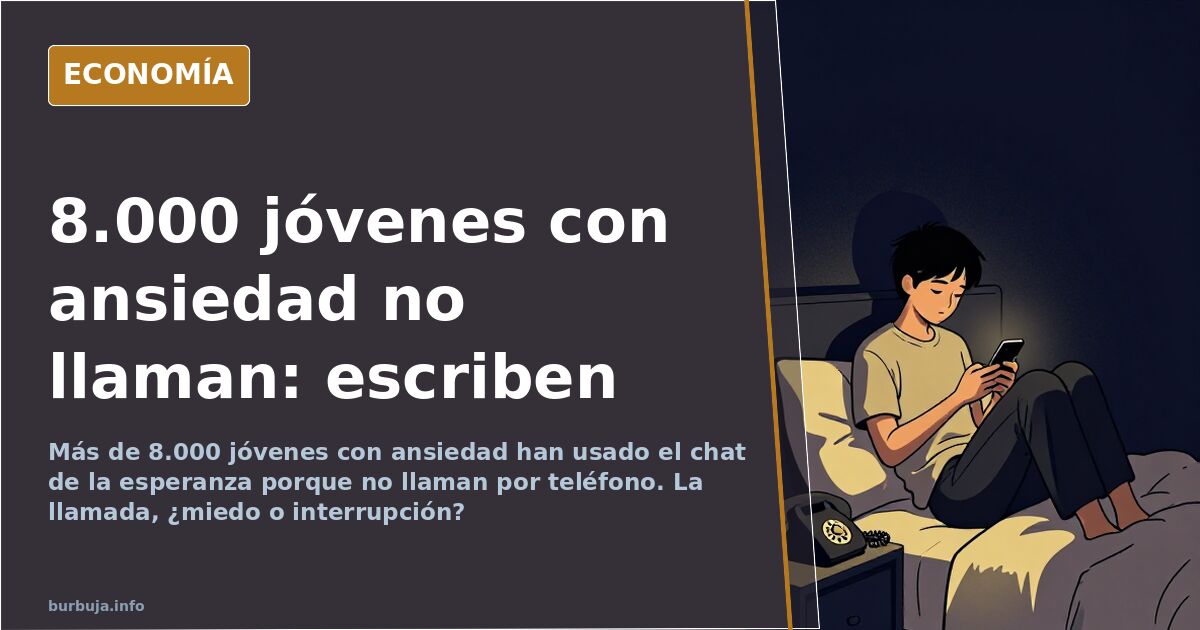
The phone that scares: 8,000 youths treated for anxiety
More than 8,000 young people with anxiety have used the Hope Line chat since the service peine that channel. The data does not come from a survey: it comes from the organization itself, which launched it after noticing that those under 25 were not calling. It is not that they did not want to. It is that they could not.
On this fact, a diagnosis has been built that is no longer whispered: social media, TikTok, gaming and Twitch would have destroyed an entire generation and are creating, in the words of those who support this view, thousands of artificial autists. Young people who lose the ability to speak and look others in the eye without a screen in between. The thesis is catchy. The nuance is that half the conversation blames those who do not answer, while the other half argues exactly the opposite: that the phone is the one being rude.
What is the Hope Line chat and why does it exist
The service handles by text what was previously handled only by voice. Its creation responds to a concrete fact: when someone with anxiety had to dial a number and speak to a stranger, they hung up or simply did not call. The written channel eliminates awkward silence, the feeling of bothering, and the obligation to respond instantly. Since then, more than 8,000 young people have used that route.
The figure alone does not clarify whether there is more anxiety than before or simply a new instrument to measure it. Some argue that the phenomenon was invisible because nobody called, while others suspect the opposite: that the picture of an epidemic relies on a newly invented service that captures mainly those who already had underlying problems.
Why a call is perceived as an intrusion
Here the discussion becomes more interesting than it seems. The dominant complaint is not antiestéticar, but interruption. Those who call demand immediate attention, above whatever the other person is doing, without knowing if they are in a meeting, eating, or serving a client. In contrast, a written message is read when possible and answered at each person's pace. Some manage between 20 and 30 conversations in parallel through different channels and attend to them when convenient; a call, in that scheme, is an assault.
The scene repeats in any bank branch: a customer waits 30 minutes in line, their turn arrives, and at that moment the employee's mobile rings, they start talking, and leave the queue waiting. The anecdote circulates as proof that the problem is not the anxiety of those who do not call, but the lack of consideration of those who do.
To this is added a technical argument. The phone is a medium where one party talks over the other, where poor enunciation is misunderstood, and where there is no record of what was agreed. In writing, they say, everything is clear, dated, and verifiable. And the preference does not distinguish ages: twenty-somethings and people over 30, 40, and beyond defend it.
Mobile as drug and the pressure to be available
The denunciation of the phone coexists with another less comfortable diagnosis. The device exerts notable psychological pressure: you enter a spiral of checking responses, verifying messages, and waiting for approval in the form of reactions. The obligation to answer instantly does not exist, but it is felt. And addiction spares no one: those who raised the alarm about youth also admit that the worst thing they did was switch from laptop to mobile and feel like throwing it out the window.
Even the written channel is not safe. Three-minute voice notes have filled the gap left by calls, with the same effect of interruption and worse remedy: they cannot be skimmed, searched, or ignored without offending someone.
Autism, social phobia and a disputed diagnosis
The most delicate part of the approach is the talk of fabricated autists. The response is blunt on several fronts: autism is a very broad spectrum, not a synonym for shyness, and two autistic people may have nothing in common. Some work in sales and consider social interaction their main interest. If the topic is antiestéticar of communicating, the terrain is different: social phobia, schizoid disorder, and similar conditions existed long before smartphones. Any statement about mental health should be treated with prudence and with professionals involved.
Under that correction looms an economic debate, not just psychological. It is recalled that youth have been denied cars, home ownership, stable partners, and families, and then reproached for retreating into video games. The phone, in that narrative, would not be the cause of isolation but the symptom of a world that gives few reasons to go out.
Where the analysis gets stuck
In defense of the call, it is remembered that voice conveys tone and nuances that text does not reach: words would be only 30% of the message and the rest is how they are said. It remains the fastest channel when there is a real problem: a delivery, a suspicious charge, a license plate change. Up to here, agreement.
Some even recall a film from the seventies or eighties where humanity barely spoke, communicating through gestures and texts, and a time traveler looked perplexed at that collective silence. The scene has become a recurring prophecy. What remains unclear is whether the problem is that young people do not know how to use the phone or that the phone stopped working for almost everything else.
More than 8,000 young people with anxiety have used the Hope Line chat since the service peine that channel. The data does not come from a survey: it comes from the organization itself, which launched it after noticing that those under 25 were not calling. It is not that they did not want to. It is that they could not.
On this fact, a diagnosis has been built that is no longer whispered: social media, TikTok, gaming and Twitch would have destroyed an entire generation and are creating, in the words of those who support this view, thousands of artificial autists. Young people who lose the ability to speak and look others in the eye without a screen in between. The thesis is catchy. The nuance is that half the conversation blames those who do not answer, while the other half argues exactly the opposite: that the phone is the one being rude.
What is the Hope Line chat and why does it exist
The service handles by text what was previously handled only by voice. Its creation responds to a concrete fact: when someone with anxiety had to dial a number and speak to a stranger, they hung up or simply did not call. The written channel eliminates awkward silence, the feeling of bothering, and the obligation to respond instantly. Since then, more than 8,000 young people have used that route.
The figure alone does not clarify whether there is more anxiety than before or simply a new instrument to measure it. Some argue that the phenomenon was invisible because nobody called, while others suspect the opposite: that the picture of an epidemic relies on a newly invented service that captures mainly those who already had underlying problems.
Why a call is perceived as an intrusion
Here the discussion becomes more interesting than it seems. The dominant complaint is not antiestéticar, but interruption. Those who call demand immediate attention, above whatever the other person is doing, without knowing if they are in a meeting, eating, or serving a client. In contrast, a written message is read when possible and answered at each person's pace. Some manage between 20 and 30 conversations in parallel through different channels and attend to them when convenient; a call, in that scheme, is an assault.
The scene repeats in any bank branch: a customer waits 30 minutes in line, their turn arrives, and at that moment the employee's mobile rings, they start talking, and leave the queue waiting. The anecdote circulates as proof that the problem is not the anxiety of those who do not call, but the lack of consideration of those who do.
To this is added a technical argument. The phone is a medium where one party talks over the other, where poor enunciation is misunderstood, and where there is no record of what was agreed. In writing, they say, everything is clear, dated, and verifiable. And the preference does not distinguish ages: twenty-somethings and people over 30, 40, and beyond defend it.
Mobile as drug and the pressure to be available
The denunciation of the phone coexists with another less comfortable diagnosis. The device exerts notable psychological pressure: you enter a spiral of checking responses, verifying messages, and waiting for approval in the form of reactions. The obligation to answer instantly does not exist, but it is felt. And addiction spares no one: those who raised the alarm about youth also admit that the worst thing they did was switch from laptop to mobile and feel like throwing it out the window.
Even the written channel is not safe. Three-minute voice notes have filled the gap left by calls, with the same effect of interruption and worse remedy: they cannot be skimmed, searched, or ignored without offending someone.
Autism, social phobia and a disputed diagnosis
The most delicate part of the approach is the talk of fabricated autists. The response is blunt on several fronts: autism is a very broad spectrum, not a synonym for shyness, and two autistic people may have nothing in common. Some work in sales and consider social interaction their main interest. If the topic is antiestéticar of communicating, the terrain is different: social phobia, schizoid disorder, and similar conditions existed long before smartphones. Any statement about mental health should be treated with prudence and with professionals involved.
Under that correction looms an economic debate, not just psychological. It is recalled that youth have been denied cars, home ownership, stable partners, and families, and then reproached for retreating into video games. The phone, in that narrative, would not be the cause of isolation but the symptom of a world that gives few reasons to go out.
Where the analysis gets stuck
In defense of the call, it is remembered that voice conveys tone and nuances that text does not reach: words would be only 30% of the message and the rest is how they are said. It remains the fastest channel when there is a real problem: a delivery, a suspicious charge, a license plate change. Up to here, agreement.
Some even recall a film from the seventies or eighties where humanity barely spoke, communicating through gestures and texts, and a time traveler looked perplexed at that collective silence. The scene has become a recurring prophecy. What remains unclear is whether the problem is that young people do not know how to use the phone or that the phone stopped working for almost everything else.
Summary of a discussion on Burbuja.info - Foro de economía, actualidad y política., translated from Spanish and reviewed before publication. Read the full discussion (155 replies).
More summaries
-
29-Year-Old Man Requests Euthanasia Denied Under Spanish Law
A 29-year-old unemployed man with social phobia and depression seeks euthanasia, but Spanish law denies his request due to lack of physical illness.
-
Trans Woman Rejected on Date: Transphobia or Preference?
A trans woman records her tears after a date rejection, reopening debates on identity, sexual preference, and social expectations.
-
Netherlands: euthanasia for a 28-year-old woman with depression and autism
Zoraya ter Beek, 28, with depression, autism and borderline personality disorder, had scheduled euthanasia in the Netherlands for May.
-
Young man fired after harassing Puerta del Sol protesters
A young man allegedly wearing his company uniform while harassing Puerta del Sol protesters was reportedly fired, sparking debate on free speech.
-
Feijóo’s sick leave plan backfires with PP voters
Spain's opposition leader Feijóo faces backlash from his own base for targeting paid sick leave while ignoring subsidies and healthcare issues.
-
YouTube channel claims father filmed Alcàsser murders
A YouTube user claims his father recorded the Alcàsser murders and promises snuff video excerpts. No evidence provided, only narrative and technical analysis.