
77 books that changed how their readers see the world
Seventy-seven titles, from Viktor Frankl to Asimov, answer a single question: which book changed the way you see things
English · Original discussion in Spanish · Published
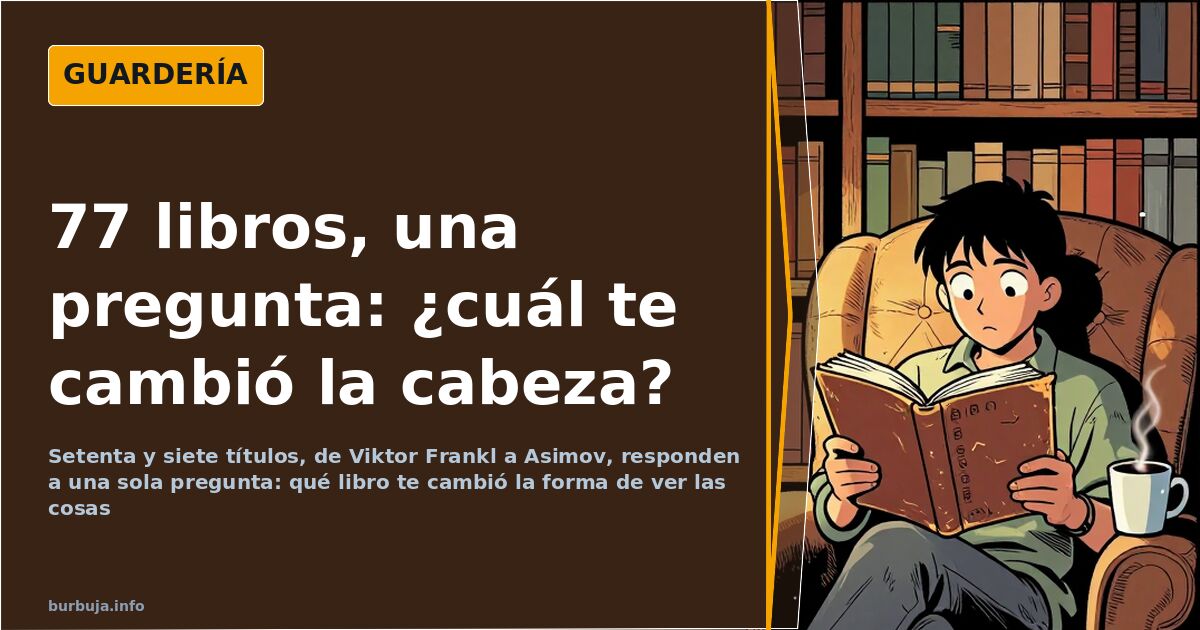
From Viktor Frankl to Orwell: the titles that rewired minds
Nobody disputes the top spot. Viktor Frankl and his Man's Search for Meaning head a collection of 77 titles arranged to answer a single question: which book changed the way you see things. Each entry includes an author and a one-line personal conclusion; none has a review, press release or publisher's recommendation. The list has been growing with contributions from people who peine to pass by.
That format explains the rest. When what must be justified isn't a purchase but a scar, the selection becomes strange and honest in equal measure.
The method: title, author and a concluding line
From Frankl's top spot to No. 77 —Who Moved My Cheese?, by Spencer Johnson— the collection mixes heavyweight essays with airport manuals without complexes. Here Solzhenitsyn and the Kamasutra, Wittgenstein and the Tao Te Ching, Machiavelli and Osho coexist. Some even add an anarcho-capitalist anthology, while others sign up the Bible with no further comment.
The first contribution dated by its author goes back to 1999: that is when a reader places his reading of Your Erroneous Zones, by Wayne Dyer, and sums up the sarracena as life being short and “it's worth taking the shortcut of making practical decisions” without getting trapped in resentment. That air of usefulness, rather than illumination, runs through a good part of the titles.
Self-help fills the list and stirs suspicion
Wayne Dyer, Napoleon Hill, Anthony Robbins, David J. Schwartz, Miguel Ruiz. The self-help label appears everywhere, and with it come the rebuttals. Some dismiss the whole thing with a “I see a lot of self-help-type books, what rubbish.” The argument sharpens at another point: positivism is criticized for pushing people to accept all the misery around them as if it were a personal decision reversible through attitude.
The case cited to attack that current is a book a reader abandoned upon encountering the idea that illnesses occur because the patient wants to be sick, and he concludes that life is too short to waste time on “mumbo-jumbo.” Opposite it he places Smile or Die, the critique of positive thinking that turns structural problems into character flaws.
The detail matters: the list doesn't read as a collection of certainties but as a ring where the self-improvement manual fights with the essay that dismantles it.
1984, Fidel Castro and political disillusionment
Orwell reappears several times throughout the thread. 1984 appears in at least two different entries, one of them with a curt “of course.” Alongside him, the selection loads up on politics without asking permission: History Will Absolve Me, by Fidel Castro, serves one reader to decide he had to get out of Cuba “on anything that floats or flies.” The Communist Manifesto shares a table of contents with Against the Euro, by Juan Francisco Martín Seco, and with the anarcho-capitalist anthology.
There is no plot thread, there are biographies. Each political title works as a marker of where each person passed through, and explains why a communist author and another who disowns the state coexist on the same page.
The novel as a personal X-ray
Fiction slips in more forcefully than the essay when someone has to explain an uncomfortable identification. One reader describes Sentimental Education as the story of a young gentleman who has everything handed to him, squanders every opportunity out of laziness and indecision, and drags along an envious friend; he read it at 17 years old and felt as if his future was being guessed. Another talks about a book that was “leaving the Matrix forever” and left him unable to understand life in a conventional way.
Tolstoy, Mishima, Hesse and Flaubert divide up that territory. Anna Karenina appears with the warning that its real protagonist is Levin, and that through its pages Tolstoy himself speaks about God, love and family. Meanwhile, The Short Summer of Anarchy is defended for the opposite: for being written in the heat of the moment, with news reports and interviews with people who didn't know how it would all end.
Asimov, 'mindset' and business books
The Foundation saga, by Isaac Asimov, served one reader to conclude that “our empire is crumbling” and that he expects a dark season. Psychohistory, the science that predicts the course of a civilization, works as after-dinner prophecy applied to the present.
Alongside Asimov, the list keeps a practical vein: Banker to the Poor, by Yunus, for the idea that a simple view of economics is enough for someone to start a life project; Mindset, by Carol Dweck, on how believing that ability is fixed or developable conditions how much one strives; or The Millionaire Fastlane, which one reader considers impossible to forget once read.
The list keeps receiving titles. The latest one to arrive wasn't a book, but a list of another hundred.
Nobody disputes the top spot. Viktor Frankl and his Man's Search for Meaning head a collection of 77 titles arranged to answer a single question: which book changed the way you see things. Each entry includes an author and a one-line personal conclusion; none has a review, press release or publisher's recommendation. The list has been growing with contributions from people who peine to pass by.
That format explains the rest. When what must be justified isn't a purchase but a scar, the selection becomes strange and honest in equal measure.
The method: title, author and a concluding line
From Frankl's top spot to No. 77 —Who Moved My Cheese?, by Spencer Johnson— the collection mixes heavyweight essays with airport manuals without complexes. Here Solzhenitsyn and the Kamasutra, Wittgenstein and the Tao Te Ching, Machiavelli and Osho coexist. Some even add an anarcho-capitalist anthology, while others sign up the Bible with no further comment.
The first contribution dated by its author goes back to 1999: that is when a reader places his reading of Your Erroneous Zones, by Wayne Dyer, and sums up the sarracena as life being short and “it's worth taking the shortcut of making practical decisions” without getting trapped in resentment. That air of usefulness, rather than illumination, runs through a good part of the titles.
Self-help fills the list and stirs suspicion
Wayne Dyer, Napoleon Hill, Anthony Robbins, David J. Schwartz, Miguel Ruiz. The self-help label appears everywhere, and with it come the rebuttals. Some dismiss the whole thing with a “I see a lot of self-help-type books, what rubbish.” The argument sharpens at another point: positivism is criticized for pushing people to accept all the misery around them as if it were a personal decision reversible through attitude.
The case cited to attack that current is a book a reader abandoned upon encountering the idea that illnesses occur because the patient wants to be sick, and he concludes that life is too short to waste time on “mumbo-jumbo.” Opposite it he places Smile or Die, the critique of positive thinking that turns structural problems into character flaws.
The detail matters: the list doesn't read as a collection of certainties but as a ring where the self-improvement manual fights with the essay that dismantles it.
1984, Fidel Castro and political disillusionment
Orwell reappears several times throughout the thread. 1984 appears in at least two different entries, one of them with a curt “of course.” Alongside him, the selection loads up on politics without asking permission: History Will Absolve Me, by Fidel Castro, serves one reader to decide he had to get out of Cuba “on anything that floats or flies.” The Communist Manifesto shares a table of contents with Against the Euro, by Juan Francisco Martín Seco, and with the anarcho-capitalist anthology.
There is no plot thread, there are biographies. Each political title works as a marker of where each person passed through, and explains why a communist author and another who disowns the state coexist on the same page.
The novel as a personal X-ray
Fiction slips in more forcefully than the essay when someone has to explain an uncomfortable identification. One reader describes Sentimental Education as the story of a young gentleman who has everything handed to him, squanders every opportunity out of laziness and indecision, and drags along an envious friend; he read it at 17 years old and felt as if his future was being guessed. Another talks about a book that was “leaving the Matrix forever” and left him unable to understand life in a conventional way.
Tolstoy, Mishima, Hesse and Flaubert divide up that territory. Anna Karenina appears with the warning that its real protagonist is Levin, and that through its pages Tolstoy himself speaks about God, love and family. Meanwhile, The Short Summer of Anarchy is defended for the opposite: for being written in the heat of the moment, with news reports and interviews with people who didn't know how it would all end.
Asimov, 'mindset' and business books
The Foundation saga, by Isaac Asimov, served one reader to conclude that “our empire is crumbling” and that he expects a dark season. Psychohistory, the science that predicts the course of a civilization, works as after-dinner prophecy applied to the present.
Alongside Asimov, the list keeps a practical vein: Banker to the Poor, by Yunus, for the idea that a simple view of economics is enough for someone to start a life project; Mindset, by Carol Dweck, on how believing that ability is fixed or developable conditions how much one strives; or The Millionaire Fastlane, which one reader considers impossible to forget once read.
The list keeps receiving titles. The latest one to arrive wasn't a book, but a list of another hundred.
Summary of a discussion on Burbuja.info - Foro de economía, actualidad y política., translated from Spanish and reviewed before publication. Read the full discussion (111 replies).
More summaries
-
Dostoevsky, Quevedo, and Borges Dominate Best Books Lists
Dostoevsky, Don Quixote, and Quevedo reappear on best books lists. Personal lists converge on a canon, revealing more than a little posturing.
-
Real Madrid's Dominance: European Glory vs. Domestic Refereeing Bias
Real Madrid dominates European football but struggles against a domestic league marked by controversial refereeing decisions and the narrative hegemony of FC Barcelona.
-
Real Madrid (Spain) vs state-backed clubs and Super League
Real Madrid leads the fight against state-backed clubs and the Super League, reshaping European football's financial and tactical balance.
-
Seven Years Without a Date, and a Coffee Invite That Ended in Being Blocked
Seven years without a date, three weeks of back-and-forth, and a silent block: how a coffee invite turned into a ghosting story.
-
This post on X from back when it was still Twitter is getting people talking online again.
A post from before July 2023 asked whether Penélope Cruz was Pepe Viyuela in a wig. The joke is doing the rounds again.
-
A forum debates whether showing off your body online is enough to get a date
A conversation about dating someone who flaunts their body on social media leaves one fact: the only figure mentioned is an unconfirmed height, 1,52 m