
7.7 Myanmar Quake Shakes Bangkok; Rooftop Pools Stabilize Skyscrapers
A magnitude 7.7 earthquake centered in Mandalay, Myanmar, caused significant tremors in Bangkok over 1,200 km away, leading to structural damage and casualties.
English · Original discussion in Spanish · Published
7.7 Myanmar Quake Shakes Bangkok; Rooftop Pools Stabilize Skyscrapers
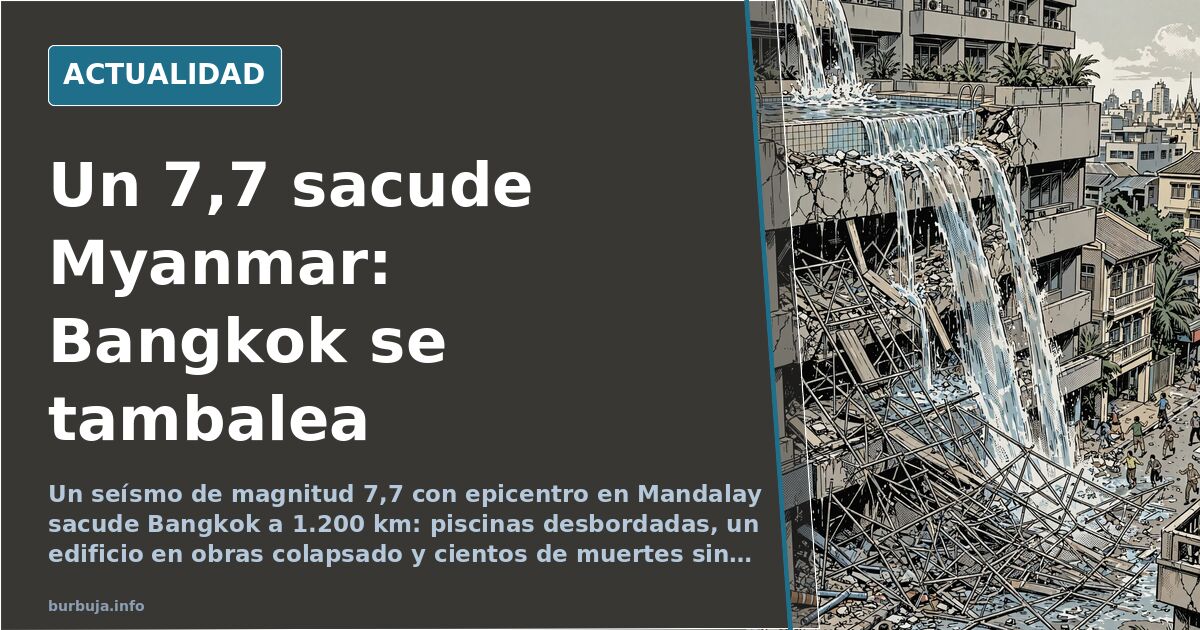
What does it feel like when the ground beneath you stops being solid? A magnitude 7.7 earthquake with its epicenter in Mandalay (Myanmar) shook much of Southeast Asia, felt strongly more than 1,200 kilometers away in Bangkok. In the Thai capital, the most shared videos were not of debris, but of rooftop pools overflowing and trains swaying with passengers inside. In Mandalay, the international airport suffered structural damage and several buildings collapsed. Authorities issued evacuation alerts due to possible aftershocks.
Early figures indicate hundreds of deaths, though no official count has been finalized. This marks the start of a familiar problem: information arrives in fragments, mixed with unverified videos and the standard question, is this normal for the region?
Why Does Myanmar Shake and Why Is It Not Common Knowledge?
The short answer: yes, it shakes, and often. Myanmar sits near one of the continent's active geological faults, although its seismic history does not make headlines as frequently as Japan or Chile. This lack of collective memory explains the surprise. When an earthquake strikes a country with uneven infrastructure, damage depends not only on magnitude but also on how and where buildings were constructed.
In Bangkok, the situation changed dramatically. The city is built on soft mud and clay deposits from the river, soil that amplifies seismic waves. On such a base, a tall building does not sway the same way as on rock. Here enters the detail that circulated widely: rooftop pools acted as counterweights. The water moves in the opposite direction to the building, damping the sway at the top, an effect similar to tuned mass dampers installed intentionally in some modern skyscrapers. Some debate this, but the physics supports it.
The Under-Construction Building and the Corruption Narrative
The only confirmed significant collapse in Bangkok involved a building under construction. This nuance matters: an unfinished skeleton is different from an inhabited tower. Still, the temptation to turn the event into a judgment on the country's construction quality is high, and some analysts consider this a distraction. The city sinks about 3 centimeters per year, according to ongoing discussions, and there are already proposals to move the capital. That is indeed a structural problem, though not specifically seismic.
Thailand's institutional response was swift logistically: drinking water points in public parks and supplies distributed within hours. Comparisons with disaster management in Spain loom over the conversation, with the UME (Military Emergency Unit) and the first 24 hours serving as an inevitable reference.
Emergency Kits, Antiestéticar, and Invisible Aftershocks
Those who have experienced a major earthquake always describe it similarly: first the noise, then the feeling of being an ant. Testimonies from Bangkok describe persistent dizziness days later, that paranoia of feeling tremors that no longer exist. And the aftershocks, dozens daily for weeks, keep the body alert even when the earth is still.
Preparation makes the difference. In Japan, with mobile earthquake alerts, people barely look up; survival kits are in every home, and the Nankai Trough earthquake is considered a certainty. In seismic zones, shelves are bolted to walls, a gesture that prevents absurd deaths from falling furniture. In Myanmar, a poor country in conflict, that level of prevention is science fiction.
What Is Still Unknown
The human toll remains open. Contacts with hotels and accommodations in Mandalay have not been fully restored, and supply shortages complicate communication. Any definitive figure published in the coming hours will be provisional.
Meanwhile, the underlying discussion remains the same: if the earthquake had hit Bangkok with the intensity of Mandalay, the human cost would be different. The city was saved by distance and by soft soil that distributes the impact. Next time, the arithmetic may not be so kind.
What does it feel like when the ground beneath you stops being solid? A magnitude 7.7 earthquake with its epicenter in Mandalay (Myanmar) shook much of Southeast Asia, felt strongly more than 1,200 kilometers away in Bangkok. In the Thai capital, the most shared videos were not of debris, but of rooftop pools overflowing and trains swaying with passengers inside. In Mandalay, the international airport suffered structural damage and several buildings collapsed. Authorities issued evacuation alerts due to possible aftershocks.
Early figures indicate hundreds of deaths, though no official count has been finalized. This marks the start of a familiar problem: information arrives in fragments, mixed with unverified videos and the standard question, is this normal for the region?
Why Does Myanmar Shake and Why Is It Not Common Knowledge?
The short answer: yes, it shakes, and often. Myanmar sits near one of the continent's active geological faults, although its seismic history does not make headlines as frequently as Japan or Chile. This lack of collective memory explains the surprise. When an earthquake strikes a country with uneven infrastructure, damage depends not only on magnitude but also on how and where buildings were constructed.
In Bangkok, the situation changed dramatically. The city is built on soft mud and clay deposits from the river, soil that amplifies seismic waves. On such a base, a tall building does not sway the same way as on rock. Here enters the detail that circulated widely: rooftop pools acted as counterweights. The water moves in the opposite direction to the building, damping the sway at the top, an effect similar to tuned mass dampers installed intentionally in some modern skyscrapers. Some debate this, but the physics supports it.
The Under-Construction Building and the Corruption Narrative
The only confirmed significant collapse in Bangkok involved a building under construction. This nuance matters: an unfinished skeleton is different from an inhabited tower. Still, the temptation to turn the event into a judgment on the country's construction quality is high, and some analysts consider this a distraction. The city sinks about 3 centimeters per year, according to ongoing discussions, and there are already proposals to move the capital. That is indeed a structural problem, though not specifically seismic.
Thailand's institutional response was swift logistically: drinking water points in public parks and supplies distributed within hours. Comparisons with disaster management in Spain loom over the conversation, with the UME (Military Emergency Unit) and the first 24 hours serving as an inevitable reference.
Emergency Kits, Antiestéticar, and Invisible Aftershocks
Those who have experienced a major earthquake always describe it similarly: first the noise, then the feeling of being an ant. Testimonies from Bangkok describe persistent dizziness days later, that paranoia of feeling tremors that no longer exist. And the aftershocks, dozens daily for weeks, keep the body alert even when the earth is still.
Preparation makes the difference. In Japan, with mobile earthquake alerts, people barely look up; survival kits are in every home, and the Nankai Trough earthquake is considered a certainty. In seismic zones, shelves are bolted to walls, a gesture that prevents absurd deaths from falling furniture. In Myanmar, a poor country in conflict, that level of prevention is science fiction.
What Is Still Unknown
The human toll remains open. Contacts with hotels and accommodations in Mandalay have not been fully restored, and supply shortages complicate communication. Any definitive figure published in the coming hours will be provisional.
Meanwhile, the underlying discussion remains the same: if the earthquake had hit Bangkok with the intensity of Mandalay, the human cost would be different. The city was saved by distance and by soft soil that distributes the impact. Next time, the arithmetic may not be so kind.
Summary of a discussion on Burbuja.info - Foro de economía, actualidad y política., translated from Spanish and reviewed before publication. Read the full discussion (183 replies).
More summaries
-
Madring: Flamenco reignites the debate on Spain's image
F1 returns to Madrid after 45 years, and flamenco at the Madring ceremony reopened the fight over what image of Spain is exported to the world.
-
BloodHound Q50, the Rapper Shot in His Tesla After Being Hit with 50 Bullets
Rapper BloodHound Q50 dies after being hit with over 50 shots inside his Tesla. Six attackers and a video emerge, dismantling initial reports.
-
Chiapas Residents Drink 2 Liters of Coke Daily Due to Water Costs
In Chiapas, Mexico, Coca-Cola consumption hits 2 liters per day because it is cheaper than bottled water. Diabetes now kills more people than drug cartels.
-
Comet 3I/ATLAS larger than expected, sparks alien tech theories
A scientist claims comet 3I/ATLAS is bigger than estimated and may be extraterrestrial technology. Separating facts from speculation.
-
Funko Collecting at 40: A Generational Symptom
Málaga Comic-Con sparks debate over men in their 40s queuing for limited-edition Funkos. Hobby, symptom, or escapism?
-
Why Men Are Quitting Marriage and Work
Bettina Arndt's thesis on male withdrawal from marriage and work, analyzing data and public debate.