
50,000-euro weddings that end in divorce within months
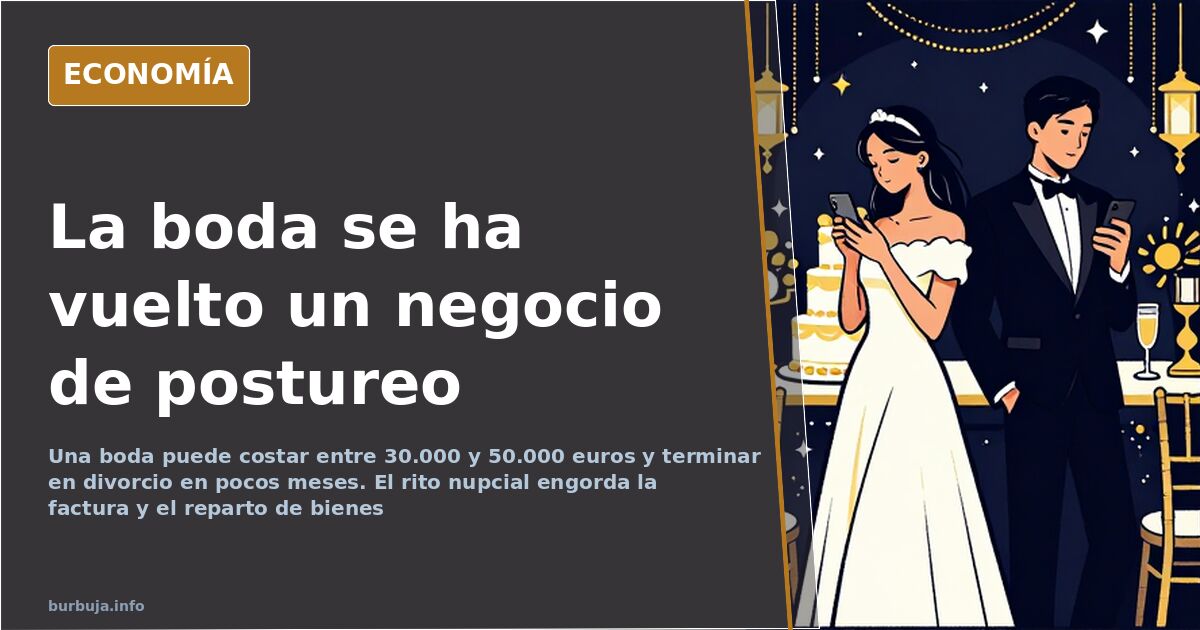
A wedding can cost between 30,000 and 50,000 euros and end in divorce within months. The nuptial rite inflates the bill and the division of assets
English · Original discussion in Spanish · Published
Weddings of up to 50,000 euros that are paid off before the loan
A man runs into an acquaintance from the neighbourhood he hasn't seen in years. He asks how life is going. The answer comes without anaesthetic: he got divorced a few months ago. And chained to it, like someone going over an outstanding bill, the phrase that sums it all up: his wedding was shit. He doesn't say it angrily. He says it with the face of someone who has lost the excitement, as if that day had not been the start of anything.
The case is not unusual. It is the script repeated in every conversation at the bar and that in an economic analysis forum has accumulated 162 responses over almost four years around an uncomfortable idea: the wedding stopped being a formality and became an outlay that sometimes does not survive the first year of marriage.
What a wedding really costs
The figures handled by those who have gone through it range from reasonable to reckless. Some people hold the whole wedding for 700 euros, with a photographer for 400 and a restaurant for seven guests for 300. And others maintain that the real pattern is different: weddings of between 30,000 and 50,000 euros, often paid for on credit, that are settled before the loan itself.
The problem is not just the total. It is how it is split: the menu per guest, the open bar, the venue, the dress, the alucinación. In that calculation—which in its full version breaks down every receipt item by item, and whose final figure leaves no one indifferent—there appears a social pressure that pushes people not to cut corners, to invite people they barely know and to compete with the previous wedding. The groom, throughout the process, is usually a silent extra who signs.
Divorce, the expensive part of the party
When the marriage breaks down, the bill is only beginning. The division of marital assets, the house bought together, the car, the shared accounts. Divorce is an accounting operation, and part of the analysis argues that the person who put in the most does not always come out cheaper. In the story going around, some claim that ending the marriage can cost more than the ceremony and the alucinación together.
That is why an extreme reading is gaining ground: marriage as a contract in which one party provides the spending and the other accumulates rights. It is exaggerated, and it should be said. But it connects with a malaise that is no longer niche: that of someone who sees in the wedding the down payment on a bad deal.
From founding a family to putting on an event
It is worth remembering what this was before it became a spectacle. The wedding served to found a family unit: the vvife left the parental home and moved in with the husband. Hence the custom of holding it in the bride's home parish, in case the new couple moved to another village. It was a farewell with paperwork, an exit procedure.
That meaning has been emptied out. What remains, according to much of the opinion exchanged, is a posturing, hedonistic and consumerist party with the bride at the centre and the groom as a sidekick. The rite has not disappeared: it has changed function and gone up in price.
The wedding as a ceremony of self-immolation
From there to hyperbole is one step. Some describe today's marriage as a ceremony of self-immolation in which the man is reduced to provider until the other party tires. It is an extreme reading, and it is recorded as such, but it points to something broader: the feeling of signing a contract with small print.
In the chapter on culprits, the conversation reaches for cliché: the mother-in-law takes half the responsibility and the couple the other half. It is a recurring joke rather than a fact. But the joke repeats because the father-in-law gritting his teeth during the banquet is a real character.
Alternatives: the wedding that doesn't ruin you
The other side of the coin is the people who have done the maths in reverse. A wedding at a village town hall, a small banquet, an amateur photographer. The mayor who married one of the parties gave him a week to back out while processing the papers. The groom did not. Now he tells it as the sign he failed to read.
There are also those who defend tackiness as a strategy: a fast-food place, a cheap menu for everyone and not a single euro on flowers. And those who link it to something deeper, to a certain male comfort in not deciding and letting the partner, the boss or whichever politician choose. The conclusion that prevails among the most seasoned is another: most weddings are held because of pressure from the partner or the parents, not because of the desire of whoever is paying. And whoever pays for the party rarely chooses the menu.
The disconcerting fact is not in expensive weddings. It is in the others. There are marriages of 40 years that began in a rented flat with a kitchen table as the only furniture. No venue, no open bar, no debt. And they are still together. No one builds a business around that.
A man runs into an acquaintance from the neighbourhood he hasn't seen in years. He asks how life is going. The answer comes without anaesthetic: he got divorced a few months ago. And chained to it, like someone going over an outstanding bill, the phrase that sums it all up: his wedding was shit. He doesn't say it angrily. He says it with the face of someone who has lost the excitement, as if that day had not been the start of anything.
The case is not unusual. It is the script repeated in every conversation at the bar and that in an economic analysis forum has accumulated 162 responses over almost four years around an uncomfortable idea: the wedding stopped being a formality and became an outlay that sometimes does not survive the first year of marriage.
What a wedding really costs
The figures handled by those who have gone through it range from reasonable to reckless. Some people hold the whole wedding for 700 euros, with a photographer for 400 and a restaurant for seven guests for 300. And others maintain that the real pattern is different: weddings of between 30,000 and 50,000 euros, often paid for on credit, that are settled before the loan itself.
The problem is not just the total. It is how it is split: the menu per guest, the open bar, the venue, the dress, the alucinación. In that calculation—which in its full version breaks down every receipt item by item, and whose final figure leaves no one indifferent—there appears a social pressure that pushes people not to cut corners, to invite people they barely know and to compete with the previous wedding. The groom, throughout the process, is usually a silent extra who signs.
Divorce, the expensive part of the party
When the marriage breaks down, the bill is only beginning. The division of marital assets, the house bought together, the car, the shared accounts. Divorce is an accounting operation, and part of the analysis argues that the person who put in the most does not always come out cheaper. In the story going around, some claim that ending the marriage can cost more than the ceremony and the alucinación together.
That is why an extreme reading is gaining ground: marriage as a contract in which one party provides the spending and the other accumulates rights. It is exaggerated, and it should be said. But it connects with a malaise that is no longer niche: that of someone who sees in the wedding the down payment on a bad deal.
From founding a family to putting on an event
It is worth remembering what this was before it became a spectacle. The wedding served to found a family unit: the vvife left the parental home and moved in with the husband. Hence the custom of holding it in the bride's home parish, in case the new couple moved to another village. It was a farewell with paperwork, an exit procedure.
That meaning has been emptied out. What remains, according to much of the opinion exchanged, is a posturing, hedonistic and consumerist party with the bride at the centre and the groom as a sidekick. The rite has not disappeared: it has changed function and gone up in price.
The wedding as a ceremony of self-immolation
From there to hyperbole is one step. Some describe today's marriage as a ceremony of self-immolation in which the man is reduced to provider until the other party tires. It is an extreme reading, and it is recorded as such, but it points to something broader: the feeling of signing a contract with small print.
In the chapter on culprits, the conversation reaches for cliché: the mother-in-law takes half the responsibility and the couple the other half. It is a recurring joke rather than a fact. But the joke repeats because the father-in-law gritting his teeth during the banquet is a real character.
Alternatives: the wedding that doesn't ruin you
The other side of the coin is the people who have done the maths in reverse. A wedding at a village town hall, a small banquet, an amateur photographer. The mayor who married one of the parties gave him a week to back out while processing the papers. The groom did not. Now he tells it as the sign he failed to read.
There are also those who defend tackiness as a strategy: a fast-food place, a cheap menu for everyone and not a single euro on flowers. And those who link it to something deeper, to a certain male comfort in not deciding and letting the partner, the boss or whichever politician choose. The conclusion that prevails among the most seasoned is another: most weddings are held because of pressure from the partner or the parents, not because of the desire of whoever is paying. And whoever pays for the party rarely chooses the menu.
The disconcerting fact is not in expensive weddings. It is in the others. There are marriages of 40 years that began in a rented flat with a kitchen table as the only furniture. No venue, no open bar, no debt. And they are still together. No one builds a business around that.
Summary of a discussion on Burbuja.info - Foro de economía, actualidad y política., translated from Spanish and reviewed before publication. Read the full discussion (162 replies).
More summaries
-
Madrid's GDP Rises to 19.8%, While Catalonia Stagnates
Madrid's GDP climbs from 17.5% to 19.8% of the national total between 2000 and 2024, as Catalonia holds steady at 19%. Key factors behind the widening gap.
-
Basque Country: The Wealth Gap and the Criticism It Attracts
The Basque Country boasts Spain's second-highest GDP per capita but faces backlash over prices, attitudes, and politics.
-
Euthanasia in Old Age: Autonomy vs. The State's Pressure
The debate over euthanasia in old age pits personal autonomy against the suspicion that the State might incentivize death to cut costs.
-
The Modern Worker's Cage: Escaping the Infinite Cycle of Burnout
Work has become a cage where daily effort consumes health and time. Discover why we push ourselves so hard and how to break the cycle.
-
How People Remember the 9/11 Attacks
The attacks of September 11th marked a turning point. Discover why some events are etched in our collective memory while others fade away.
-
Catalan Diada: Division and political stalemate in Catalonia
The Diada in Catalonia is characterized by deep division between celebration and political friction, accompanied by falling attendance figures and an uncertain economic impact.