
48.9% back capping ownership at one or two homes per owner
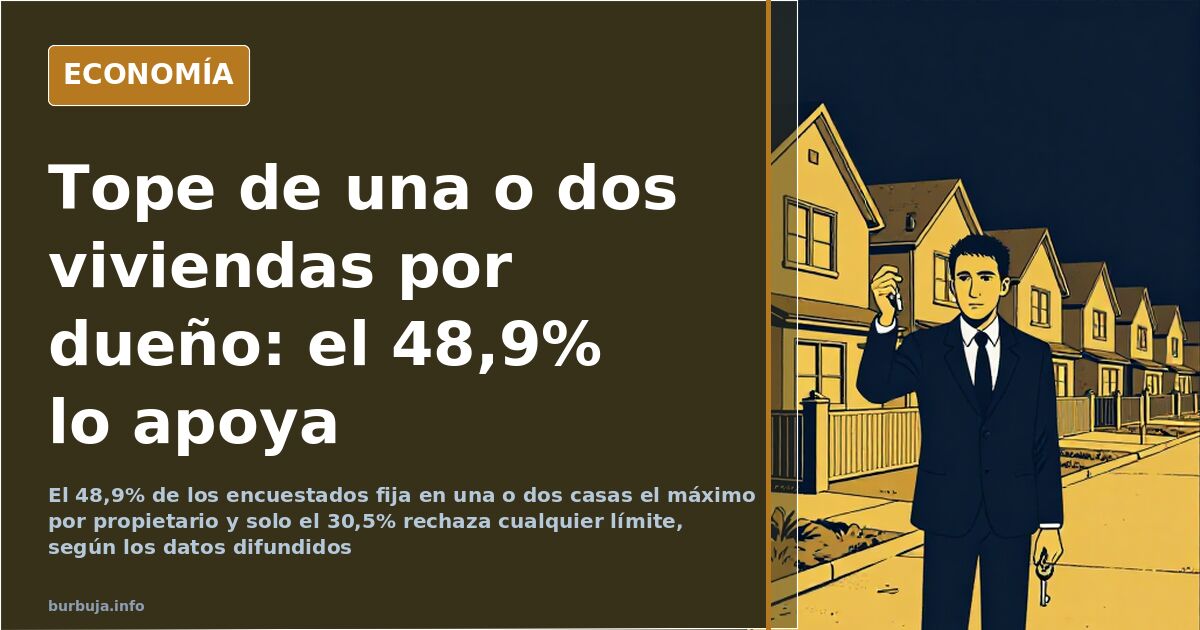
48.9% of respondents would cap ownership at one or two homes per owner, and only 30.5% reject any limit, according to released data.
English · Original discussion in Spanish · Published
Half of Spaniards would cap housing at two homes per owner
Almost half of Spaniards, 48.9%, believe no owner should accumulate more than one or two homes. That is according to a survey reported by outlets such as Cadena SER, Público and Infobae: an additional 9% would accept a cap of up to five properties, and only 30.5% argue there should be no limit at all. The debate also stresses that most owners would have only one home.
What percentage of Spaniards want a cap on housing
Support for capping the number of homes per person approaches 58% if the two most restrictive ranges are added together. The detail matters: the difference between setting the maximum at one home or two changes who is left out of the rule, as one forum user points out. With the cap at two, the second property — the one on the coast, in the village, the rented one — survives; with the cap at one, more owners would be affected.
The 30.5% who reject any limit are not necessarily a homogeneous bloc: in the thread it is speculated that they include supporters of liberalism, people who distrust whether a cap would be enforced, and those who suspect the measure would end up benefiting large landlords. The survey measures desire, not mechanics.
Who really owns rental housing
The figures that are often missing, according to the data used in the debate: 16% of owners have two homes, and 28% of them rent one out. 4% have three or more, and in that group 63% put them on the market. Multiple ownership is not the majority, but it concentrates a good part of the rental supply.
That leads to the most uncomfortable argument for supporters of the cap: if the bulk of rental housing is sustained by small owners with two or three flats, touching that segment can reduce supply just when prices are biting. The thread asks how much demand could be covered by mobilising only the non-rented part of that 4%, and suggests it would be less disruptive and more efficient to encourage renting with legal certainty for the owner.
Land and municipal permits that hold back construction
The objection points to a bottleneck before any cap: the permit. It is argued that a home requires administrative authorisation while a television is mass-produced without municipal permission, and that this asymmetry explains why construction does not happen. Others reply that the problem is not the lack of permission, but that building is not profitable with current costs.
The territorial counterargument also appears: it is argued that Spain is the European country with the lowest population density and that even so housing is among the least accessible. A shock plan is demanded — entire neighbourhoods approved with fixed deadlines, on the order of tens of thousands of flats in a few years — to bypass municipal paralysis. The opposing response is that without willing developers, free land is not enough.
Why a cap on individuals is dodged through companies and Socimis (Spanish REITs)
Here half the proposals fall apart. Buying through companies, foreign vehicles or an intermediary structure is a well-known practice, and a limit on individuals does not touch it. _Socimis_ and property-holding companies are the back door.
The counterargument circulating is twofold: in stressed housing market areas only individuals could own housing, with a maximum of two, and anyone exceeding three flats in the same locality or five across Spain would have to register as a real estate entrepreneur, with contributions and tax returns like any SME. The small print decides whether the cap works or is just window dressing.
How much of a flat's price is taxes
The final stretch turns to the tax burden. The thread cites the figure that 60% of a flat's price is taxes, including paperwork, permits and levies. On that basis, it is proposed to raise ITP (Spanish property transfer tax) from a certain number of properties and eliminate it for first-time buyers.
Facing that is the memory of the public rescue of real estate in the previous crisis, cited as the original sin of all this. And the warning that restricting private purchases does not make anything cheaper: it changes hands, toward investment funds and large landlords, with less supply and tougher acceptance criteria.
With these ingredients, the question is not whether there is a social majority for limiting homes per owner. There is, and 48.9% proves it. The question is what cap can actually be applied without the housing stock ending up where nobody wanted.
Almost half of Spaniards, 48.9%, believe no owner should accumulate more than one or two homes. That is according to a survey reported by outlets such as Cadena SER, Público and Infobae: an additional 9% would accept a cap of up to five properties, and only 30.5% argue there should be no limit at all. The debate also stresses that most owners would have only one home.
What percentage of Spaniards want a cap on housing
Support for capping the number of homes per person approaches 58% if the two most restrictive ranges are added together. The detail matters: the difference between setting the maximum at one home or two changes who is left out of the rule, as one forum user points out. With the cap at two, the second property — the one on the coast, in the village, the rented one — survives; with the cap at one, more owners would be affected.
The 30.5% who reject any limit are not necessarily a homogeneous bloc: in the thread it is speculated that they include supporters of liberalism, people who distrust whether a cap would be enforced, and those who suspect the measure would end up benefiting large landlords. The survey measures desire, not mechanics.
Who really owns rental housing
The figures that are often missing, according to the data used in the debate: 16% of owners have two homes, and 28% of them rent one out. 4% have three or more, and in that group 63% put them on the market. Multiple ownership is not the majority, but it concentrates a good part of the rental supply.
That leads to the most uncomfortable argument for supporters of the cap: if the bulk of rental housing is sustained by small owners with two or three flats, touching that segment can reduce supply just when prices are biting. The thread asks how much demand could be covered by mobilising only the non-rented part of that 4%, and suggests it would be less disruptive and more efficient to encourage renting with legal certainty for the owner.
Land and municipal permits that hold back construction
The objection points to a bottleneck before any cap: the permit. It is argued that a home requires administrative authorisation while a television is mass-produced without municipal permission, and that this asymmetry explains why construction does not happen. Others reply that the problem is not the lack of permission, but that building is not profitable with current costs.
The territorial counterargument also appears: it is argued that Spain is the European country with the lowest population density and that even so housing is among the least accessible. A shock plan is demanded — entire neighbourhoods approved with fixed deadlines, on the order of tens of thousands of flats in a few years — to bypass municipal paralysis. The opposing response is that without willing developers, free land is not enough.
Why a cap on individuals is dodged through companies and Socimis (Spanish REITs)
Here half the proposals fall apart. Buying through companies, foreign vehicles or an intermediary structure is a well-known practice, and a limit on individuals does not touch it. _Socimis_ and property-holding companies are the back door.
The counterargument circulating is twofold: in stressed housing market areas only individuals could own housing, with a maximum of two, and anyone exceeding three flats in the same locality or five across Spain would have to register as a real estate entrepreneur, with contributions and tax returns like any SME. The small print decides whether the cap works or is just window dressing.
How much of a flat's price is taxes
The final stretch turns to the tax burden. The thread cites the figure that 60% of a flat's price is taxes, including paperwork, permits and levies. On that basis, it is proposed to raise ITP (Spanish property transfer tax) from a certain number of properties and eliminate it for first-time buyers.
Facing that is the memory of the public rescue of real estate in the previous crisis, cited as the original sin of all this. And the warning that restricting private purchases does not make anything cheaper: it changes hands, toward investment funds and large landlords, with less supply and tougher acceptance criteria.
With these ingredients, the question is not whether there is a social majority for limiting homes per owner. There is, and 48.9% proves it. The question is what cap can actually be applied without the housing stock ending up where nobody wanted.
Summary of a discussion on Burbuja.info - Foro de economía, actualidad y política., translated from Spanish and reviewed before publication. Read the full discussion (214 replies).
More summaries
-
Europe sets its sights on older people’s ‘too big’ homes
The European Commission calls for mobilising every square metre of housing stock and notes that 55% of Spanish households live in overly large homes.
-
70% Homeownership Claim Sparks Housing Debate
A forum user claims 70% own homes, 30% rent, igniting debate on housing policy and political parties' narratives.
-
Euthanasia in Old Age: Autonomy vs. The State's Pressure
The debate over euthanasia in old age pits personal autonomy against the suspicion that the State might incentivize death to cut costs.
-
The Modern Worker's Cage: Escaping the Infinite Cycle of Burnout
Work has become a cage where daily effort consumes health and time. Discover why we push ourselves so hard and how to break the cycle.
-
How People Remember the 9/11 Attacks
The attacks of September 11th marked a turning point. Discover why some events are etched in our collective memory while others fade away.
-
Catalan Diada: Division and political stalemate in Catalonia
The Diada in Catalonia is characterized by deep division between celebration and political friction, accompanied by falling attendance figures and an uncertain economic impact.