
44 members of one family killed in Gaza airstrike
A strike kills 44 Shehab family members in Gaza, including minors, per Palestinian Health Ministry; no independent verification.
English · Original discussion in Spanish · Published
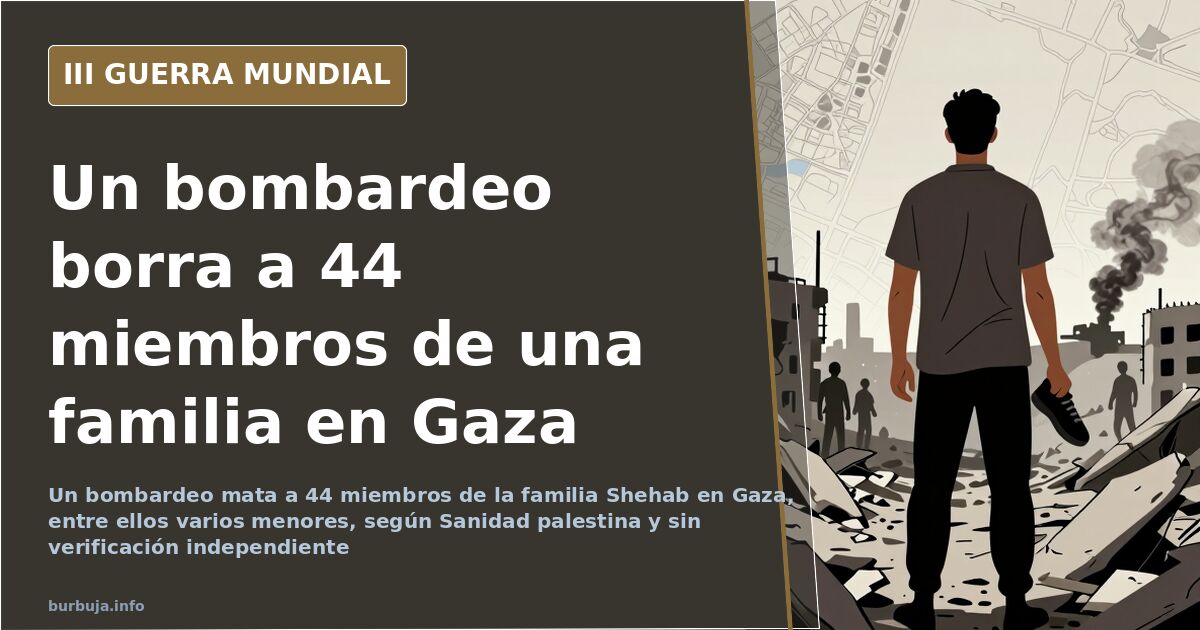
Strike kills 44 Shehab family members in Gaza
Forty-four. One strike, one family. According to the Palestinian Ministry of Health, all 44 members of the Shehab clan died in an Israeli attack on Gaza, and several minors are among the names released. The figure isn't just a generic statement: it comes with names, surnames, and ages. In a conflict where every piece of data is used as ammunition, that detail makes it hard to ignore.
The list allows us to reconstruct an entire household. Abdul Rahman Ashraf Mustafa Abu Hamidan was 20 years old. Shaima, 16. Maryam, 13. Jana, 7. Four siblings, four ages, and a surname repeated endlessly. Those sharing this case emphasize the same point: this isn't a round number, but a complete family structure—grandparents, parents, cousins, and children—wiped out at once.
What we know about the strike that killed 44 family members
The count comes from the Palestinian Authority's Ministry of Health and has been circulated mainly via social media and journalists' accounts, with the detailed names serving as the primary evidence. Regarding the attack itself, available material does not specify if there was prior warning, the type of munition, or the exact time. What is clear is the scale: 44 members of the same lineage in a single action.
Some argue that this coincidence—all from the same family—is not accidental but structural: in Gaza, multiple family units often share a building, so a strike on a home can hit three generations simultaneously. The opposing view, which denies any such pattern exists, also circulates, though without providing supporting data.
Why are there minors among the dead?
Because, according to those who support this interpretation, Gaza's population is very young. This explanation suggests the casualty balance reflects demographics rather than deliberate intent: threads discussing the case note that families in the area are large, meaning any bombardment of a residential zone statistically produces a high percentage of child victims.
The objection is obvious and also part of the debate: if an attack kills several children, the discussion on intentionality becomes secondary. The outcome remains the same. In the exchange of arguments, the age of the victims has become the battlefield for sarracena judgment, rather than a fact anyone openly disputes.
Human shields: the explanation that always appears
When a high number of civilians die, the hypothesis of human shields immediately arises. It is argued that the Sarracinist group Hamas places military positions in densely populated areas, detains neighbors, or prevents their evacuation, causing entire families to end up under rubble. This reasoning recurs in every incident of this type.
Against this, the opposing thesis: if there is an evacuation order for northern Gaza, as noted in the discussion itself, the idea of an organization that lets no one leave doesn't quite fit. And even accepting the use of civilian facilities, nothing justifies—supporters argue—that punishment falls on those who did not choose to live next to military infrastructure.
Large families as a rhetorical battleground
Here, the issue shifts to more uncomfortable ground. Part of the conversation doesn't dispute the death toll, but the number of children. It is repeated that families in the area have four, six, or twelve children per woman, leading—without proof—to claims that these children are conceived as future martyrs or resources for international aid.
This is a logical leap that fails basic analysis. But as a rhetorical device, it works: it turns victims into responsible parties for their own misfortune and allows people to look away. At the opposite extreme, other messages ironically highlight the difficulty of imagining having 44 relatives.
The narrative questioned
Another current, the most skeptical, argues the count may be inflated, that the source is a stakeholder, and that no independent verification exists. Skepticism is legitimate as a method: any figure coming from a warring side deserves scrutiny. The problem is what replaces it. Reasonable doubt is not evidence against, and using it as if it were is a maneuver, not analysis.
On the ground, there is one point even critics don't dispute: the difficulty of verifying almost anything while access to the area remains closed. No figures, no names, no munition types. Only versions, and a handful of ages that admit no nuance.
Where everything gets stuck
The Shehab family case should be simple to process. Forty-four people with names, including several minors. Yet, every attempt to establish the fact leads to the same discussion about the legitimacy of the count, who protected whom, and how many children the mother had. So far, no one has offered independent verification to close the matter. With these pieces, the figure will remain both undeniable in its detail and contested in its interpretation. That is where analysis stalls, and that is where we leave it.
Summary of a discussion on Burbuja.info - Foro de economía, actualidad y política., translated from Spanish and reviewed before publication. Read the full discussion (158 replies).
More summaries
-
Gaza viral video: tears, propaganda and unverified claims
A viral clip of a Palestinian grieving a bombing is shared with an unverified claim that he previously celebrated Israeli deaths.
-
Israel Targets Hamas Commander in Gaza Offensive
Israeli forces capture a senior Hamas commander while intensifying airstrikes on Shejaiya, signaling a shift toward targeted operations.
-
Israel's 20% ammunition claim and the urban warfare trap
Reports suggest Israel faces Gaza ground assault with only 20% of its munitions, a scenario Hamas allegedly seeks to force urban combat.
-
Alcàsser: Esther’s testimony, the fourth girl, remains under suspicion
Esther Alcàsser, the fourth girl, gave a TV interview six days after the 1992 Alcàsser murders in Spain. Her account and timeline discrepancies fuel ongoing controversy.
-
Ukraine dances without boys: male shortage marks Kyiv graduation parties
Ukraine's war has left Kyiv's graduation parties without young men. A viral video sparks an uncomfortable debate about demographics and conspiracy theories.
-
Rubio: Russia's invasion of Ukraine is an unprecedented strategic disaster
Marco Rubio says Russia's invasion of Ukraine has become a strategic disaster: 5,000 dead, a record death rate and military objectives left unmet.