
30-Year-Old Italian Joins Clarissan Order Amid Declining Vocations
Ana María, a 30-year-old Italian, takes perpetual vows as a Poor Clare while convents in Italy close due to a lack of new members.
English · Original discussion in Spanish · Published
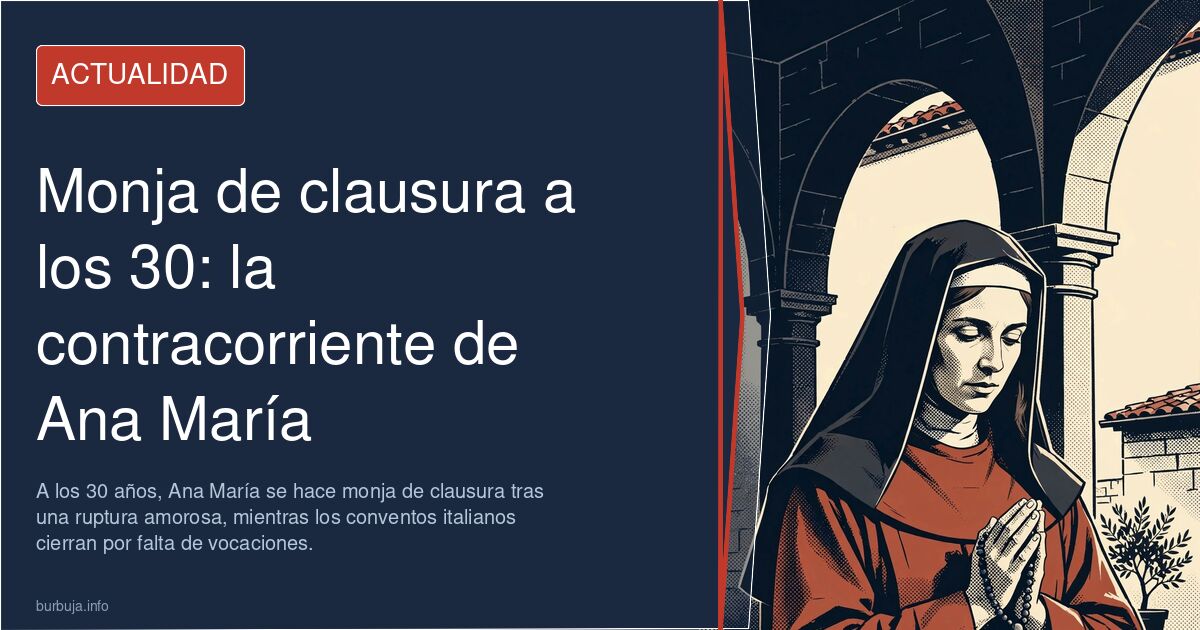
Ana María, 30: Perpetual Vows in an Era of Empty Convents
Ana María is just over 30 and has recently said “yes, forever.” Not to a husband or a permanent contract, but to enclosure. This young Italian has professed as a Poor Clare nun while dozens of monasteries in her country shut down due to a lack of vocations. The story, detailed in the report that broke the news, triggered a reaction less pious than expected: Is this a true calling or an escape route?
The Cost of Living Without Rent or Mortgage
The first reaction wasn’t theological; it was financial. Enclosed life offers housing, food, a fixed schedule, and no salary to defend before a boss. Zero rent. Zero mortgage. Zero unemployment. Outsiders sum it up in three words: better than struggling.
Here lies the uncomfortable core. Ana María’s perpetual promise is signed in the era of project-based contracts, and the contrast between the two explains much of the public debate. Some argue that the serenity attributed to these nuns—this facial placidity many envy—is not mystical but structural: clear purpose, stable routine, and a community with bonds reinforced by years of shared life. Against this weighs an unromantic fact: nuns do not receive a standard salary. Communities sustain themselves through guesthouses, workshops, and the sale of sweets, including turrón and marzipan.
Enclosure Is Not a Spa with a Scapular
The idyllic reading has limits. The routine initially appreciated becomes, after months or years, a static landscape. Living with the same people for decades is not always harmonious, and friction is the norm in some communities. Silence is comforting for a week; by the second year, it weighs heavily.
There also arises a longing for the world: the feeling that something outside is being missed and will never be recovered again. Without real spiritual work behind it—and even with it—the equation does not hold well.
The Emptying Map: Vocations That Do Not Arrive
This case matters precisely because it goes against the current. Italian convents are closing, not due to a lack of buildings, but candidates. The average age of communities rises, orders merge houses, and new entries, when they occur, are often late: people who have already lived outside and return with heavy baggage.
A procedural curiosity few know: before admitting a candidate, orders require medical and psychiatric histories. One does not enter on a whim, and certainly not solely due to a breakup.
Breakup as an Entry Point
Ana María stated it plainly: after the end of a romantic relationship, she began to reflect. That trigger—grief, the review of one’s life at thirty—is a known pattern. At that age, existential crises disguise themselves in many ways, sometimes even as a vocation.
Analysis stalls here, and one should not force it. From the outside, it is impossible to know if what lies behind the veil is a call or a well-argued flight. What can be measured is the aggregate result, and that does not deceive: communities empty out while a 30-year-old signs away forever. Today, the exception confirms the statistic.
Ana María is just over 30 and has recently said “yes, forever.” Not to a husband or a permanent contract, but to enclosure. This young Italian has professed as a Poor Clare nun while dozens of monasteries in her country shut down due to a lack of vocations. The story, detailed in the report that broke the news, triggered a reaction less pious than expected: Is this a true calling or an escape route?
The Cost of Living Without Rent or Mortgage
The first reaction wasn’t theological; it was financial. Enclosed life offers housing, food, a fixed schedule, and no salary to defend before a boss. Zero rent. Zero mortgage. Zero unemployment. Outsiders sum it up in three words: better than struggling.
Here lies the uncomfortable core. Ana María’s perpetual promise is signed in the era of project-based contracts, and the contrast between the two explains much of the public debate. Some argue that the serenity attributed to these nuns—this facial placidity many envy—is not mystical but structural: clear purpose, stable routine, and a community with bonds reinforced by years of shared life. Against this weighs an unromantic fact: nuns do not receive a standard salary. Communities sustain themselves through guesthouses, workshops, and the sale of sweets, including turrón and marzipan.
Enclosure Is Not a Spa with a Scapular
The idyllic reading has limits. The routine initially appreciated becomes, after months or years, a static landscape. Living with the same people for decades is not always harmonious, and friction is the norm in some communities. Silence is comforting for a week; by the second year, it weighs heavily.
There also arises a longing for the world: the feeling that something outside is being missed and will never be recovered again. Without real spiritual work behind it—and even with it—the equation does not hold well.
The Emptying Map: Vocations That Do Not Arrive
This case matters precisely because it goes against the current. Italian convents are closing, not due to a lack of buildings, but candidates. The average age of communities rises, orders merge houses, and new entries, when they occur, are often late: people who have already lived outside and return with heavy baggage.
A procedural curiosity few know: before admitting a candidate, orders require medical and psychiatric histories. One does not enter on a whim, and certainly not solely due to a breakup.
Breakup as an Entry Point
Ana María stated it plainly: after the end of a romantic relationship, she began to reflect. That trigger—grief, the review of one’s life at thirty—is a known pattern. At that age, existential crises disguise themselves in many ways, sometimes even as a vocation.
Analysis stalls here, and one should not force it. From the outside, it is impossible to know if what lies behind the veil is a call or a well-argued flight. What can be measured is the aggregate result, and that does not deceive: communities empty out while a 30-year-old signs away forever. Today, the exception confirms the statistic.
Summary of a discussion on Burbuja.info - Foro de economía, actualidad y política., translated from Spanish and reviewed before publication. Read the full discussion (152 replies).
More summaries
-
Pedro Sánchez: Is Spain's PM a 33rd Degree Freemason?
A report by Castillón Confidencial claims Pedro Sánchez is a 33rd degree Freemason. Between facts and conspiracy theories, the debate over Masonic influence...
-
78-Year-Old Hollywood Producer Confronted Over Lunch With Teen
A 78-year-old Hollywood producer was filmed lunching with a 15-year-old girl. The viral video raises questions about vigilante justice and consent laws.
-
Faroe Islands' Gender Gap Drives Southeast Asian Marriages
The Faroe Islands face a demographic imbalance with over 2,000 more men than women, prompting many to seek partners in the Philippines and Thailand.
-
Gym Member Pays €70 Monthly, Finds Dog Tied to Machine
A gym member paying €70/month reports finding a dog tied to equipment and plans to file a formal complaint with management.
-
Lobo Estepario: Charismatic briefly, exhausting after three days
The character denouncing systemic zombies divides opinion: charming in small doses but draining over time, with suspicions of undiagnosed ADHD.
-
Moroccan ball boys block Senegal goalkeeper from drying gloves
Ball boys physically stopped the Senegal goalkeeper from drying his gloves during the Africa Cup of Nations final. Was it violence or a misunderstanding?