
25-Year-Old Unemployed Man Posts Suicidal Thoughts on Forum
An unemployed 25-year-old in Spain posts suicidal thoughts, sparking a thread with 188 responses ranging from advice to criticism.
English · Original discussion in Spanish · Published
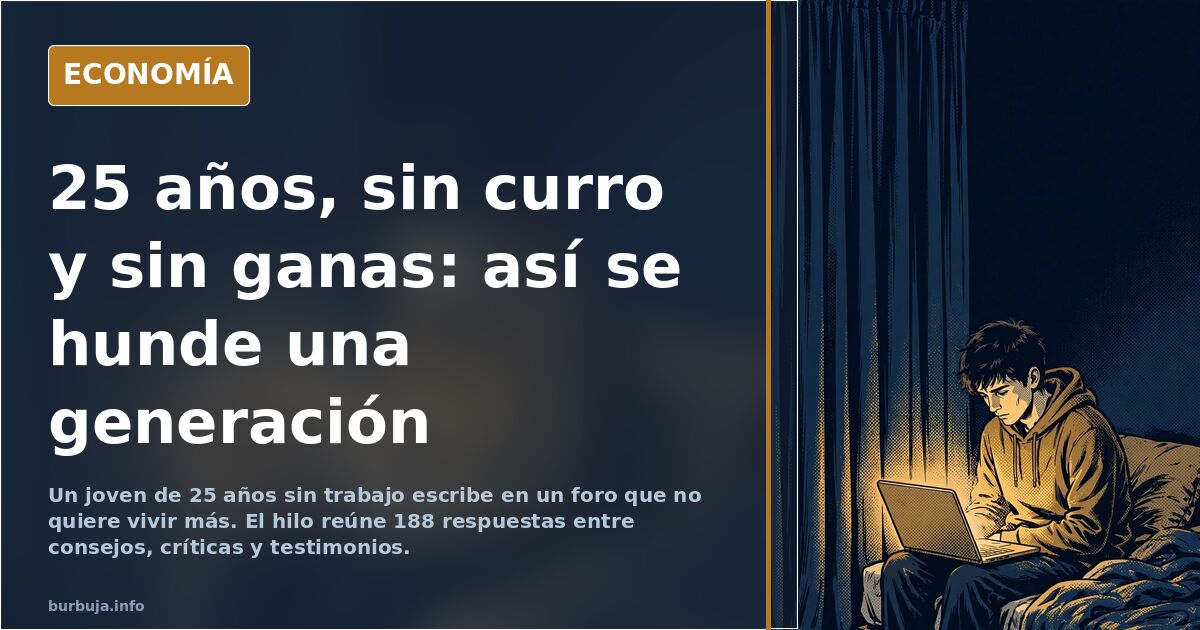
At 25, jobless and hopeless: a cry that defines a generation
What happens when the present is bleak at 25 and the future simply doesn't exist? A young man wrote it bluntly: "25 years old and I don't want to live anymore." The phrase, which could be a movie line, kicked off a conversation gathering 188 replies. The recurring diagnosis: long-term unemployment, a sense of failure, and an unforgiving society.
The initial message isn't an isolated case. It's a portrait of a generation reaching adulthood burdened by emotional debt and empty fridges. Collective responses oscillate between "man up" and "leave Spain," passing through "I was better off at 35 than at 25." A mix of opinions that looks less like a debate and more like a confessional.
Profile of those who can't find work at 25
The original poster gives few details, but subsequent replies suggest he has been jobless for six months, taking a toll on him. "He needs a job, but one where he doesn't have to think," states one participant. The proposal is clear: mechanical jobs, like driving for Uber, that keep the mind blank and the wallet slightly fuller. The idea isn't new: employment as anesthesia.
Lack of work isn't just an economic problem; it's an identity burden. "You don't realize how damn easy it is to get that, bro," another retorts. Condescension mixes with compassion. At 25, without a job, social narratives automatically place you in the losers' wagon.
From 'Leave Spain' to 'Join the Foreign Legion'
The most repeated prescription is escape. "Leave Spain," "go backpacking in Segarro," "move to Mexico or Colombia," "try Romania." The country is perceived as a cage. The idea that the problem is systemic, not individual, gains traction: "the problem isn't you, it's the country," summarizes one message. Emigration as therapeutic solution.
Some propose extreme solutions: "car, hose, sweet death," drops one with chilling coldness. Others suggest joining the Spanish Foreign Legion (La Legión). The range goes from practical to macabre, amidst a chorus of "exercise," "expand your social circle," or "walk dogs from a shelter." Advice that hides an uncomfortable truth: nobody really knows what to say.
The quarter-life crisis isn't just economic
Distress isn't explained solely by unemployment. There's a component of generational disillusionment. "This world isn't made for certain people," reflects a participant. The sensation that the system rewards the worst and crushes the sensitive hovers over the exchange. The pandemic, though not explicitly mentioned, seems to have left a residue of darkness.
Comparison with other ages is inevitable. "If you're bad at 25, I don't want to imagine at 35," says one. "I was better at 35 than at 25," corrects another. The perception that youth is life's best moment clashes with the reality of those living it in anguish. At 25, time is an asset, but also a sentence if you don't know what to do with it.
Suicide as taboo and symptom
The original post's title leaves no doubt: "25 years old and I don't want to live anymore." The phrase, mixing dark humor and despair, opens a topic society prefers to ignore. "More young people ask about suicide every day," laments a participant. Mental health enters the conversation without euphemisms.
Responses swing between jokes and real concern. "It's the weekly thread for us to commit suicide," ironizes one. But beneath the banter lies a grain of truth: the feeling that life isn't worth living is normalizing among the young. And nobody has the recipe.
In the end, the conclusion is as simple as it is desolate: at 25, jobless and with self-esteem on the floor, life can seem like crap. No, there's no magic solution. Not a training course, not a alucinación to Bali, not a gym. Sometimes, all that's left is enduring. Or writing in a forum at 3 AM. Dry irony: the best-educated generation in history, asking strangers for advice.
What happens when the present is bleak at 25 and the future simply doesn't exist? A young man wrote it bluntly: "25 years old and I don't want to live anymore." The phrase, which could be a movie line, kicked off a conversation gathering 188 replies. The recurring diagnosis: long-term unemployment, a sense of failure, and an unforgiving society.
The initial message isn't an isolated case. It's a portrait of a generation reaching adulthood burdened by emotional debt and empty fridges. Collective responses oscillate between "man up" and "leave Spain," passing through "I was better off at 35 than at 25." A mix of opinions that looks less like a debate and more like a confessional.
Profile of those who can't find work at 25
The original poster gives few details, but subsequent replies suggest he has been jobless for six months, taking a toll on him. "He needs a job, but one where he doesn't have to think," states one participant. The proposal is clear: mechanical jobs, like driving for Uber, that keep the mind blank and the wallet slightly fuller. The idea isn't new: employment as anesthesia.
Lack of work isn't just an economic problem; it's an identity burden. "You don't realize how damn easy it is to get that, bro," another retorts. Condescension mixes with compassion. At 25, without a job, social narratives automatically place you in the losers' wagon.
From 'Leave Spain' to 'Join the Foreign Legion'
The most repeated prescription is escape. "Leave Spain," "go backpacking in Segarro," "move to Mexico or Colombia," "try Romania." The country is perceived as a cage. The idea that the problem is systemic, not individual, gains traction: "the problem isn't you, it's the country," summarizes one message. Emigration as therapeutic solution.
Some propose extreme solutions: "car, hose, sweet death," drops one with chilling coldness. Others suggest joining the Spanish Foreign Legion (La Legión). The range goes from practical to macabre, amidst a chorus of "exercise," "expand your social circle," or "walk dogs from a shelter." Advice that hides an uncomfortable truth: nobody really knows what to say.
The quarter-life crisis isn't just economic
Distress isn't explained solely by unemployment. There's a component of generational disillusionment. "This world isn't made for certain people," reflects a participant. The sensation that the system rewards the worst and crushes the sensitive hovers over the exchange. The pandemic, though not explicitly mentioned, seems to have left a residue of darkness.
Comparison with other ages is inevitable. "If you're bad at 25, I don't want to imagine at 35," says one. "I was better at 35 than at 25," corrects another. The perception that youth is life's best moment clashes with the reality of those living it in anguish. At 25, time is an asset, but also a sentence if you don't know what to do with it.
Suicide as taboo and symptom
The original post's title leaves no doubt: "25 years old and I don't want to live anymore." The phrase, mixing dark humor and despair, opens a topic society prefers to ignore. "More young people ask about suicide every day," laments a participant. Mental health enters the conversation without euphemisms.
Responses swing between jokes and real concern. "It's the weekly thread for us to commit suicide," ironizes one. But beneath the banter lies a grain of truth: the feeling that life isn't worth living is normalizing among the young. And nobody has the recipe.
In the end, the conclusion is as simple as it is desolate: at 25, jobless and with self-esteem on the floor, life can seem like crap. No, there's no magic solution. Not a training course, not a alucinación to Bali, not a gym. Sometimes, all that's left is enduring. Or writing in a forum at 3 AM. Dry irony: the best-educated generation in history, asking strangers for advice.
Summary of a discussion on Burbuja.info - Foro de economía, actualidad y política., translated from Spanish and reviewed before publication. Read the full discussion (188 replies).
More summaries
-
128,000 pesetas in 1988: the salary that supported a family now barely covers one person
A salary of 128,000 pesetas in 1988 supported a family of four. Adjusted for today, that's €2,368, not enough to live alone in a big city.
-
Earning €51,000 gross in Spain doesn't make you rich
A remote worker in provincial Spain earns €51,000 gross but feels poor due to taxes and living costs.
-
Musk Links USAID to COVID Funding; Trump Orders Agency Shutdown
Elon Musk accuses USAID of funding bioweapons, prompting Trump to shut down the agency amid scrutiny of controversial spending.
-
Fight Halts Paris de Noia Orchestra at Oleiros Fest
A brawl at Lorbé festivities in Oleiros, Spain, forced the Paris de Noia orchestra to stop performing and local police to evict those involved.
-
PP and Vox Cuts Spark Cultural Debate in Spain
Forum users clash over funding cuts for works like Orlando and Buzz Lightyear, debating censorship versus fiscal responsibility.
-
Julio Iglesias sues Yolanda Díaz over slavery accusations
Julio Iglesias sues Spanish Deputy PM Yolanda Díaz for unproven slavery claims made on her personal account, bypassing parliamentary immunity.