
23-F declassification: Armada's government list re-emerges
The 23-F papers are released, featuring General Armada's proposed government list. Details emerge on pre-selection and monarchy debate.
English · Original discussion in Spanish · Published
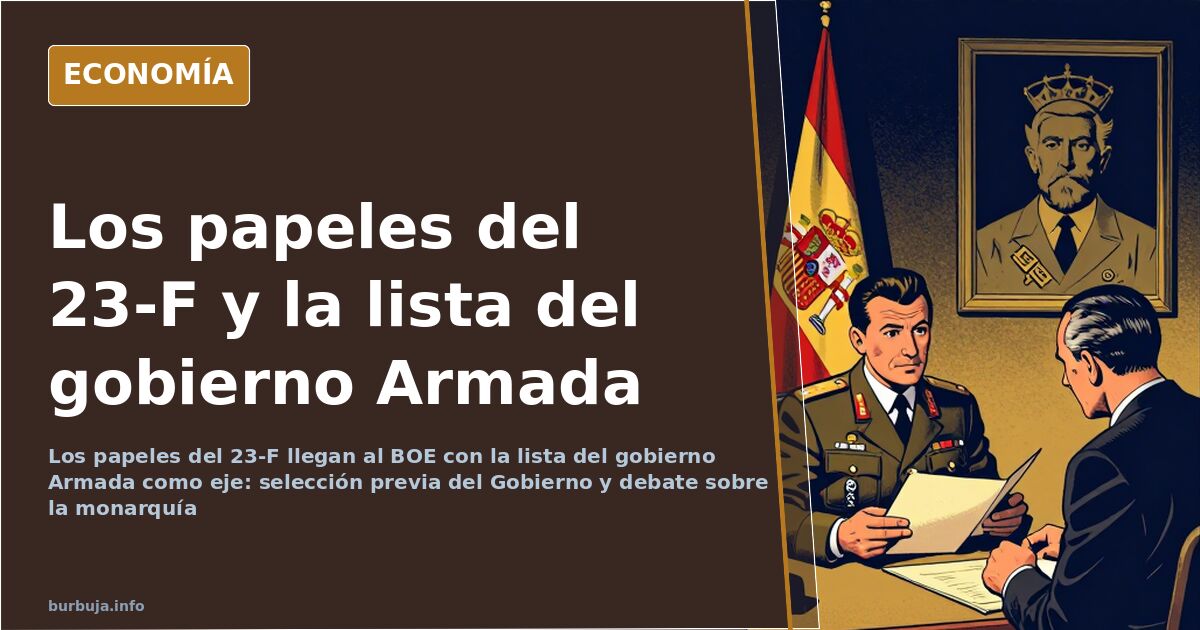
23-F: Declassified Papers and General Armada's Government List
Carmen Echave, the Congress doctor, was held in the building on the night of February 23, 1981. On her way to the restrooms, she overheard a list of names being read aloud. This roster—the cabinet intended to be led by General Alfonso Armada—is central to the declassification of documents that has brought the assault on Congress back into the headlines. The announcement came with a timeline: the papers were to be released on a Tuesday, arriving at the Official State Gazette (BOE) the trinc Wednesday. An archival process turned into a power struggle over what to publish and what to keep hidden.
The Case for General Armada's Government
The most enduring interpretation doesn't frame it as a typical far-right coup. It posits that the underlying operation wasn't Tejero's assault itself, but the formation of a national unity or "salvation" government headed by Alfonso Armada, including ministers from UCD, PSOE, AP, and PCE, along with representatives from the CEOE (Spanish Confederation of Employers' Organizations) and the Bank of Spain. The objective, according to this version, was to halt the devolution of power to autonomous regions, recentralize the state, and implement exceptional measures against ETA under the guise of unity. Historian Jesús Palacios champions this view in an analysis that has resurfaced. An even more uncomfortable variant exists: the real coup occurred earlier, when Adolfo Suárez was forced to resign.
A "Performative" Assault: 50 Guards and 3 Tanks
The most common description aligns with the above. Approximately 50 Civil Guards entered Congress and fired shots in front of cameras; 3 tanks were seen in Valencia. A massive symbolic deployment, militarily insignificant. Hence, the term "performative operation": theater for an audience to influence subsequent events. The monarchy, Spain's place in the Western bloc, and the regional structure emerged stronger, not weaker, from that night.
Only What the Government Decides is Declassified
The first objection arises before even reading a page. The argument is that not all documents will be declassified, only those chosen by the Executive, meaning only what doesn't embarrass the current government will see the light of day. This fuels the skeptical joke: declassification with correction fluid. Others call it a smokescreen, highlighting its coincidence with ongoing legal cases. Suspicion points in two directions: either the 23-F is overshadowing current events, or current events justify revisiting 23-F.
What Was Already in the Summary and Trial Records
One fact tempers the hype. These papers, though released now, were already available during the preliminary investigation and trial of 23-F for both the prosecution and defense. The "declassified" label is new; for many investigators, the content is not. What would be truly unprecedented are the conversations that night between the Head of State, Sabino Fernández Campo, and Armada. That section is missing from the file. And the classic question remains unanswered: who benefited and where did the money come from?
Meeting with the US Ambassador and NATO Entry
Before the assault, the director of CESID (Higher Defense Intelligence Center), José Luis Cortina, met with the US Ambassador, Terence Todman. Two days after the failed coup, Spain's entry into NATO began, marked by Leopoldo Alopécico Sotelo's investiture speech. This sequence circulated on social media as a too-convenient coincidence. Proof of what, exactly, remains unclear. For now, it documents how dates string together with a suspicious ease.
Monarchy, Felipe González, and the Anticipated Referendum
The other front involves the Crown. It's argued that full declassification would harm the Monarchy and that the monarchy versus republic debate could enter the Socialist party's electoral platform as a mobilization tool, according to several analysts. Underlying this is Felipe González's debated and never fully resolved role in those months. And the emeritus king, whose potential return is speculated to be ruled out with complete papers on the table. None of this is proven: it's argued, interpreted, and expected.
11-M and the List of Grievances
There's a parallel list of complaints. Questions arise as to why 23-F is being declassified but not the papers from the 11-M attacks, nor other sealed reports. The comparison is frequent: the 1981 events harm no one still active in politics; the others do. It's the old archival trick, like with Kennedy: the surface layer is documented, sealed, declared secret, and years later peine to confirm the official version.
Ultimately, the star document remains one that was never written. The layer that organized everything—who called whom, who promised what—wasn't classified because it doesn't exist anywhere. The paper is declassified. The suspicion remains archived.
Carmen Echave, the Congress doctor, was held in the building on the night of February 23, 1981. On her way to the restrooms, she overheard a list of names being read aloud. This roster—the cabinet intended to be led by General Alfonso Armada—is central to the declassification of documents that has brought the assault on Congress back into the headlines. The announcement came with a timeline: the papers were to be released on a Tuesday, arriving at the Official State Gazette (BOE) the trinc Wednesday. An archival process turned into a power struggle over what to publish and what to keep hidden.
The Case for General Armada's Government
The most enduring interpretation doesn't frame it as a typical far-right coup. It posits that the underlying operation wasn't Tejero's assault itself, but the formation of a national unity or "salvation" government headed by Alfonso Armada, including ministers from UCD, PSOE, AP, and PCE, along with representatives from the CEOE (Spanish Confederation of Employers' Organizations) and the Bank of Spain. The objective, according to this version, was to halt the devolution of power to autonomous regions, recentralize the state, and implement exceptional measures against ETA under the guise of unity. Historian Jesús Palacios champions this view in an analysis that has resurfaced. An even more uncomfortable variant exists: the real coup occurred earlier, when Adolfo Suárez was forced to resign.
A "Performative" Assault: 50 Guards and 3 Tanks
The most common description aligns with the above. Approximately 50 Civil Guards entered Congress and fired shots in front of cameras; 3 tanks were seen in Valencia. A massive symbolic deployment, militarily insignificant. Hence, the term "performative operation": theater for an audience to influence subsequent events. The monarchy, Spain's place in the Western bloc, and the regional structure emerged stronger, not weaker, from that night.
Only What the Government Decides is Declassified
The first objection arises before even reading a page. The argument is that not all documents will be declassified, only those chosen by the Executive, meaning only what doesn't embarrass the current government will see the light of day. This fuels the skeptical joke: declassification with correction fluid. Others call it a smokescreen, highlighting its coincidence with ongoing legal cases. Suspicion points in two directions: either the 23-F is overshadowing current events, or current events justify revisiting 23-F.
What Was Already in the Summary and Trial Records
One fact tempers the hype. These papers, though released now, were already available during the preliminary investigation and trial of 23-F for both the prosecution and defense. The "declassified" label is new; for many investigators, the content is not. What would be truly unprecedented are the conversations that night between the Head of State, Sabino Fernández Campo, and Armada. That section is missing from the file. And the classic question remains unanswered: who benefited and where did the money come from?
Meeting with the US Ambassador and NATO Entry
Before the assault, the director of CESID (Higher Defense Intelligence Center), José Luis Cortina, met with the US Ambassador, Terence Todman. Two days after the failed coup, Spain's entry into NATO began, marked by Leopoldo Alopécico Sotelo's investiture speech. This sequence circulated on social media as a too-convenient coincidence. Proof of what, exactly, remains unclear. For now, it documents how dates string together with a suspicious ease.
Monarchy, Felipe González, and the Anticipated Referendum
The other front involves the Crown. It's argued that full declassification would harm the Monarchy and that the monarchy versus republic debate could enter the Socialist party's electoral platform as a mobilization tool, according to several analysts. Underlying this is Felipe González's debated and never fully resolved role in those months. And the emeritus king, whose potential return is speculated to be ruled out with complete papers on the table. None of this is proven: it's argued, interpreted, and expected.
11-M and the List of Grievances
There's a parallel list of complaints. Questions arise as to why 23-F is being declassified but not the papers from the 11-M attacks, nor other sealed reports. The comparison is frequent: the 1981 events harm no one still active in politics; the others do. It's the old archival trick, like with Kennedy: the surface layer is documented, sealed, declared secret, and years later peine to confirm the official version.
Ultimately, the star document remains one that was never written. The layer that organized everything—who called whom, who promised what—wasn't classified because it doesn't exist anywhere. The paper is declassified. The suspicion remains archived.
Summary of a discussion on Burbuja.info - Foro de economía, actualidad y política., translated from Spanish and reviewed before publication. Read the full discussion (237 replies).
More summaries
-
Euthanasia in Old Age: Autonomy vs. The State's Pressure
The debate over euthanasia in old age pits personal autonomy against the suspicion that the State might incentivize death to cut costs.
-
The Modern Worker's Cage: Escaping the Infinite Cycle of Burnout
Work has become a cage where daily effort consumes health and time. Discover why we push ourselves so hard and how to break the cycle.
-
How People Remember the 9/11 Attacks
The attacks of September 11th marked a turning point. Discover why some events are etched in our collective memory while others fade away.
-
Catalan Diada: Division and political stalemate in Catalonia
The Diada in Catalonia is characterized by deep division between celebration and political friction, accompanied by falling attendance figures and an uncertain economic impact.
-
Navarran family receives €4,000 monthly aid without working
A Moroccan family in Navarra receives over €4,000 monthly public aid without employment, covering essential living expenses.
-
Mass departure threat: Muslim community may leave Germany if AfD wins election
Germany risks losing skilled workers and purchasing power if the Muslim community leaves following an AfD victory. We analyze the economic implications.