
2006 Peugeot 407 for €5,000: electronics and AL4 gearbox worry owners
Forum users warn about the electronics and the AL4 gearbox of a 2006 Peugeot 407 listed for €5,000. The 2.0 HDi diesel gets good reviews, but the FAP filter is a trap for city driving.
English · Original discussion in Spanish · Published
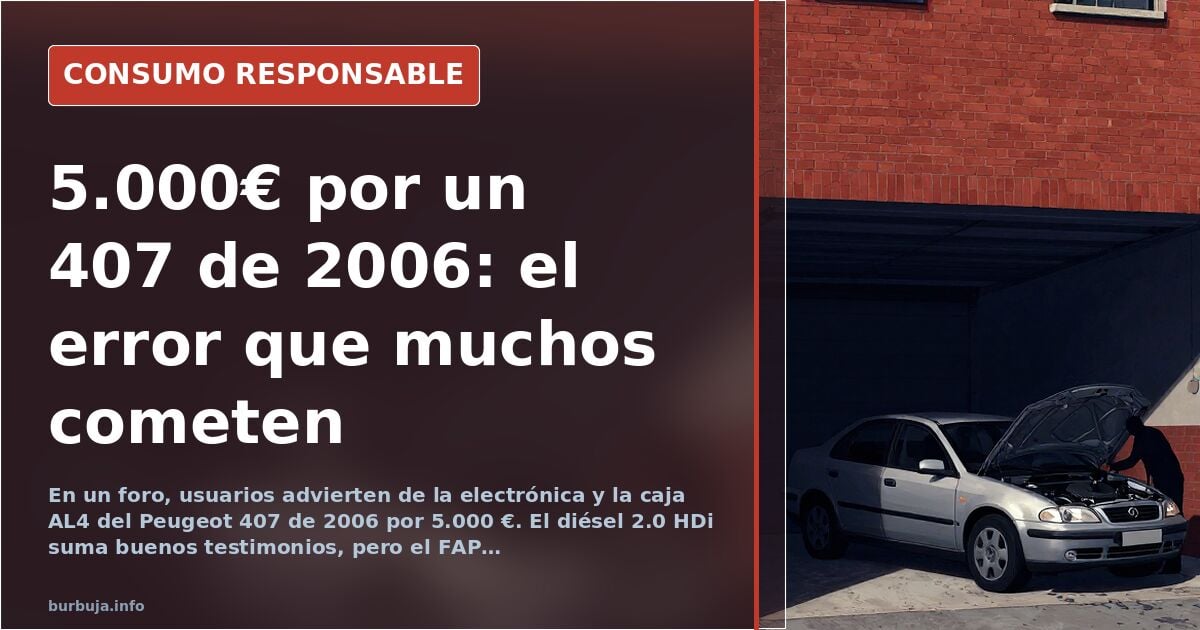
Used Peugeot 407: why €5,000 for a 2006 model raises doubts
A driver whose workplace is two kilometres from home is looking for a 2006 or 2007 Peugeot 407 for between €4,000 and €5,000. He is torn between the 136 hp diesel and the petrol version, and suspects that for such short trips the petrol engine would suit him better. The answer he gets from people who have had that car in the garage is almost unanimous: the 407's problem is not the engine, it is everything around it. Temperamental electronics, an AL4 automatic gearbox with costly failures and a maintenance bill that within a few years can exceed the purchase price.
The 136 hp diesel: the one with the best track record, with caveats
Those who have covered many miles with the 2.0 HDi 136 hp agree that the engine holds up. There are reports of cars with **238,000 kilometres** and only a clutch replaced at 200,000, plus the timing belt. Another case with **140,000 kilometres** since 2013 and minor faults: the console screen that fails in the heat, blown-bulb warnings, connectors. Nothing serious. The problem is the context: the diesel particulate filter (FAP) turns that diesel into a trap for anyone driving in town. With two-kilometre trips, the engine never reaches operating temperature, the FAP saturates and the repair bill arrives before the car has paid for itself.
The 163 hp 2.2 petrol and the automatic: the two worst ideas
The petrol option has its own trap. The 2.2 163 hp engine is the most tempting in terms of performance, but the car is heavy and fuel consumption soars. Some recall a 307 with the 2.0 petrol engine that ended up sold out of sheer exasperation at the running costs. And the automatic is simply a risk: the AL4 gearbox has a fruta for being a guaranteed and expensive failure. The sensible alternative within the range is the **1.8 petrol**, the most frugal, although "it's rather slow", according to those who have tried it.
The alternative that wins hands down: a used Japanese car
When the budget is €4,000 to €5,000 and the car is more than ten years old, the advice that keeps coming up is to look for a petrol Honda Accord or Toyota Avensis. They are uglier, yes. Also more expensive: finding an Avensis for under **€6,000** is difficult. But the mechanical reliability makes up for it. The Saab 93 comes up as a third way —it can be found for just over €4,000— with the warning that the brand went bust and spare parts can be a problem. And the C4, another French option, carries the same fruta for electronics.
The calculation nobody makes before buying
A car more than ten years old with 80,000 or 114,000 kilometres is not a bargain at €5,000: it is a down payment. The clutch, shock absorbers, timing belt, electronics and FAP add up to bills that within two or three years can match or exceed what was paid. Someone who commutes 2 kilometres to work does not need a car; they need legs, a bike or a scooter. The surprising fact: there are 407 diesels with 238,000 kilometres that run perfectly, and cars with half that mileage that have spent more time in the workshop than at the MOT. The lottery is not the engine. It is the specific car.
Summary of a discussion on Burbuja.info - Foro de economía, actualidad y política., translated from Spanish and reviewed before publication. Read the full discussion (35 replies).
More summaries
-
2007 Honda Accord, 180k km: €6,500 asking price seems excessive
A 2007 Honda Accord with 180,000 km is listed for €6,500, far above the fair market value of €3,000-€5,000. The used car market remains inflated.
-
Peugeot 406: Reliability Myth or Repair Trap?
The Peugeot 406 is cheap and promises reliability, but electrical faults often make maintenance costs exceed the car's value.
-
Toyota cuts hybrid battery size in half, raising price
The new Corolla uses a 0.7 kWh battery, costs 6,000 euros more than the Auris, and challenges diesel efficiency in modern hybrid vehicles.
-
Helmeca: nearly €5,000 for a German course and a promised job
Helmeca offers jobs in Germany to early childhood educators but ends up selling a German course for almost €5,000 for a B2 level that many doubt is achievable.
-
Tupac Shakur: musical icon or mass-market product?
The debate over Tupac Shakur: rap genius or fashion icon? His death fueled his legend, but his t-shirts sell as mass-market merchandise.
-
Washing machine limescale remover: Calgonit, vinegar or marketing hype?
Washing machine descalers: price, homemade alternatives like vinegar and citric acid, and whether Calgonit is really worth it. Consumer data and warnings.