
2,000 Chinese workers to build Zaragoza battery gigafactory
Around 2,000 Chinese workers will construct a battery gigafactory near Zaragoza, sparking debate over reciprocal trade barriers with China.
English · Original discussion in Spanish · Published
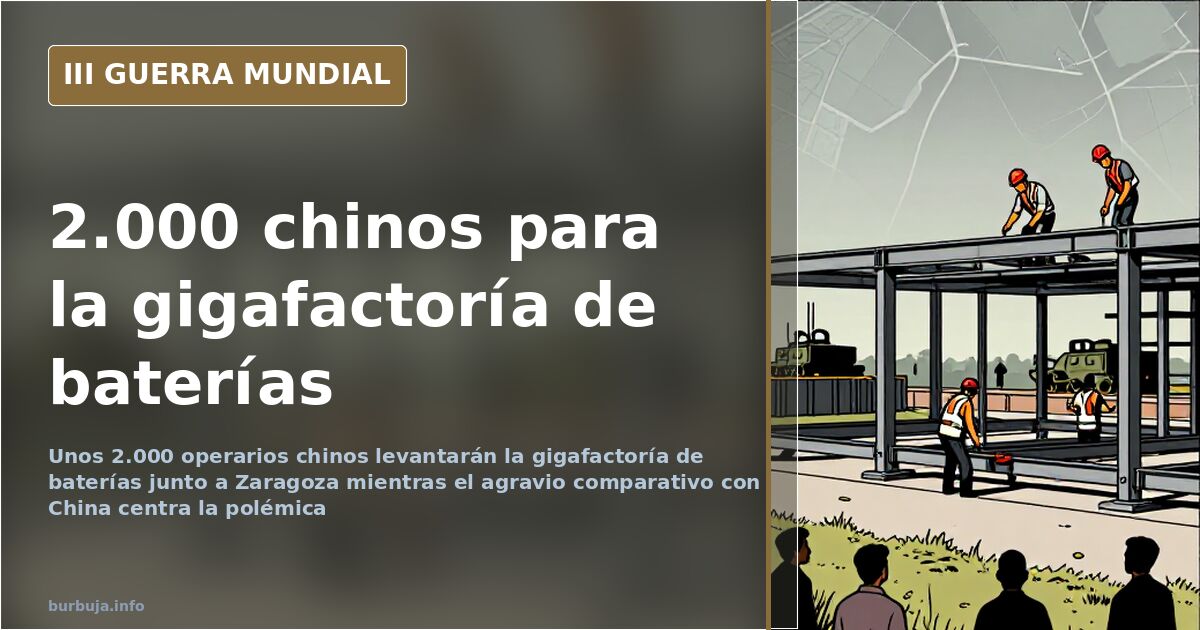
2,000 Chinese workers for the Zaragoza battery gigafactory
Two thousand workers. This figure is not an idle guess: these are the Chinese employees who, according to the initial proposal, will build the battery gigafactory on the outskirts of Zaragoza. The construction is not carried out solely by local firms. Chinese companies are entering the project, bringing their own workforce with them.
What is being built and why foreign labor is imported
The project is a battery gigafactory, a large-scale facility for producing batteries. The controversy lies not in the factory itself, but in who builds it. Alongside Spanish construction firms, Chinese contractors enter with their own teams, and the estimated number of workers is around 2,000. The strongest argument from those defending this approach is technical: welding structures, calibrating machinery, and installing process piping require specialized skills, certifications, and prior experience that cannot be filled by just anyone available in the local unemployment pool. Local joblessness, they argue, is not a sufficient answer.
Perceived unfairness compared to China
This is where the conversation breaks down. As frequently mentioned, for decades any multinational wanting to manufacture in China was required to partner with a local entity and share technology. This requirement is often cited when discussing sector joint ventures. The lingering question is why this reciprocity is not applied here. "The criticism isn't about investing in Spain, but about importing labor; China never allows such practices at home," summarizes one viewpoint. The underlying logic is simple: if a local partner is mandatory for entry, symmetry is broken upon exit.
Is it normal to deploy own staff for turnkey projects?
One perspective argues that it is indeed standard practice. When a project is sold as turnkey—including furnaces, boilers, and complete plants—the provider deploys its specialized personnel and hires local labor for minor tasks. Subsequently, they train the remaining operators and depart. "It's logical that 2,000 Chinese workers come; it's remarkable they don't even worry about the costs of relocating such a massive number of technicians," notes another comment, seeing this as a way to accelerate startup. Debatable, but not exceptional.
Ports, Stellantis, and the EBRO brand
The factory does not land in empty space. It arrives where China has been operating for years: the ports of Valencia and Bilbao are the most cited examples. And it doesn't come alone. The European automotive industry is facing its own crisis, with Stellantis at the center and a historic brand repurposed as a commercial draw. That the name EBRO reappears on a car based on Chinese platforms is interpreted by some as a nod to history and by others as proof that Spanish industrial property is little more than a wrapper. Some also note that China already brings a high level of automation.
Who retains the technology?
The other major issue is intellectual property. Whoever builds the factory controls the process, and whoever controls the process retains the knowledge. A cited precedent is the 50% joint venture between PSA and Changan, signed in 2010, headquartered in Shenzhen, with large-scale production capacity. Years later, much of the engineering in certain models includes Chinese components. In contrast stands Northvolt, the European battery manufacturer that subcontracted to a competitor and ultimately paid the price. This contrast frames the debate: is bringing in a partner a surrender or a learning opportunity?
From employment to background noise
The topic drifts into rougher terrain. Part of the discussion compares the arrival of these workers with migration flows and associated social spending, using figures more as weapons than data. Others recall that the European auto industry has made poor decisions for years, with or without China. A third group simply waits to see what happens. No one agrees on whether the general public will benefit.
Ultimately, the unsettling fact is not Chinese: industrial robots entered a European factory in 1967, when FIAT installed them in Mirafiori. The debate over whether machines or humans do the work has been open for nearly sixty years. What is new is not automation. What is new is who signs the paychecks.
Two thousand workers. This figure is not an idle guess: these are the Chinese employees who, according to the initial proposal, will build the battery gigafactory on the outskirts of Zaragoza. The construction is not carried out solely by local firms. Chinese companies are entering the project, bringing their own workforce with them.
What is being built and why foreign labor is imported
The project is a battery gigafactory, a large-scale facility for producing batteries. The controversy lies not in the factory itself, but in who builds it. Alongside Spanish construction firms, Chinese contractors enter with their own teams, and the estimated number of workers is around 2,000. The strongest argument from those defending this approach is technical: welding structures, calibrating machinery, and installing process piping require specialized skills, certifications, and prior experience that cannot be filled by just anyone available in the local unemployment pool. Local joblessness, they argue, is not a sufficient answer.
Perceived unfairness compared to China
This is where the conversation breaks down. As frequently mentioned, for decades any multinational wanting to manufacture in China was required to partner with a local entity and share technology. This requirement is often cited when discussing sector joint ventures. The lingering question is why this reciprocity is not applied here. "The criticism isn't about investing in Spain, but about importing labor; China never allows such practices at home," summarizes one viewpoint. The underlying logic is simple: if a local partner is mandatory for entry, symmetry is broken upon exit.
Is it normal to deploy own staff for turnkey projects?
One perspective argues that it is indeed standard practice. When a project is sold as turnkey—including furnaces, boilers, and complete plants—the provider deploys its specialized personnel and hires local labor for minor tasks. Subsequently, they train the remaining operators and depart. "It's logical that 2,000 Chinese workers come; it's remarkable they don't even worry about the costs of relocating such a massive number of technicians," notes another comment, seeing this as a way to accelerate startup. Debatable, but not exceptional.
Ports, Stellantis, and the EBRO brand
The factory does not land in empty space. It arrives where China has been operating for years: the ports of Valencia and Bilbao are the most cited examples. And it doesn't come alone. The European automotive industry is facing its own crisis, with Stellantis at the center and a historic brand repurposed as a commercial draw. That the name EBRO reappears on a car based on Chinese platforms is interpreted by some as a nod to history and by others as proof that Spanish industrial property is little more than a wrapper. Some also note that China already brings a high level of automation.
Who retains the technology?
The other major issue is intellectual property. Whoever builds the factory controls the process, and whoever controls the process retains the knowledge. A cited precedent is the 50% joint venture between PSA and Changan, signed in 2010, headquartered in Shenzhen, with large-scale production capacity. Years later, much of the engineering in certain models includes Chinese components. In contrast stands Northvolt, the European battery manufacturer that subcontracted to a competitor and ultimately paid the price. This contrast frames the debate: is bringing in a partner a surrender or a learning opportunity?
From employment to background noise
The topic drifts into rougher terrain. Part of the discussion compares the arrival of these workers with migration flows and associated social spending, using figures more as weapons than data. Others recall that the European auto industry has made poor decisions for years, with or without China. A third group simply waits to see what happens. No one agrees on whether the general public will benefit.
Ultimately, the unsettling fact is not Chinese: industrial robots entered a European factory in 1967, when FIAT installed them in Mirafiori. The debate over whether machines or humans do the work has been open for nearly sixty years. What is new is not automation. What is new is who signs the paychecks.
Summary of a discussion on Burbuja.info - Foro de economía, actualidad y política., translated from Spanish and reviewed before publication. Read the full discussion (202 replies).
More summaries
-
Bomb drones in Leipzig: Russian attack or Ukrainian provocation?
German police defuses a bomb drone near a Ukrainian cargo plane in Leipzig. A second drone impacts an aircraft. Russia or false flag?
-
Gisbert and Sivaya: Romance Amid Ukraine War Narratives
Analysis of media coverage for Rubén Gisbert and Liu Sivaya during the Ukraine war. Is this digital propaganda or reality?
-
Is the Russian military truly obsolete?
Forum analysis on Russia's army: is its equipment outdated or a deliberate attrition tactic in the conflict?
-
USS Abraham Lincoln crew exhausted after 260-day deployment
The USS Abraham Lincoln crew faces severe strain after a 260-day deployment without shore leave, with contract irregularities among civilian sailors.
-
Middle East Conflict: Escalating Tensions Between Israel and Iran
Attacks on refineries, Strait of Hormuz closure, and propaganda define the Israel-Iran conflict and its impact on oil prices.
-
Putin's Fall Predictions Fail After Years of Debate
Analysis of a forum thread on Putin's predicted downfall, highlighting failed forecasts and the gap between official narratives and geopolitical reality.