
1999's 1.9 TDI beats a €20,000 Opel on fuel economy
A 1999 Seat Ibiza TDI with 350,000 km, bought for €500, outperforms a €20,000 Opel in a fuel consumption test that reopens the debate over the modern car
English · Original discussion in Spanish · Published
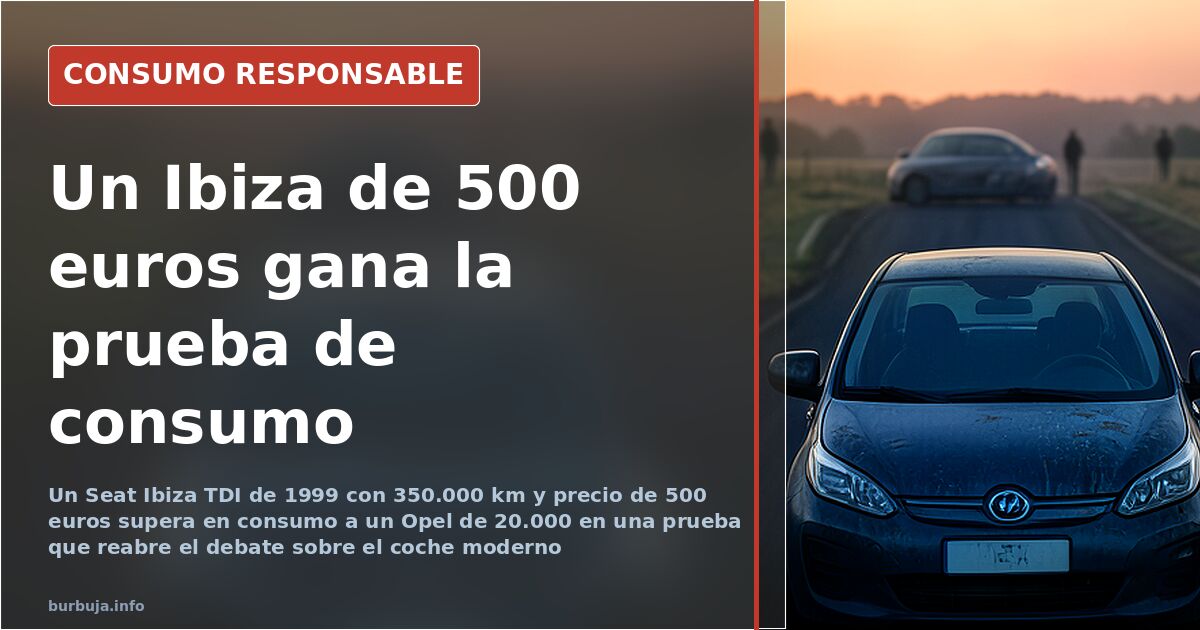
The €500 Ibiza that makes the new car look ridiculous
A 1999 Seat Ibiza TDI, with 350,000 kilometers on the clock and bought for €500, has once again stirred up the debate on responsible fuel consumption. The scene is familiar: a comparative fuel economy test between a veteran diesel from the VAG group and a modern €20,000 Opel ends with the old car trouncing the new one. The video, released by automotive commentator J. F. Calero, has led part of the audience to champion simple mechanics over the complexity of today's cars, while others point out that the diesel of the 2000s will not be coming back, not through regulation.
The trigger is less the figure itself than the political reading made of it. 350,000 kilometers without a blown turbo, without AdBlue and without a particulate filter become an argument against the environmental sticker and against the regulatory offensive pushing electric vehicles. The discussion, which has gone on for almost five years, has shifted from mockery of the presenter to a technical analysis of why an engine from two decades ago can be more efficient than one homologated today.
What the fuel consumption test really measures
The comparison rests on a simple idea: over the same distance, the old car uses less fuel. Those who defend the result argue that the credit lies not in its age but in its architecture. A naturally aspirated diesel or one with a fixed-geometry turbo, low relative compression and two valves per cylinder wastes less on pumping losses and emissions control systems. The modern car, by contrast, carries more weight, more safety equipment and more devices, all paid for in liters.
The technical nuance comes from those who point out that petrol has around 10% less energy per liter than diesel and that the diesel cycle is thermally about 20% more efficient than the Otto cycle. With those premises, the conclusion is almost arithmetic: if the Ibiza had been petrol-powered, the difference would have been different. The test does not prove that old is better in the abstract, but that the simple diesel of the 2000s was a highly refined tool for its purpose.
The problem of weight and emissions rules
Here comes the point that generates the most consensus among different camps. The new car weighs more because it protects more, is more stable and better equipped. That excess weight is offset by finer injection and electronic management, but the gain is eaten up by the regulations themselves. EGR, the particulate filter and AdBlue add complexity and, in urban traffic, problems: the mix of oil vapors and carbon buildup ends up clogging the intake manifold.
Some argue that the environmental sticker works in practice as a forced retirement scheme for indestructible cars. It is not a thesis that can be proven with the available data, but it explains why the owner of a 600,000-kilometer vehicle views any regulatory change with suspicion. The irony is that this same driver probably never needed a diesel and bought one out of fashion, on a dealer's advice, or because of the price of diesel at the time.
The electric car as an object of suspicion
Distrust of the electric car runs through much of the analysis. The most repeated argument is not technical but economic: if the modern combustion car is already perceived as a source of expensive breakdowns, the electric car is seen as an even bigger leap in the same direction. The phrase that sums up the stance is that a car that takes more than three minutes to refuel is a scam, a quip that at heart is about range, time and freedom of movement.
The official sector responds with lower local emissions and a lower cost per kilometer, but the debate has shifted to the terrain of trust. The same administration that promoted diesel for years now penalizes it, and that U-turn is read as proof that public recommendations are not neutral. Suspicion needs no proof to take hold among consumers.
The criticism of the commentator: verbosity and commercial dependence
The video has also served to settle scores with the author himself. Some credit him with honesty and passion, while others fault him for verbosity that stretches the videos beyond what is necessary. The sharpest criticism is not aimed at his knowledge but at his business model: if manufacturers lend cars for testing, independence suffers. They cite the case of a compact car test treated with disproportionate harshness and an intolerant response to criticism.
None of that invalidates the fuel consumption figure, but it does provide context for why the video has become a rallying flag. The person matters less than the symbol: a guy who says out loud what many drivers think when they compare their old faithful car with the one on offer at the dealership.
What remains of the 1.9 TDI
The technical consensus is that diesel peaked with that family of engines and that what came after was a regulatory race downhill. The 1.9 TDI is remembered as a rock, with cheap maintenance and breakdowns limited to the mass airflow sensor, engine mounts and timing belt. Its natural successor, the 2.0 TDI, already carries more electronics and more systems.
The final paradox is a market one. The more these cars are talked about, the more their value rises and the harder it will be to find one when the current one gives out. The ironic recommendation making the rounds —buy a hybrid or electric to free up the old diesels— sums up the mood. And the figure that turns everything on its head: a €500 vehicle has put a €20,000 one on the ropes. The industry has an explanation. So does the buyer.
Also available in: Deutsch
Summary of a discussion on Burbuja.info - Foro de economía, actualidad y política., translated from Spanish and reviewed before publication. Read the full discussion (78 replies).
More summaries
-
Opel Insignia AdBlue issues: high repair costs and limited service
AdBlue failures in diesel Opel Insignia models can cost over 1,200 euros, with only one official workshop available in Valencia, Spain.
-
Citroën C-Elysée: the cheap car that ends up costing you
A forum user looking for a diesel estate for 25,000 km a year ended up ordering an Opel Astra for €17,000; the C-Elysée failed to convince him as either a diesel or an LPG car.
-
How many litres of milk can you get from 1 kg of condensed milk?
A forum calculation says a 1 kg can yields 6.6 to 10 litres, but others warn it's not milk but added sugar.
-
Which condensing natural gas boilers actually last longest?
A technical analysis of the most reliable natural gas boilers: brand comparison, durability and real-world costs.
-
Motorhome living: nomadic freedom or heading for shantytown trouble
An analysis of life in a motorhome: the real costs, the legal pitfalls and the alternatives to fixed rent.
-
Mattress buying guide: memory foam, latex or springs?
A mattress buying guide comparing memory foam, latex and springs. Avoid common mistakes and hidden costs when investing in your sleep.